A defining moment for Britain's space security
With space now a frontline domain of modern warfare, the UK faces an urgent choice: go it alone and fall behind, or deepen ties with the US to secure the capabilities needed to protect its assets and position itself as a resilient space power
The United Kingdom government is just weeks away from a crucial decision that will shape the future of Britain’s space sector, its national security and its role as a strategic partner to the United States. With space now firmly recognised as a contested warfighting domain, ministers face stark choices about sovereignty, collaboration and how quickly the UK can acquire the capabilities needed to defend its critical assets in orbit.
Why it matters now
The challenge is acute. The UK and Europe remain significantly behind the US – and behind Russia and China – in space defence. Adversaries are developing and fielding counter‑space capabilities at speed, while many Western systems were designed for a less hostile era. As a result, satellites that underpin military operations, communications and everyday economic activity are increasingly exposed.
While strategic autonomy remains an important ambition, defence analysts argue that the UK does not have the time or financial capacity to close this gap alone. Instead, the question now confronting policymakers is how to strike the right balance between sovereign capability and partnership with allies that already possess proven technology.
That reality was acknowledged recently by a senior UK minister, who noted that “the solutions of ten years ago no longer cut it” – a reflection of how rapidly the space threat environment has evolved.
The warning has been echoed by US defence leaders. General Stephen Whiting, Commander of US Space Command, has cautioned against the risk of a potential “space Pearl Harbor”, describing Russia as a sophisticated space power capable of neutralising low‑Earth orbit assets early in a conflict. Preventing such a scenario, he has argued, depends on updating strategic capabilities at pace to counter both Russian and Chinese advances.
Collaboration between the US and UK is critical
Against this backdrop, the UK and the US have moved to deepen co-operation. Earlier this year, a joint statement was signed by Sir Harvey Smyth, Chief of the Air Staff, and General Chance Saltzman, Chief of Space Operations for the US Space Force.
The agreement reaffirmed a shared commitment to closer military collaboration in space and highlighted the need for the UK to take advantage of US technological leadership to protect national assets from adversarial threats.
“Space is now fundamental to military advantage and national resilience,” one senior defence figure involved in the process said. “No ally can protect these capabilities alone in today’s threat environment.”
That collaboration is becoming increasingly urgent. Media reporting has already highlighted hostile activity targeting British and European space infrastructure, while other European powers are actively looking to the US for support. In this context, the UK has an opportunity to act as a first mover – shaping the market rather than reacting to it – by adopting cutting‑edge space technology that delivers credible deterrence and operational resilience.
“This is about giving the UK real choice and real resilience in space,” said Rod Drury, Vice President of Global Space at Lockheed Martin.
“By investing in sovereign production, skills and advanced technology here in Britain, we can strengthen deterrence, support allied operations and ensure the UK is equipped to operate and survive in an increasingly contested space environment – now and in the future.”
Industry leaders argue that this cannot be achieved with legacy equipment. Systems that may have served well for decades are no longer fit for purpose in a domain marked by constant technological competition. What is required instead is a tech‑enabled military capable of deterring, fighting and winning through continuous innovation at a wartime pace.
Proposed investment would bolster UK satellite production
It is this strategic backdrop that frames Lockheed Martin UK’s proposal to invest £100m in the North East of England, potentially creating around 2,000 jobs across the UK by establishing a satellite production line.1 Around 500 of those proposed roles would be based in the North East of England, a region with a long heritage of supporting the Armed Forces, both through service and through the defence industry.
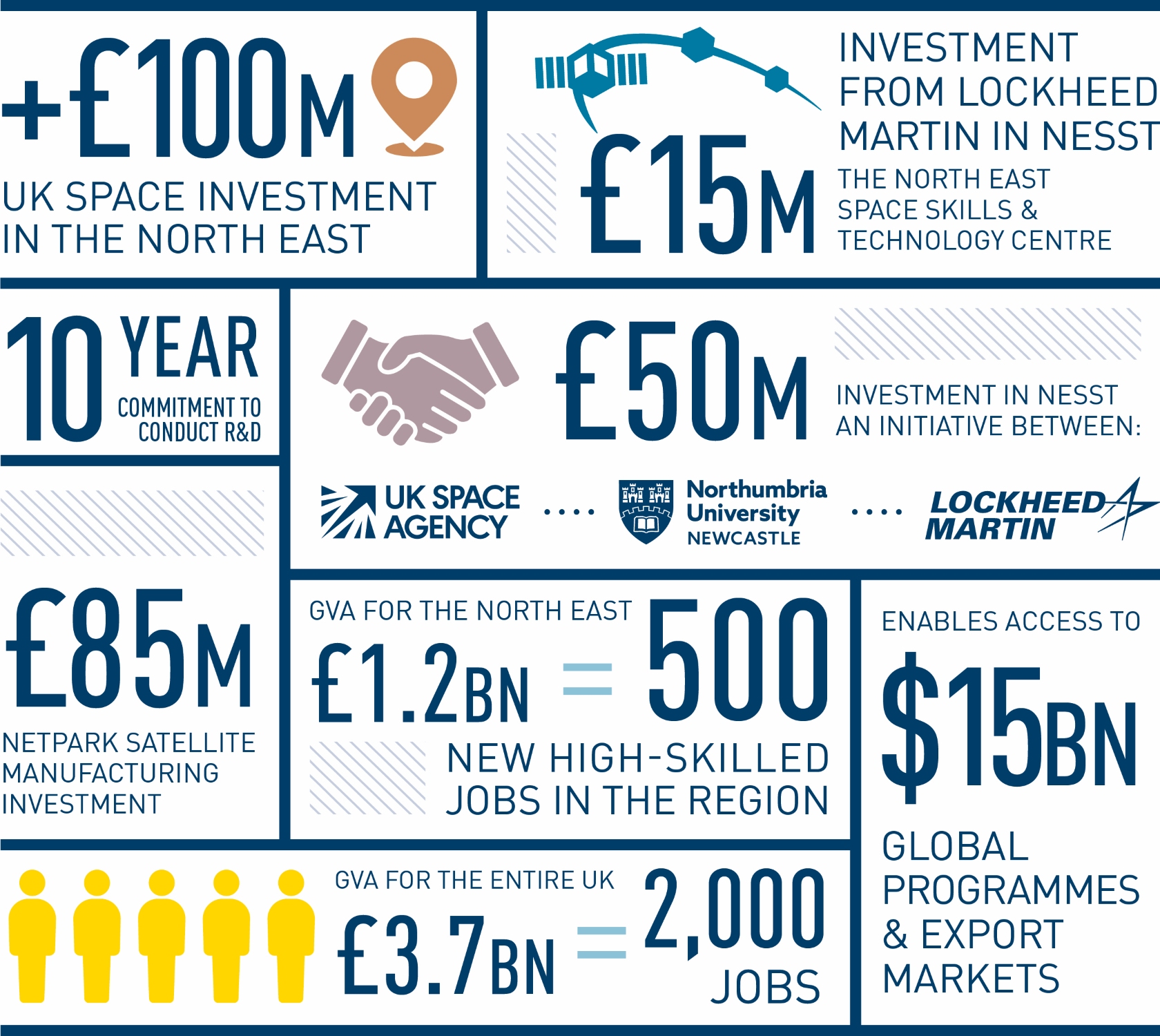
The move would establish a UK sovereign production line, enabling Britain to compete in an addressable market of close to 90 major international programmes. Crucially, it would also support UK exports to friendly nations, partners and allies. By creating additional capacity for US programmes, supporters argue, the UK would strengthen its standing within the Special Relationship rather than weaken it.
The proposal goes beyond manufacturing alone. Lockheed Martin UK points to the transfer of more than £200m of design and manufacturing expertise to UK engineers, enabling them to build, update and sustain advanced space systems independently over time. That knowledge transfer, the company says, would enhance sovereign capability while embedding Britain more deeply into allied supply chains.
The potential economic impact is significant. Parliament has already noted that the global space economy is “primed for growth”, and industry estimates suggest UK‑based space vehicle activity could generate up to $15bn in market opportunities. Lockheed Martin has been present in Britain for more than 80 years and is already expanding its footprint through partnerships such as the £50m North East Space Skills and Technology Centre, developed with the UK Space Agency and Northumbria University. Plans are also advancing for a proposed £85m satellite manufacturing facility at NETPark near Durham.
The UK can position itself as a resilient space power – now
For proponents, the strategic logic is clear. Development of offensive space capabilities among adversaries far outpaces that of the UK and Europe, and there is neither the time nor the investment available to catch up independently. Relying solely on European solutions, they warn, risks creating a dangerous gap in deterrence – one that adversaries are already prepared to exploit.
The decision now facing the government is therefore not simply industrial but strategic. By combining sovereign capability with proven US technology, the UK could position itself as a stronger, more resilient space power – and as a more valuable ally at a moment when space security is no longer optional but fundamental to national defence.
References
- Data from independent economic impact assessment carried out on behalf of Lockheed Martin
