Switched On: Unlocking the UK’s Homegrown Power for a Clean, Secure and Affordable Energy Future
Image credit: New Statesman
Energy security has become one of the defining political issues of 2025. At this year’s party conferences, EDF brought together voices from across the political spectrum to explore how Britain can power a clean, secure, and affordable future.
With an uncertain geopolitical situation, there is growing pressure to strike the right balance between energy supply, cost, and sustainability. As a result, energy security has never been higher on the political and public agendas.
The centrality of energy security was the focus of important debates at this year’s Labour and Conservative Party conferences, where speakers from across the political spectrum explored barriers to and solutions for an affordable energy-secure future.
Opening the Labour event, Josh Buckland, EDF’s Director of Strategy and Policy, reminded the audience that the political debate around secure energy continues to be shaped by global events.
“The geopolitical environment after the war in Ukraine has fundamentally shifted the dynamic around energy security,” he explained. “It’s now one of the most fundamental national security issues the government faces.”
Buckland went on to argue that cheap, homegrown electricity will define Britain’s competitiveness for decades to come. However, he cautioned that the current system was potentially a barrier to achieving that goal.
“The spark gap means electricity is four times the price of gas,” Buckland explained. “That punishes anyone trying to electrify.”
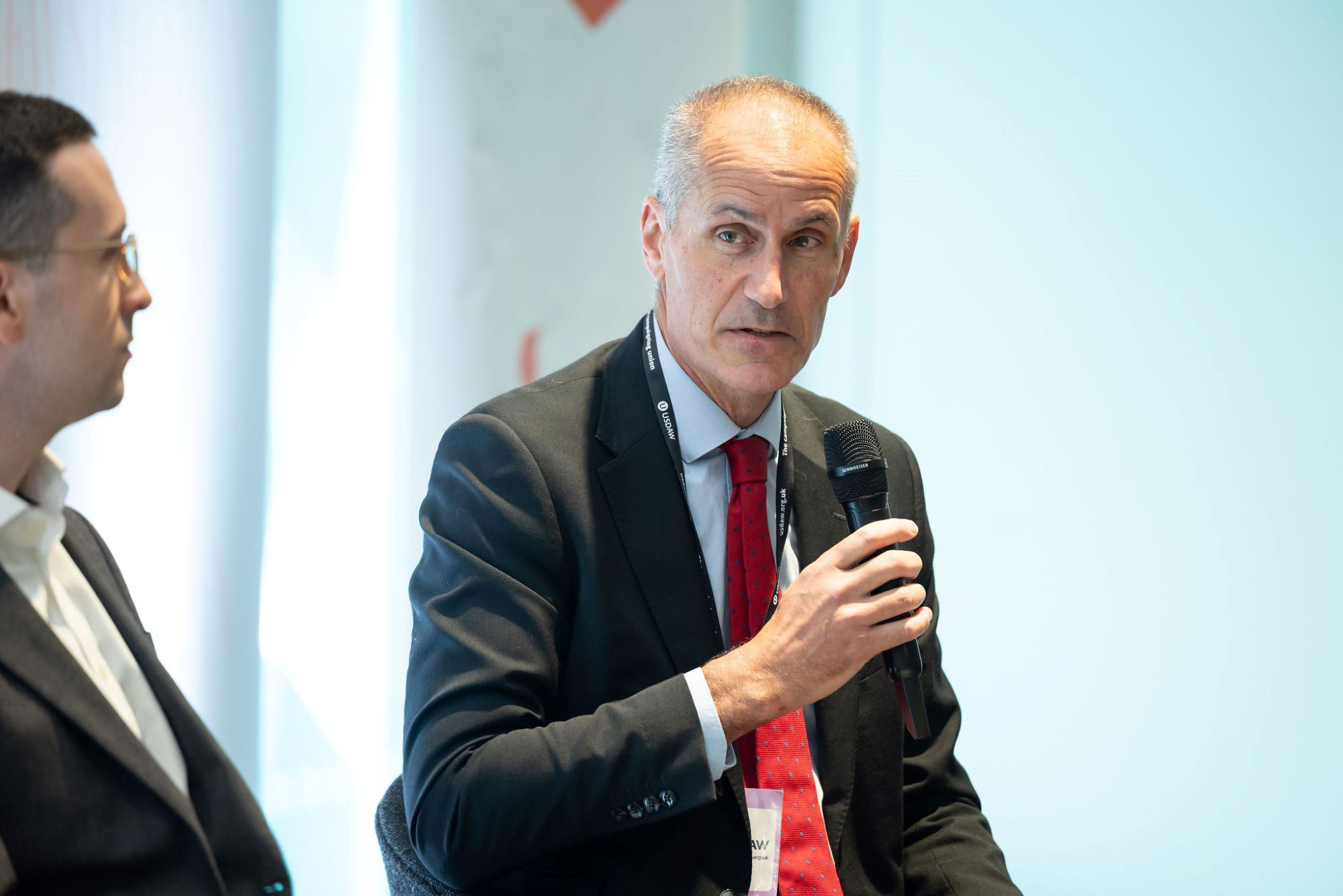 Image credit: New Statesman
Bill Esterson MP, Chair of the Energy Security and Net Zero Select Committee, warned attendees that dependence on imported energy had left the UK exposed. “We import half our gas, and that dependency is only increasing,” he said. “We’re at the mercy of global events. Whatever Putin does next will influence our bills.”
At the Conservative event, shadow energy minister Andrew Bowie MP struck a similar note. “We can have clean, secure, and affordable energy, but not the way we’re doing it now,” he argued. “Energy costs too much for households and for industry, and people feel poorer because of it. That has to change.”
There was cross-party agreement that the UK’s long-term prosperity depends on electrification. But with household budgets under pressure, speakers at both events warned that the transition will only succeed if consumers feel it is in their interests.
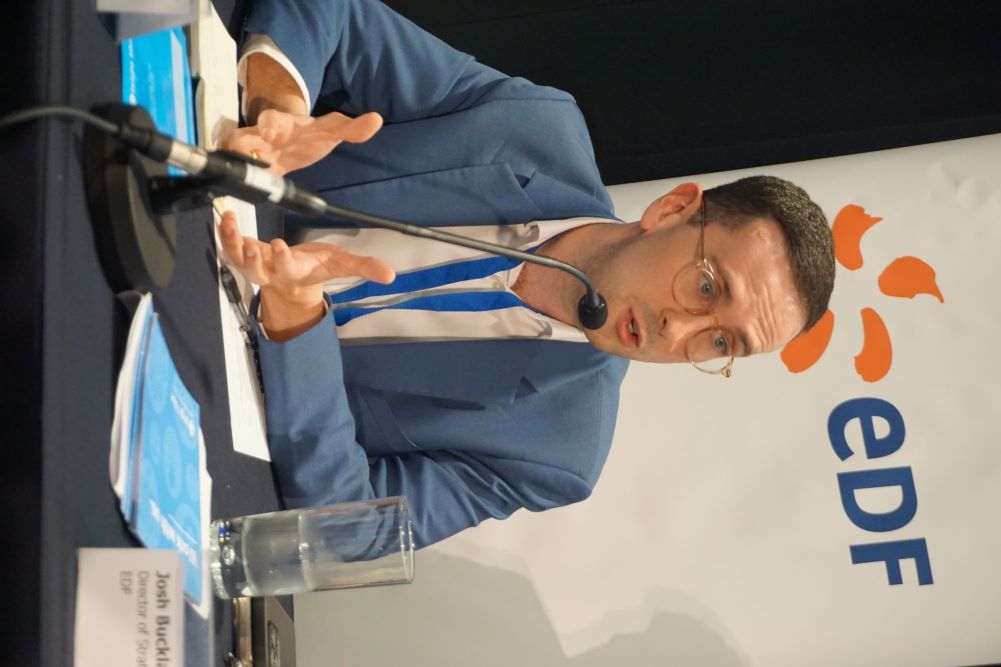 Image credit: Bright Blue
“Electrification is the future of the British economy, but we’re not moving fast enough,” said Ben Westerman, Director of Policy and Advocacy at Electrify Britain. “Until energy bills come down, consumers won’t see electrification as an upgrade.”
He pointed to a structural problem in the way the UK prices energy. “Twenty-two per cent of the electricity bill is made up of levies, versus six per cent for gas. That has to change.”
At Labour’s conference, the GMB’s Rhea Wolfson linked energy policy to jobs and community resilience.
“For a successful climate transition, we need three things: decarbonisation, lower bills, and jobs,” Wolfson said. “Jobs are vital. £50 off a bill doesn’t build passionate support. Jobs do.” She also warned that communities left behind by previous industrial transitions will not support another one if it negatively impacts their towns and families.
Wolfson pointed to projects like Hinkley Point C as proof that large-scale investment can anchor public support. “People see secure work and a future for their kids. That’s what wins hearts.” She compared today’s challenge to the 1960s switch from town gas to natural gas, which took 15 years and 100,000 skilled workers. “That’s the scale of planning we need again.”
For industry, the message was about stability and confidence. “Industry has hundreds of billions ready to invest,” said Charles Hendry, a former Conservative energy minister. “What it hates most is uncertainty.”
A major factor behind that uncertainty was identified as an overly complex planning process when it comes to developing major new infrastructure projects. Buckland echoed the point, arguing that planning reform is essential if new infrastructure investment is to be unlocked.
“There were 4,000 separate documents for the Sizewell C planning process and 40,000 pages in the environmental statement alone,” Buckland pointed out. “That’s the sort of challenge we must fix if we want to deliver.”
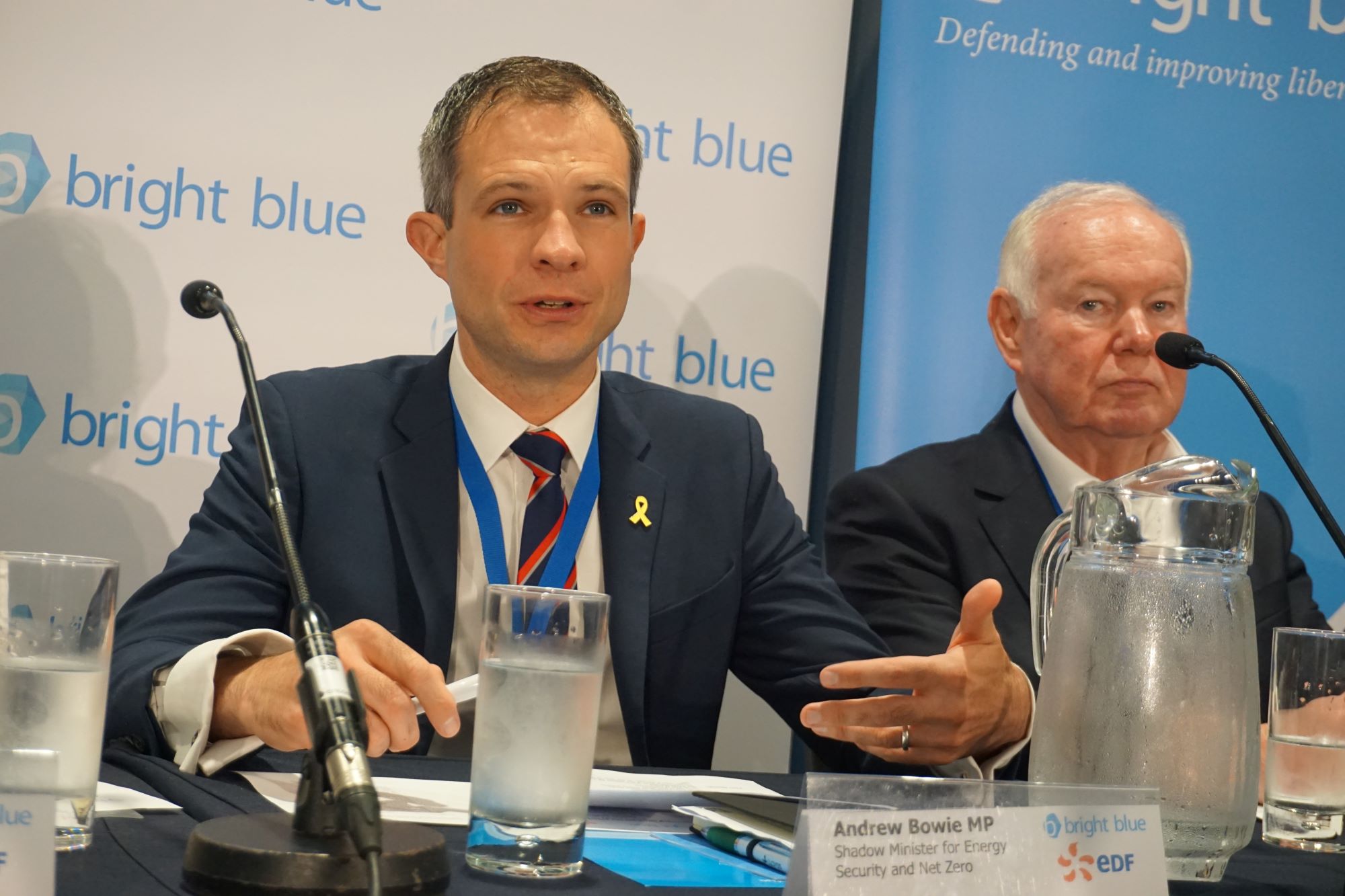 Image credit: Bright Blue
Others emphasised the importance of balancing energy supply so that the nation is not overly reliant on one single approach. “We need diversity,” Andrew Bowie said. “Being dependent on one technology brings its own problems.”
The Conservative conference also heard that, in an increasingly interconnected world, there should be an acceptance that energy security can also be supported by close cooperation with allies.
“The idea of total energy independence is for the birds,” said UCL’s Professor Jim Watson in Manchester. “Even the US trades energy. Interconnection with France and Norway strengthens our resilience.”
While both parties agreed on the urgency of securing the UK’s energy future, their proposed routes differ. At the Labour event, discussion centred on fairness, public investment and the role of government in driving clean growth. At the Conservative session, the emphasis was on affordability, market reform and creating the conditions for private capital to deliver.
Yet across both panels, there was broad alignment on one thing: the UK’s energy transition must be anchored in security. Speakers from industry, unions and academia all highlighted the potential of homegrown electricity and the need to reduce exposure to volatile global markets and strengthen resilience at home.
 Image credit: New Statesman
As Buckland concluded, “The UK has the opportunity to become a true energy island using homegrown electricity to power our economy, grow our industries and lead globally.” The challenge he identified is to now match ambition with delivery. “We need a joined-up approach, a cross-government electrification taskforce, grid reform, and clarity on the role of nuclear. That’s how we build confidence and make the transition real for people.”
