Lee Anderson: Tory MPs Were Snobby About How I Speak
12 min read
Reform’s party chairman Lee Anderson tells Adam Payne that Andy Burnham is no working-class hero – and insists it is his insurgent party on the right that is still setting the political agenda. Photography by Tom Pilston
Lee Anderson wants to climb a hill, the highest point in Nottinghamshire. It’s not a natural hill but the slag heap for the Silverhill Colliery.
This was where his father and grandfather worked as coal miners. Anderson followed them into the pits after school. He had come here a few weeks previously to scatter the ashes of an “old miner mate”.
Taking a seat next to the old colliery wheels, restored and reinstated, it’s a fitting setting to explore how Reform will adapt now Andy Burnham has launched his campaign to win back working-class support for Labour.
Anderson admits that Burnham poses a “different” electoral challenge to Reform compared with Keir Starmer, describing the former Manchester mayor as a “good communicator” (although stresses that Burnham’s predecessor Starmer set an “awful, dreadful” bar).
“The bounce is not a Burnham bounce,” he insists. “It’s a get-rid-of-Starmer bounce, the most unpopular prime minister ever, ‘we’re fed up’. Of course, a few of them Labour voters who came to us over the past two years at local elections might say they could consider voting Labour now they’ve got a new leader. But come and ask me in six months about those same voters. Will they vote Labour? I’ll give you the answer now, and it’s no.”
Burnham is Anderson’s fifth PM since he was first elected in 2019. A former Labour councillor, his defection to the Tories in 2018 and subsequent victory in Ashfield at the general election was cited at the time as evidence of a great realignment. Labour’s electoral coalition was breaking down, it was said, as the interests and concerns of its constituent parts diverged.
His subsequent defection to Reform UK meanwhile sounded, for the commentariat, the death knell of Boris Johnson’s realignment and the emergence of Reform as the dominant force on the right.
Now as Reform slips behind Labour, and the Tories threaten to draw level in the polls, does Anderson think the wheels are coming off the bandwagon?
“It’s funny that people in your industry forget the previous 365 polls, which put us in front. That’s all they’re talking about. What about the last two years?” he says. “We’re not complacent. We know we’ve got a job to do.”
“We are making a huge difference in policy. Not just the Labour Party, but the Tory Party as well,” Anderson continues.
“Some of the policies that the Tories and the Labour government have spoken about, they wouldn’t have been speaking about them if it weren’t for Reform UK.”
Anderson highlights the party’s controversial stance on the European Commission of Human Rights (ECHR) as an example. “We’re leading on leaving the ECHR. The Tories I know still in Parliament don’t want to leave the ECHR. They’re all a bunch of wet liberals. Labour’s talking tough on immigration now. That’s because of us. It’s not because of Labour’s spads or policy team or the backbenchers; it’s because of us.”
There’s only seven of us. I suppose I’m the only one who’s got a slight accent
After leaving the mines, Anderson worked at the Citizens Advice Bureau, “seeing people in real poverty, helping them”, before moving into charity work. “When I was working on minimum wage for a local homeless charity, I didn’t blame the government or go online and say ‘this is crap’. I went and got another job. In fact, I had three jobs, at three different charities,” he says, working with “young kids, care leavers… looking after them, making sure they’re okay”.
He believes left-wing opponents save their most vehement dislike for him because of this background: “A lot of it’s jealousy because I’ve come through the working-class route.”
Anderson claims that the level of abuse he receives on X from “left-wing agitators”, as well as bots and people “who haven’t got the guts to put the name or a picture to a profile”, has driven him close to quitting Elon Musk’s “sewer” website, where he is an active user. “I can guarantee, if I wake up in the middle of the night, at 2 o’clock, and go to the toilet, and if I’m daft enough to go on X, which I am sometimes, and I post something, I can guarantee within 30 seconds, the same people will respond with a negative. They’re literally up all night looking to say something,” he says.
So, why hasn’t he quit X? “I thought about packing it in,” he explains, “but it makes me about £400 a month, and it’s paying for my next holiday.”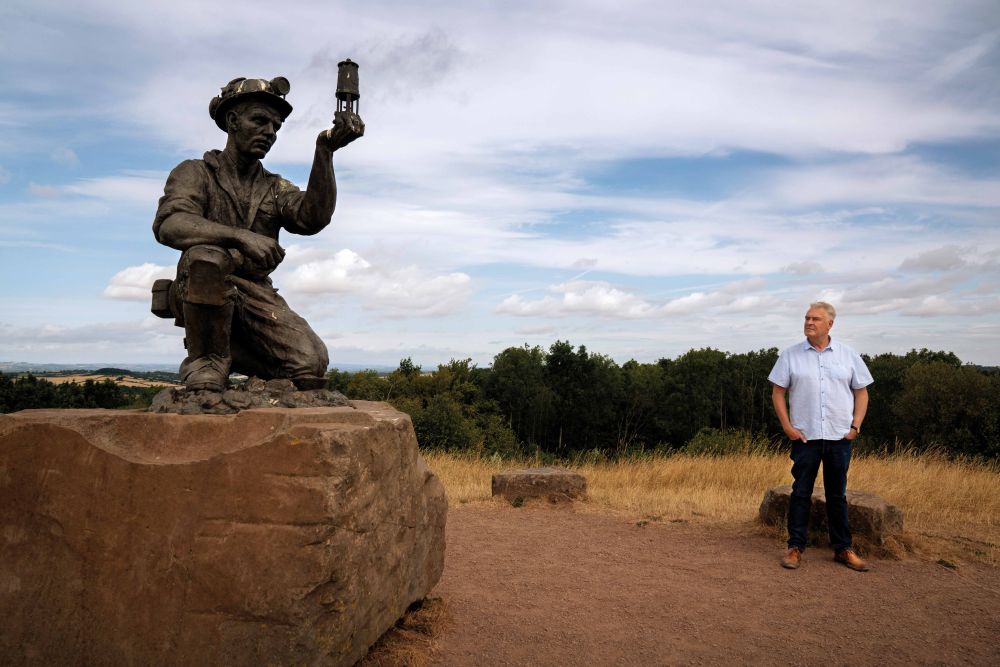
The House puts to Anderson that there is a back-handed compliment in the Labour Party choosing to be led by someone who, like him, is proudly working class. The Reform MP bridles at the comparison with Burnham.
“He tries to promote himself as this sort of working-class hero. But what’s his work history? Straight out of uni, working in politics, and fair play to him. He has made a good career out of it. He’s done what he’s wanted to do. He’s a good communicator.
“But has he ever been 1,000 metres under, on his hands and knees, doing a rotten job seven days a week, talking to real men about not just work, about politics, about the family, about the problems we’ve got? No, he hasn’t. I have.”
He dismisses No 10 North as “completely ridiculous”, saying the UK government should work from nowhere but Downing Street: “If they can’t do that, then they shouldn’t be running the country.”
But given Reform claims to be the real home of the forgotten working class, the true anti-establishment party, does Anderson wish that its top team had more people who speak with regional accents – and fewer people who sound exactly how the public expects politicians to sound?
“There’s only seven of us,” he says, referring to the party’s MPs, before adding: “I suppose I’m the only one who’s got a slight accent.”
Does he feel he is looked down on because of the way he speaks? “When I first got there [Westminster], one of the things we say here – and bear in mind, I’m trying to speak to you correctly, without my vernacular – is, ‘Hey up, duck! How you doing, duck?’ Some of the Tories would say, ‘How you going, duck? All right?’ A lot of that was joking and trying to make you feel welcome, but some of it were…” He pauses. “Yeah, snobbery.”
“But after about a year, you think, ‘Fuck ‘em’,” he continues. “I’ve got as much right to be here, and a lot of those people who were making those comments lost the seats at the last election. I didn’t. I won my seat in a different party when they all said I couldn’t. My vote share went up. And at the local elections last year, we won every single seat here, not just one. We won with over 50 per cent of the vote in every single ward in Ashfield and Mansfield.
“So, the people who were laughing, who lost their parliamentary seats – well, they’re not laughing now, because I was right.”
Restore Britain just want to stop us from winning. It’s as simple as that
Anderson is dismissive of Restore Britain, insisting that Rupert Lowe’s hard-right party will be an electoral flash in the pan, despite recently showing signs of eating into Reform support.
He acknowledges Lowe’s sizeable social media reach (“Fair play to Rupert, he’s got a platform”) but insists that “decent” people who have drifted from Reform to Restore Britain since the 2024 general election will come back to “the people’s army” before the country goes to the polls again.
“He has got a huge social media following. But what they don’t realise is – which I learned very quickly in politics – Twitter is not the ballot box. It’s not.” He adds: “Once people get to the ballot box they’ll think, ‘Well, if I vote Restore, I’ll probably get a Labour MP, I’m not going to do that.’
“Restore Britain just want to stop us from winning. It’s as simple as that.”
Anderson says his party should simply “ignore” Lowe, rather than engage in a battle for the right, and accuses Restore activists of “bullying” Reform members during the recent Makerfield election.
“They were turning up in Jeeps and threatening our staff and bullying people, trying to get on our battle bus, effing and blinding. This is not campaigning. Why aren’t you knocking on doors and putting your message across to people, rather than threatening and intimidating staff and our volunteers? It’s not the way we do politics in this country, is it?”
A Restore spokesman later describes the claims as “nonsense”.

If Anderson is right, and his party does turn it around in time for the next general election, as Farage’s chief whip he would be tasked with managing a parliamentary Reform party that will have grown from seven MPs to a three-figure total.
And while Reform is keen to take a sledgehammer to large parts of what it describes as the Westminster establishment, one institution that Anderson intends to preserve is whipping, telling The House that Reform MPs publicly criticising a Farage government would not be tolerated.
“What we’re doing at the moment is going through the parliamentary selection process. And this is what we speak about: not just becoming a candidate, but if you do become an MP, about the whipping system, about we’re there to do a job, we’re there to pass laws.”
He says MPs should always keep disagreements with their government private, dismissing Burnham’s pledge to grant Labour MPs more freedom from the whip as something you wouldn’t find in a Reform ministry: “I just think, ‘oh shut up’. He’s your leader. You should back him. Have your arguments in private. Go and see him. Give him a bollock in private. Shout at him. Scream.” Anderson would, however, seek to do away with “pointless debates” by which he means Westminster Hall debates; adjournment debates where there is only “me and probably two or three Labour MPs” in the House of Commons; and opposition day debates “where the vote doesn’t mean anything”.
“It’s great for me to put my point across and represent people and talk about stuff,” he says. “But it doesn’t change anything. It just gets you a few clicks on social media, gets you headlines.
“There’s lots of stuff we need to do in this country, and we’re wasting so much parliamentary time.”
To that end, the Ashfield MP believes parliamentary recess should be much shorter, and that it should be normal for MPs to legislate at weekends.
“We’re lazy. We’re bone-idle. Quote me on that,” he says.
“We should be at work. There’s enough that needs doing in this country not to be sat on a pit tip talking to you. The country’s in a right state at the moment, and we’ve got, what, six or seven weeks off? Then we go back for 10 days. Then we’ve got conference recess. Conference should be held over a weekend. Why have we got recess for conference?”
If you want a pint, the safest place for an MP is on the estate
Anderson says he personally wouldn’t be bothered if the parliamentary estate stopped serving alcohol, but believes there is an important MP safety argument for keeping the bars open.
“I’ve never been a big socialiser,” he says. “I might go [to an event] because I have to be there. I don’t really want to go. If you want a pint, the safest place for an MP is on the estate.”
Asked if he has ever felt unsafe drinking off the estate, he says: “I had somebody come up to me and call me a racist in the Marquis of Granby, to my face. I told him to eff off, and he went. That’s problem solved, isn’t it? But you shouldn’t really have to put yourself in that position.” But he adds: “Is it right that some MPs get pissed, start throwing their weight around and saying silly things on the Terrace? No, it’s not. They should be banned forever.”
What about restoration and renewal? While Anderson agrees that the Palace of Westminster “is dropping to bits”, he opposes a full decant, explaining that if it was up to him, necessary repairs would be carried out “as and when” to keep the building running “tickety-boo”: “If you say we’re going to close it and spend 50 billion on it, we’ll never get back there. It’ll take 10 years, 15 years to do it all.”
A week after our conversation, Lowe seemingly extended an olive branch to Farage, posting on social media that Reform and Restore Britain should work together to defeat the left and bring about a “patriotic government” at the next general election. Farage said he was “open-minded” about collaboration but stressed that he had “no desire” to accept Lowe’s conditions, which included excluding former Tory ministers from a future Reform-Restore cabinet. Judging by Anderson’s comments on this late July morning, he’ll probably take some convincing.
Anderson believes Reform may be forced to expedite its general election strategy, telling The House that Burnham has “probably” got it in him to call a snap election. The Prime Minister has so far ruled out going to the country early, telling the BBC that doing so would “postpone” his programme for fixing the country. Anderson is unsure.
“I don’t know. I flip-flop a little bit on this,” he says. “Is Burnham willing to give up 100 red wall MPs for the sake of becoming prime minister again and getting another five years? I think he probably is. He’s probably that callous and ruthless that he would. He’d surrender this area and areas like this.”
Interview over, Anderson makes his way down the hill with its sweeping views across a parched Nottinghamshire all the way to Lincoln Cathedral in the far distance. There’s a battle ahead and he’s ready for the fight.
