No Guarantee Jobs Will Remain In Amazon's Robot Rollout
8 min read
Amazon says its robots won’t replace human workers, but its chief technologist refuses to guarantee all jobs will remain. Sophie Church reports from Silicon Valley.
Every Friday, Aaron Parness and his team gather around, grab a few beers and watch videos of their robots fail. One will squeeze yoghurt pouches too hard; another will pick one shampoo bottle from the shelf and 10 fall out. Handling tennis balls is a particular challenge for automatons.
Parness, director of applied science at Amazon Robotics, makes his creations sound inept, clownish almost, but the point about these ‘failure parties’ is that it allows the engineers to identify where robots fail to match their human co-workers – and correct the defects. And that is much less reassuring.
Of all the tech giants developing artificial intelligence and robotics, Amazon is perhaps the fastest-moving. In 2021, three Amazon engineers in the back of a lab started thinking about how robots could aid human work. Now, there are around 100 doing the same task. Globally, of the items delivered in 2024, 75 per cent were assisted at some point in their journey by a robot. In June, Amazon deployed its millionth robot.
How can I guarantee that I know what’s going to happen in the future? I don’t have that kind of skill
Amazon has invited The House, along with media outlets from across the world, to San Francisco for its ‘Delivering the Future’ event – a chance for the company to show off its latest robots.
This is also an opportunity to prove the AI doomsayers wrong. Over these two days, Amazon is clear: its technology will not replace workers.
Instead, by ferrying stock round warehouses, and picking products from the highest and lower shelves, robots will free workers from menial, mundane tasks, so they can focus on more creative, managerial work.
“It’s not a people versus machines mentality we have. It’s an augmentation strategy,” Tye Brady, chief technologist of Amazon Robotics, tells The House in an Amazon warehouse near San Jose. “I call it the robotics flywheel. If you build better machines and you have amazing employees that collaborate together, you become more productive.”
And yet, just a few days before ‘Delivering the Future’ began, The New York Times reported that Amazon hopes the company can replace half a million jobs with robots.
Today, Brady refuses to guarantee that jobs won’t be lost as Amazon rolls out its robotics worldwide.
“How can I guarantee that I know what’s going to happen in the future? I don’t have that kind of skill,” he says. “But what I do [know] is that we have the skills to give people the machines to be more efficient, and we can give them machines that allow them to be in a more safe environment.”
Brady says Amazon values the individual employee “like there’s no tomorrow”. But again, he stops short of guaranteeing that all workers will be able to upskill into new roles as robots enter onto factory floors.
It’s not a people versus machines mentality we have. It’s an augmentation strategy
“We have upskilling opportunities, and more than 700,000 employees have taken us up on that,” he says. “That is something that we’re very passionate about, not only for our current employees, but even future employees.”
Brady, like the other Amazon heads joining in San Francisco, is relentlessly positive about the reforms the company can make in the workplace.
Each Amazon team lead – from those in charge of transportation to delivery experience and sustainability – bounds on to the warehouse’s makeshift stage for a scripted, Ted talk-style speech. There are fist bumps, hoodies and multiple rounds of applause, often initiated by the person speaking.
It is an overwhelming display of Amazon’s prowess – yet questions remain. For example, if 10 people are replaced by one robot on a production line, surely those 10 people cannot all manage one robot?
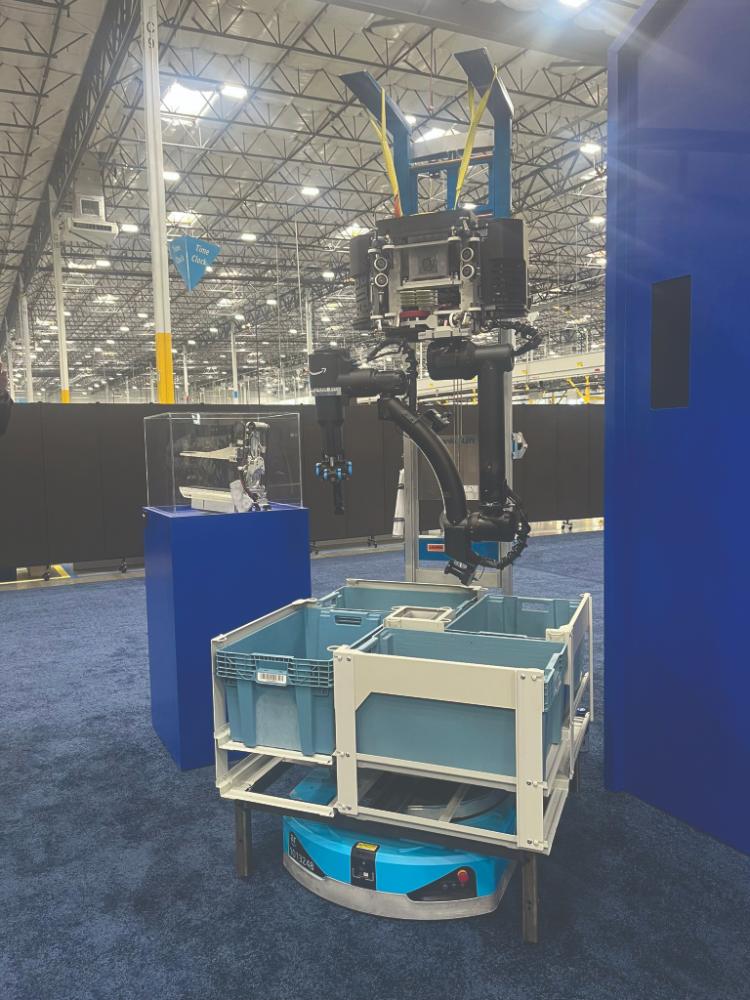 Amazon's BlueJay robot, DUR3 Delivery Station, San Jose
Brady asks The House to do an “expansion of thinking”. With its smart robots – Vulcan, Blue Jay and Hercules, among others – Amazon can store, say, 40 per cent more goods inside one factory, giving it more inventory to sell. If Amazon can build its same-day delivery capabilities, it will generate more demand. Those 10 people can then “put their minds to a higher level of focus”, he says, by using Amazon’s new AI-powered dashboard Project Eluna to monitor what’s going where in warehouses, or to supervise that case of spilt maple syrup on aisle 12.
After all, robots aren’t human. Amazon’s fleet have not quite yet got to grips with black shiny plastic bags, nor tennis balls. “The hardest part about beating a grand master at chess for a robot is moving the pieces,” Parness says. “We still struggle to get anywhere close to what you have with your hands in terms of sensor density, the kinds of information you have, and your ability to process that information. We are at the very early stages of doing that.”
Parness has a solution for a hypothetical situation where AI-powered robots become more powerful than people. “Robots don’t like salt water,” he says, suggesting with a smile that he would simply throw a bit of that on them.
On a serious note, he says there is a “lot of overblown concern about those Terminator-like scenarios”.
“The optimist in me believes that the reason that never happens is because people are the ones who are designing them, and people are the ones who are giving a signal of ‘this is a useful thing’ or ‘this is not a useful thing’. Robots that are enslaving us, we’re going to give that early signal, like, ‘not useful’.”
But with Amazon developing robots so quickly, concerns will inevitably remain.
To fight the backlash against automation, The New York Times reports that Amazon has considered reimagining its image as a “good corporate citizen” through being a force for good in local communities.
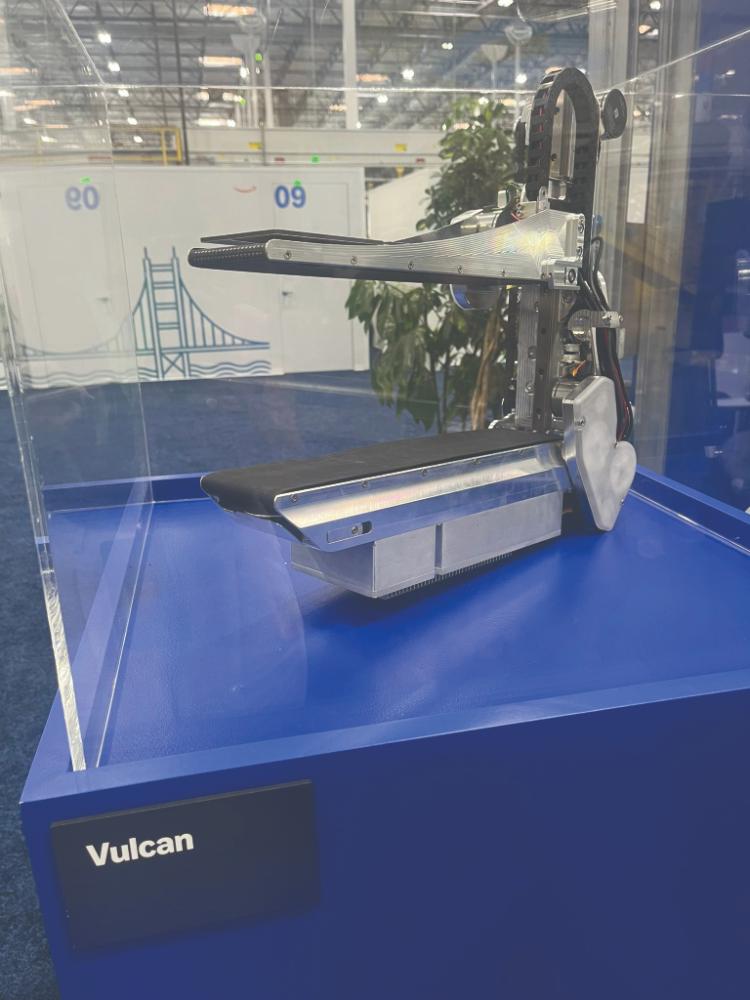 Amazon's Vulcan robot, DUR3 Delivery Station, San Jose
And so, our next stop in California is the San Francisco-Marin Food Bank, from where Amazon is helping deliver groceries directly to people’s homes. We start our tour with a drinks reception in the foodbank’s lobby. Waiters – seemingly as many as there are media – mill between us, offering negronis and wagyu steak tartare canapés.
Amazon has invited San Francisco mayor Daniel Lurie on-stage inside the foodbank to talk about the company’s impact on the city. “Amazon is showing that they are committed to San Francisco. I appreciate them for that,” the mayor says, after briefly mentioning the city’s problems with drug addiction on its streets. “Let’s go, San Francisco – we got this.”
We are guided around four stations, with foodbank workers, visibly moved at points, explaining how Amazon is supporting their operations. It is a joyous, earnest scene. Yet such offsetting measures – in the community or towards sustainability goals, for instance – may just be polish for Amazon’s underlying problems.
While Brady insists Amazon is the world’s best employer, there are employees who disagree. UK workers have claimed the company monitors their toilet breaks, and presided over unsafe working conditions. In Coventry, Amazon was accused of “propaganda sessions” in which the company allegedly tried to dissuade them from voting to unionise. And back in the US, in Alabama, labour officials ruled that Amazon had improperly influenced a vote to unionise.
Why does Amazon refuse to support its workers organising?
“Employees always have the right to choose,” Brady replies. “I respect that right. But personally, I like the ability to directly connect with my boss. I like to directly connect with the company. This is me personally: I don’t need somebody representing what my thoughts are.”
As ‘Delivering the Future’ winds to a close in San Francisco, Xavier Van Chau, Amazon’s highly valued PR man, asks Parness a question that has the air of the pre-rehearsed about it.
“These technologies that Amazon are introducing – what do they represent in terms of where robotics are going for people in their lives?”
“What gives me a lot of fulfillment is knowing that by giving robots a sense of touch, you unlock a ton of application,” Parness dutifully replies. The technology Amazon is developing could, he says, be used to clean the garage, clean a child’s closet, or push a gurney in hospital.
“This is a super interesting fundamental technology that’s going to change the way robots are useful for us for decades.”
That may well be true. But the more robots Amazon brings into the workplace, the more questions will be asked of the company’s commitment to humans.
