How Britain Planned For Nuclear War – Then Abandoned Home Defence
Home Guard volunteer men, 1944 (Dave Bagnall Collection / Alamy)
10 min read
Modern British home defence plans have their roots in the 1950s, taking in everything from invading forces in the Shetlands to the death of millions in a nuclear war. The scale of preparation has changed markedly over time, James Waller writes, but the nature of the threats have not
The phrase ‘home defence’ conjures up images of Colonel Mainwaring and the Home Guard standing firm in the Second World War, or the traffic warden from the 1984 film Threads, defending what was left of Sheffield from what was left of its population. It speaks to a nation so determined to defend its democratic principles that for decades the state made intricate war plans to suspend democracy as part of preparations for ‘home defence’ against the Soviet threat.
Yet this most sensitive of subjects remains little-understood, despite its increasing relevance to our modern world. In 2025, the British government publicly reconfirmed the renewed importance of defending the homeland from attack, 30 years after home defence planning was abandoned.
British Cold War planning for both civil and home defence has its roots in the 1950s, when the Soviet Union had only a handful of atomic weapons, and British planners assumed a conventional war might last months before the bomb fell. This allowed time for orderly evacuations from major cities.
The Civil Defence Corps reached a 1954 peak of 330,000 volunteers, trained to rescue survivors from atomic attack while the Home Guard, briefly revived, stood ready to repel Soviet paratroopers. But the arrival of the infinitely more destructive hydrogen bomb, coupled with Britain’s economic struggles, made such ambitions untenable. The Home Guard was disbanded in 1957, the Civil Defence Corps in 1968, public evacuation plans cancelled, and the machinery of civil defence placed on “care and maintenance” – Whitehall code for ‘spend as little as possible and hope not to be caught out if the balloon goes up’.
Home defence planning continued, however, with a focus on protecting the military and government infrastructure needed to fight and survive a nuclear war. The Ministry of Defence’s assumption was that, following a period of international tension, Nato would begin the ‘Transition to War’ process and the armed forces would be mobilised. The government would prepare the nation for war, issuing pre-printed ration cards to the population, emptying hospitals and dispersing the emergency services away from likely targets.
The Wartime Broadcasting Service would be activated, replacing BBC and ITV, and informing the population of how to survive a nuclear attack. The police would close the motorways to enable military reinforcements to travel to Europe, while the population would be encouraged to ‘stay put’ and not evacuate.
As part of the process, Parliament would dissolve itself. Britain would be carved into fiefdoms run by regional commissioners, ministers and their civil servants who would disperse to regional bunkers to assume total control. Several ministers would discover they had been nominated as a prime-minister-in-waiting, evacuated to remote parts of the UK, or to sea on the Royal Yacht Britannia, in the hope that one would survive and be ready to assume charge of what remained of the nation after a nuclear attack occurred.
Although all government plans worked on the assumption that there would be popular support for the war, there was little confidence that the ‘stay put’ policy for the population would work. The army recognised it would need to be involved in building and operating refugee camps for hundreds of thousands of displaced civilians who would flee from the cities to Cornwall, Wales and the west coast of Scotland (a curious precursor of the Covid lockdowns, when people fled London for those same rural locations).
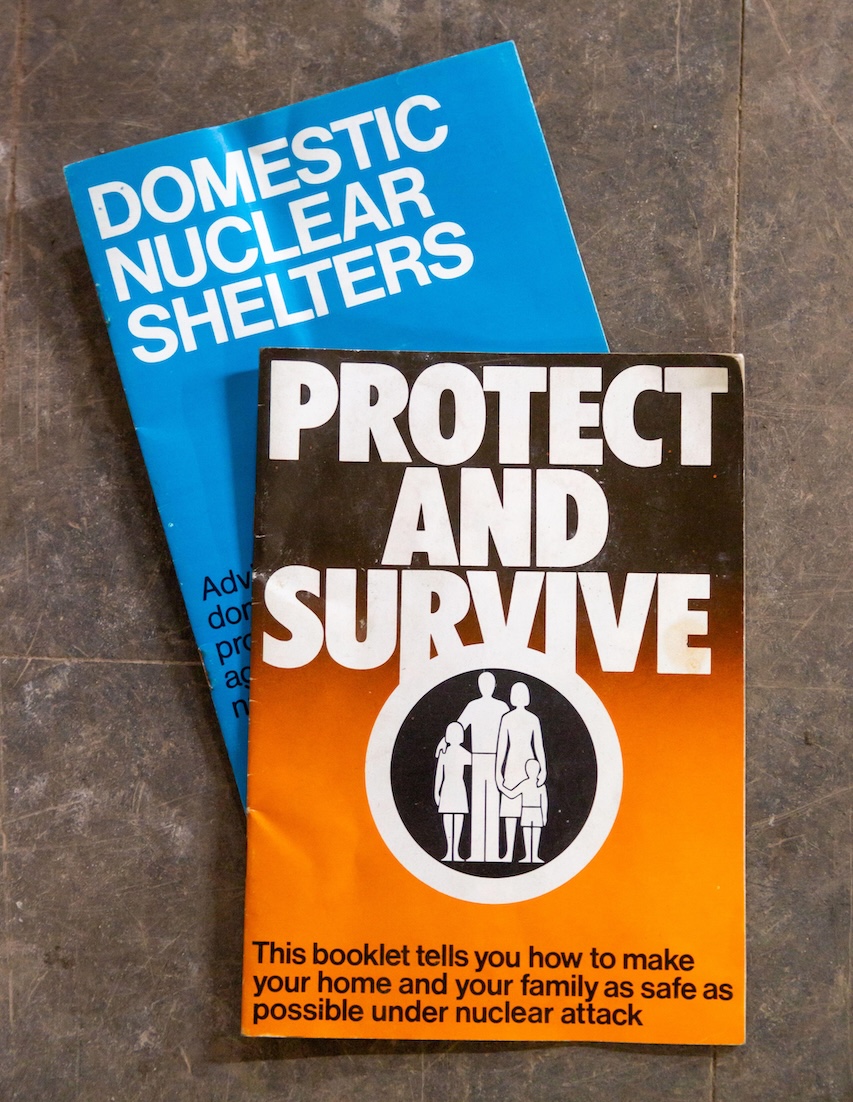 Protect and Survive, a public information campaign intended to advise the public on how to protect themselves during a nuclear attack (Alamy)
By the 1980s, it was recognised in government that some kind of civilian mass evacuation and shelter plan was needed, but the challenge of moving potentially tens of millions of civilians away from likely targets in a few days was seen as impossible, and all planning work – beyond issuing copies of Protect and Survive – was abandoned, leaving the population to their fate.
When the war started, Nato had enough conventional munitions to last about seven days before they were exhausted and a Warsaw Pact breakthrough became inevitable. At this stage it was assumed that tactical and nuclear weapons would be used in increasingly significant numbers by both sides.
Before and during the war, the Royal Navy would be responsible for keeping British ports open from disruption and ensuring that nearly 250,000 US troop reinforcements could arrive, and the Polaris submarine force could sail to carry out their nuclear mission. The Soviet navy was likely to use submarines and trawlers to mine ports, especially the Clyde where Polaris submarines were based. Subsea cables and oil rigs were also seen as particularly vulnerable to sabotage.
The RAF would rely on increasingly elderly jet fighters and Second World War-era Shackleton bombers for airborne early warning and radar stations to intercept Soviet air raids before they could reach the UK. They expected to face nearly 200 heavy bombers, using conventional bombs or missiles on military and civilian targets. Daily casualties from Soviet bombing were expected to far exceed the worst days of the Blitz. Air-launched chemical weapons were also expected to be used on UK soil, indiscriminately targeting military and civilian sites to disrupt reinforcements and cause panic.
Even the best-case government plans assumed over 20 million people dead or dying
Over 65,000 troops would guard ‘key points’: sites deemed critical to the ability of the UK to fight, and recover from, nuclear war. More than 400 sites existed, ranging from nuclear weapons facilities to government bunkers and food depots. These were expected to be high-priority targets for the hundreds of Spetsnaz commandos expected to be infiltrated in the run-up to war.
Although a full-fledged Soviet invasion of the UK was seen as exceptionally unlikely, MoD planners were concerned that a diversionary attack involving mass parachute landings, most likely in the Shetland Islands, would occur during the conventional phase of the war. The army developed ‘Plan Alpha’ as a last resort, where hundreds of troops were to be airlifted to recover British territory from Soviet occupation.
Had the war entered a nuclear phase, the damage would have been catastrophic. The 1954 Strath Committee had assessed that in the event of 10-megaton hydrogen bombs being detonated over British cities, over 12 million people would be killed, and four million more seriously injured – sufficient to cause the complete ‘breakdown’ of the state.
By 1984, the MoD expected that over 100 military sites including airfields, bunkers and ports would be attacked by nuclear weapons, as well as most major cities. Even the best-case government plans assumed over 20 million people dead or dying, and food, fuel and supplies rapidly running out. Power would lie with those who controlled the food and ammunition, for as long as both lasted.
Ironically, the most powerful surviving military force in the UK might have been American. As part of Nato reinforcement plans, hundreds of thousands of US troops would be surged into Britain before the war, outnumbering British forces nearly three to one, yet the UK had no oversight or control over American plans to defend their bases in the UK. Post-strike, these survivors would be “over-armed, underfed, and over here”, with little prospect of returning home.
The challenge facing the MoD was that it had nowhere near enough resources to deal with the likely scale of threat. In 1983 prime minister Margaret Thatcher was briefed that the British army was 40,000 troops short of being able to meet its tasks, lacked adequate protection against nuclear and chemical weapons, and had insufficient weapons and communications equipment.
The Royal Navy estimated that it needed 80 dedicated minesweepers to clear ports, at a time when it had fewer than 35 in service. The RAF had 30 per cent fewer air-launched missiles than it needed, while its long-range surface to air missile capability was reliant on the utterly obsolete 1950s vintage Bloodhound missile. At a strategic level, military headquarters were seen as being vulnerable to attack or sabotage, and the last-ditch emergency communications equipment needed to keep military commanders and politicians in contact with each other after nuclear attack did not work.
This forced tensions within the MoD, where spending on home defence competed with other Nato priorities, causing internal debate about whether the UK approach should be ‘fortress Britain’ prepared to protect against external attack – or to avoid spending money on capabilities like bunkers, radars and radios that would be of limited wider utility in peacetime.
The future of home defence is likely to be very different to that of the past, even though the threats have not demonstrably changed since the 1980s
Ministers settled on internally reprioritising some MoD money, focusing on small improvements rather than wholesale change, but trying to improve overall levels of protection. By the end of the 1980s, command and control facilities had been improved, and munition stockpiles increased. War plans were tested through major exercises like ‘Brave Defender’ in 1985 where over 35,000 troops practised their wartime roles. In less than a decade, home defence planning had gone from moribund to highly credible, for a relatively small outlay of cash.
The end of the Cold War in 1990 marked the effective end of home defence planning for the MoD. With the only credible threat removed, swingeing cuts soon saw the scrapping of the entire operation, with bunkers closed, units disbanded, and all home defence exercises scrapped. Today, the final versions of these once highly secret plans for home defence lie all but forgotten in the National Archives.
There followed 30 years of defence policy, which focused on global operations rather than preparing for a national struggle for survival. To save money, there was increased reliance on a ‘just in time’ logistics system, and a running down of stockpiles, munitions and logistics networks. All of which made sense in a world without an existential threat to the homebase. But with Russia once again resurgent, has the time come to re-examine the need for home defence?
 Defence Secretary John Healey and Foreign Secretary Yvette Cooper visit HMS Prince of Wales anchored of the coast of Naples, Italy, in November 2025 (Stefan Rousseau / PA Images / Alamy)
The government believes the time is right to look again at this; the 2025 Strategic Defence Review (SDR) had, for the first time in decades, an entire chapter dedicated to home defence and national resilience. It called for improved plans to protect the homebase, protect critical national infrastructure and regenerate the ability of the nation to transition to war.
The future of home defence is likely to be very different to that of the past, even though the threats have not demonstrably changed since the 1980s. Russian tactics in Ukraine involving missile, drone and air attack, sabotage of key sites and cables, and potentially sabotage attacks on ‘key points’ all mirror the assessed threat to the UK in the 1980s.
With a much smaller military than the 1980s, the SDR acknowledges that future UK home defence planning will rely far more heavily on the private sector, industry and beyond to prepare the nation for war, however.
The challenge is regenerating the national capacity to mobilise, to plan for defending the homeland against threats like air or missile attack, where currently no infrastructure exists to protect the population from air or missile attack on a scale not experienced by the population in over 80 years.
James Waller is an amateur Cold War historian, with a particular research interest in Cold War planning for home defence and the machinery of government in war
