RMT General Secretary Eddie Dempsey: "Here's The Thing – Strikes Are Effective"
RMT's Eddie Dempsey in August 2023 (Credit: Vuk Valcic / ZUMA Press Wire / Alamy)
12 min read
RMT union general secretary Eddie Dempsey talks to Sienna Rodgers about the potential for disputes under Great British Railways, the value of ‘militant strike action’, and why he won’t be leaving his council home
For rail unions, Great British Railways is an opportunity for their members: stronger collective bargaining and more leverage. Labour ministers, meanwhile, sell state ownership as the key to lower fares and higher productivity. Are they heading for a fight?
As Wes Streeting battles with the “moaning minnies” – as he calls them – at the BMA, could the nationalisation of the railways be a threat to the trade unions, given ambitions around AI and reducing the duplication of jobs embedded in the current privatised system?
“That will depend on what comes out in the negotiations,” says RMT general secretary Eddie Dempsey, who admits: “There are some things that are going to be difficult to deal with. One of the things we’ve benefited from, in a weird way, is we’ve had no government seriously interested in investing in new technology in the industry.”
He argues that the rail unions are not resistant to change – yet the prospect of strikes is already present.
“Provided we’ve got national agreements and national bargaining, which allows us to deal with change in a way that makes sense, there shouldn’t be problems.
“But if they take the approach that the previous government did under Rishi, which was, ‘We’re going to cut a load of money out of the industry, we’re going to have a massive reorganisation, and we’re going to try and force that on the trade unions in the middle of a cost of living crisis,’ and expect us to make a deal on that during pay negotiations? That’s not going to work, and we won’t have that,” Dempsey tells The House.
Has he had any assurances that his preferred approach will be the one taken?
“I’ve told everyone with a pair of ears in government and industry: we want to sit down and address productivity in railways seriously. We want to talk about a long-term workforce plan seriously. But we’ve also made it crystal clear: if you try to force productivity discussions on us in a high-pressure environment of pay [talks], you’re going to have a trade dispute.”
The RMT recently settled on pay with Transport for London (TfL) after strike action. The deal will see staff pay increase each of the next three years, based on the RPI measure of inflation rather than CPI – a win for the union. (Dempsey objects to CPI because it does not take housing costs into account and “RMT members live in houses”.)
The lesson? Strikes work. “Here’s the thing – strikes are effective,” he says. “I hate to say this: people aren’t paid according to what social value they bring to society. If they were, you wouldn’t see nurses going to food banks. Your wages depend on the strength of the union and your preparedness to take militant strike action.”
The RMT has already declared a fresh dispute with Network Rail, which responded that it was “surprised and disappointed” as pay talks had not begun.
“Well, we wrote them to start negotiations. We’re disappointed they haven’t started,” replies Dempsey. “If they’ve got any sense, and if this Labour government’s got any sense, they will do what Sadiq Khan has done – they’ll do a multi-year deal with us, and then we’re out of their hair for the rest of this Parliament.
“But if they want to try and force us into a position where they’re expecting us to trade terms and conditions, and talk about meaningless productivity, which isn’t real, in order to make a deal? Our members are fed up of that, and we’re not going to do it.”
“In the past, I’ve said things a bit clumsily, probably, from time to time, but that’s just because of the way we debate in our union”
Compared to general unions with lower density in their sectors and less homogeneous workforces, the rail unions find it easier to ballot their members and get ‘yes’ votes.
“The simple fact is, if you don’t use your collective power now and again, it atrophies. If you don’t use it, you lose it,” Dempsey warns.
“It’s been a tough time for working-class people in this country for many years. I’m fed up with it, and I don’t think people should put up with it. There’s no reason for it. We are a rich country – it’s just our economy’s rigged.”
What did he make of Sadiq Khan’s handling of the Tube dispute, and of him as London mayor generally?
“Sadiq? I don’t mind Sadiq, actually. What I found tricky was, I think the people who are most responsible for what happened now are the commissioners and TfL. They’ve got too much power,” he says.
“I think he’s being prevented from doing some of the things he wants by the commissioners. That, for me, is a worry, because I know who elected Sadiq Khan – I don’t know who elected them.”
As general secretary of the National Union of Rail, Maritime and Transport Workers since being elected unopposed in March, the baby-faced 43-year-old has big shoes to fill. Dempsey’s predecessors, whose black-and-white portraits watch him as he works in his Euston office, include Mick Lynch and Bob Crow – arguably the most recognisable trade union leaders since Arthur Scargill.
Even before he rose to the top of the RMT, Dempsey was a known figure on the left and a divisive one. In 2019, when backing a no-deal Brexit – as he did – was a big deal, Ash Sarkar and Owen Jones pulled out of speaking at a demonstration because he was on the bill.
Earlier that year, he ran into trouble with comments at a ‘full Brexit’ rally in which he said those who turned out for Tommy Robinson protests were united in “their hatred of the liberal left – and they are right to hate them”.
“The problem with people on the left of politics, and has been for a long time, is they spend so much time worrying about what goes on in people’s heads, they forget what’s going into their bellies,” Dempsey says today.
“In the past, I’ve said things a bit clumsily, probably, from time to time, but that’s just because of the way we debate in our union. We’ve got quite a competitive debate style internally.
“It does produce a particular style of argument,” he explains. “It’s why people like Mick Lynch, why people liked Bob Crow – because they get straight to the punch, and sometimes they say things with a bit of a sting in it.”
He fondly recalls a time when the left “looked like the working class, spoke like the working class in their language, smelled like them, drank like them, watched the same football games – because they were the same thing”.
Since then, the left has gone down “a rabbit hole”, he says, “with some of this post-modernist way of thinking that was coming out of university campuses rather than out of the industrial politics of shopfloor militancy”.
“We don’t support the invasion by Russia of Ukraine, but neither did we support all of the nonsense that went on before it”
He confirms that there were RMT members on the recent Tommy Robinson-led ‘Unite the Kingdom’ march, and guesses that members have also protested outside refugee centres, as well as joining counter-protests against both.
But he is not interested in identity politics or wedge issues: “If we don’t have unity, we’re unable to fight on behalf of our members. That’s the bread and butter of what we do.”
Dempsey is seen by some as being anti-immigration himself, though he is currently fighting visa changes that could see 63 TfL workers forced to leave the country.
“Migration isn’t a moral question,” he says. “Trade unions were founded, a lot of them, to control the supply of labour. My father’s union fought for 140 years against shipping companies using labour from all around the world to undermine trade unions and destroy their strikes. That’s not the same thing as saying, ‘Here is somebody who’s migrated to Britain, you’ve got a problem with that person’.”
“Don’t invite people in to work and then treat them like dirt,” he adds.
Detractors on the left sometimes label Dempsey a “tankie”, the shorthand for pro-Soviet communists. Dempsey prefers to be described as “old-school”.
Controversially, he was pictured posing with a Russian separatist in 2015; when it later surfaced, Labour MP Chris Bryant demanded an apology. Dempsey refuses to offer one, insisting he was simply on a humanitarian visit to Odessa to mark the 2 May 2014 House of Trade Unions fire, in which 42 died after violent clashes with pro-Ukrainian activists.
“We don’t support the invasion by Russia of Ukraine, but neither did we support all of the nonsense that went on before it,” Dempsey says, appearing to diverge with the mainstream western view that responsibility for conflict between the two lies overwhelmingly with Russian aggression.
Notably, the RMT is opposed to Britain sending military aid to Ukraine. The general secretary says this policy is “not specifically about Ukraine” but rather that “we can’t afford to be getting involved in conflicts around the world”.
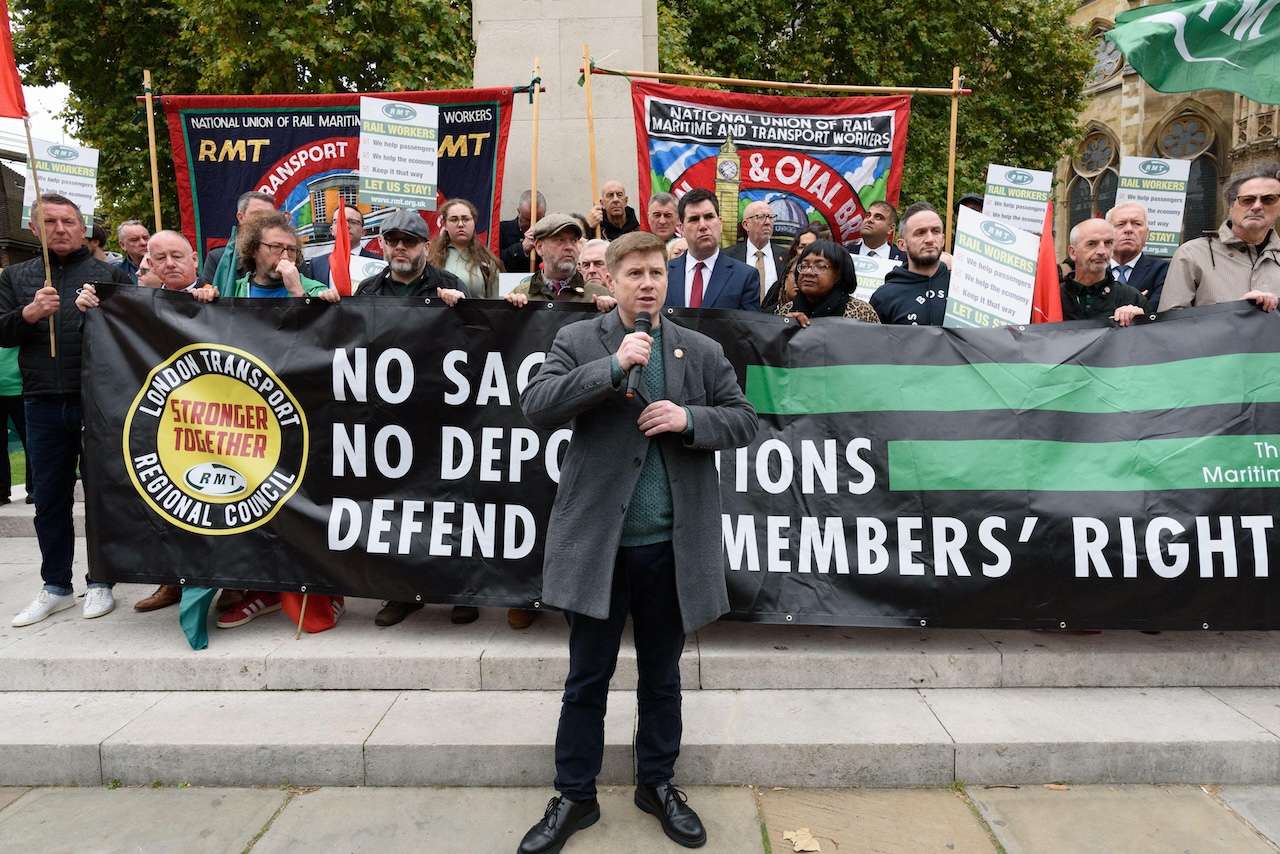 Eddie Dempsey with members of the RMT union protesting outside Parliament against government changes to the Skilled Worker visa scheme, October 2025 (Credit: Ron Fassbender/Alamy Live News)
Born to an Irish family, Dempsey grew up between rural Ireland and south London, where he lived on the Woodpecker Estate, a picture of which hangs on the exposed brick wall beside his desk. “It was rough. It was tough. We were skint. There were a lot of problems, a lot of tragedies around us, but there was a sense of community.”
His mother staffed cafés, squeezed oranges in an orange factory (“She would walk down Surrey Canal Road, carrying two buckets of orange juice – perks of the job”), and worked in the local leisure centre. “She used to let me and my mates in, and say we were all her sons. That raised a few eyebrows because 70 per cent of us wouldn’t be white, but they wouldn’t say anything to my mother – she would tear the skin off you with a lash of her tongue.”
Dempsey is at his persuasive best when he tells the stories of his deep roots in the labour movement. His grandfather, based in Acton Works, was also a union member. His father, a deep-sea sailor for 20 years, was in the National Union of Seamen, which later merged with the National Union of Railwaymen to become the RMT.
“He was out on strike in 1966, they shut his docks in 1981, then he went to work on the buildings,” Dempsey says. “He worked through cancer twice. He worked through chemotherapy – he couldn’t afford the day off because there was no sick pay. And during that period, he saw his wages slashed by 30 per cent. Then finally he was made redundant, and his redundancy money was robbed, and he died without a penny. That’s the life of working-class people.”
His father’s politics were neither left nor right, according to Dempsey, though he did used to quote John Hume: “You can’t eat the flag”.
“He never really spoke to me much about unions or anything else until he was retired, because he was an Irish man of that generation. He barely spoke to me at all – unless he had a few pints of Guinness, he was great fun then!”
Dempsey’s first job was on Deptford market and he compares this life to Only Fools and Horses. Today, his total pay package comes to £108,000, and he lives in an Islington council house – for which he is unapologetic.
“Council houses were not built for poor people. It’s not charity,” he says. “I like my neighbours. I like where I am. I was born in a council gaff, and I’m not moving out.”
Class analysis is everything for Dempsey, who laments Britain’s lack of industrial strategy in recent decades and harks back to a time when the country stood on its own two feet.
“We have lost our independence as a country. We’ve lost all of our national wealth. We’ve lost most of our industry. As a result of that, we’ve lost much of our trade union movement and our labour movement. That has left working-class people in a place where their lives feel chaotic and insecure and open to people who want to promote horrific alternatives.”
He is not convinced that the Budget was focused on living standards as the leadership claimed because, like many in Labour, he is appalled by this government’s post-Truss focus on bond market reaction.
“I don’t think they’re going far enough because they’re worried about spooking the markets,” he says. “You can’t make democratic choices to improve people’s lives in a substantial way, because the people who own your economy will call that in. They’ll pull the plug on us, and we’ll find ourselves in a mire. We’ve got to get off of that hook long term.”
“My real fear is not so much where we are today,” he adds. “If we end up with a Reform-Tory, free-market, head-banging coalition, the wheels are going to come off.”
His answer to the fight against Nigel Farage? Use GBR – a “once-in-a-lifetime opportunity” – as a starting point for redeveloping manufacturing, taking back ownership of public services, and giving working people employment rights, better pay and a common sense of identity.
Some on the left would like to see Dempsey enter Westminster politics. “I see him as the kind of leader the left needs,” says one source. “Jeremy [Corbyn] and Zarah [Sultana] are both able to speak to the existing left base, but I can’t envisage either of them challenging Reform.”
But he gives the idea of him standing for Parliament short shrift: “No. I’m an industrial trade unionist.”
The union ended its link with TUSC, the electoral outfit co-founded by Crow, several years ago “because it was not politically viable”. Dempsey is not interested in Your Party, nor in reaffiliating RMT to the Labour Party – the status quo is “working quite well for us”, he says.
“I belong to the RMT. That’s it. I’m not in any political party. I don’t intend to join any political party. I do this – permanently.”
