First Sea Lord: The UK Is Not Afraid Of Calling Out Russian Sabotage
Gen Sir Gwyn Jenkins, tells The House that such an attribution by the UK is a key part of its deterrence arsenal (© UK Ministry of Defence, Crown copyright, 2025)
11 min read
As the Russian threat to UK security grows, General Sir Gwyn Jenkins – the first Royal Marine to be appointed First Sea Lord – talks to Matilda Martin about undersea cables, anti-submarine warfare and responding to ‘deliberate sabotage’
In January, the Royal Navy spent several days monitoring a suspected Russian spy ship as it passed through British waters.
Defence Secretary John Healey told Parliament this was the second time the ship – called Yantar – had entered British waters in recent months, and said it was being used by the Russians to gather intelligence and map the UK’s critical underwater infrastructure.
Addressing Vladimir Putin directly, Healey said: “We see you. We know what you are doing. And we will not shy away from robust action to protect this country.” He also revealed he had authorised a Royal Navy submarine to surface close to Yantar “to make clear that we had been covertly monitoring its every move”.
The Yantar is operated by the Russian navy and is described by the country as an “oceanic research complex”. Russian news agency TASS reported soon after that the Russian embassy had dismissed the accusations of the threat to undersea infrastructure as “utterly groundless”, adding that the statements made by Healey “only serve as a motive to escalate tensions”.
The First Sea Lord and Chief of Naval Staff, Gen Sir Gwyn Jenkins, tells The House that such an attribution by the UK is a key part of its deterrence arsenal.
That people know “we can both identify particularly malicious intent when it’s taken place and then attribute that malicious intent to particular actors” is, he says, a “powerful deterrence measure in its own right”.
Sir Gwyn, who took up his role in May, praises Healey’s statement as showing “an absolute willingness to call this stuff out”.
“I don’t think there is any fear of compunction on the part of our government to want to attribute this stuff. If it’s attributable, if we think that there is malicious intent behind a piece of sabotage, we will absolutely out that to the Russians,” he says.
“We’re very good at our forensic analysis. If something is deliberately sabotaged, we will attribute it, and we will be able to point fingers at the actors who undertook that, and try and hold them to account.”
Despite the war in Ukraine, Russia has continued to invest in its underwater capabilities, posing a particular threat to the UK. In spite of technological advancements in recent years, Sir Gwyn tells The House that scientists’ assertions that the sea is “about to become transparent” are “overstated”.
One of the challenges facing Sir Gwyn is the protection of the UK’s vast undersea network, connecting us to Europe and the rest of the world.
“I don’t think there is a good level of general knowledge of just how dependent this nation is on the seas,” he complains.
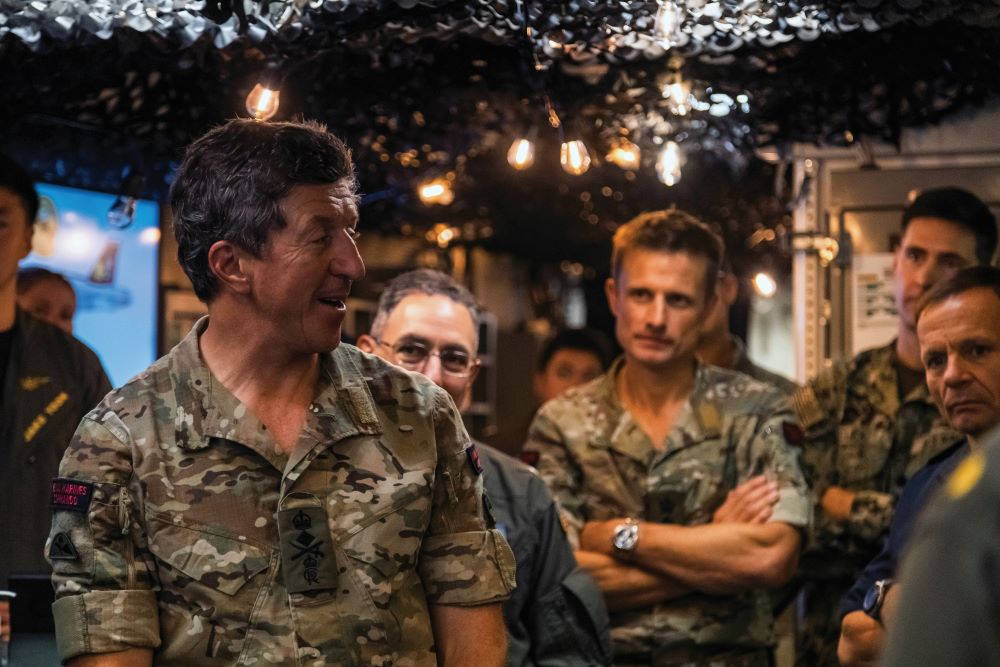 Sir Gwyn is the first Royal Marine to head up the Royal Navy (© UK Ministry of Defence, Crown copyright, 2025)
Despite advancements in the space domain and air travel, which Sir Gwyn feels often dominate media reporting, the UK is still hugely reliant on its undersea grid.
Every day, 99 per cent of the UK’s data travels through undersea cables, including financial transactions and communications. A coordinated attack on a number of those cables simultaneously could hit the UK financially and impact the day-to-day lives of its citizens.
“We are utterly dependent on the communications that run under our sea, and the energy that comes under our sea, and I do worry sometimes that it is just taken as a given.”
In the government’s strategic defence review published in June, Britain’s navy was told it “must play a new, leading and coordinating role in securing the UK’s critical undersea infrastructure and maritime traffic that is vital to daily national life”.
Sir Gwyn was an unusual appointment, being the first time in the Royal Navy’s almost 500-year history that a Royal Marine has been chosen for the role. It marks another milestone in the UK’s drive towards war-fighting readiness, amid growing threats from Russia’s “continued investment in underwater capabilities”.
“From my perspective, there’s great opportunity in being the first,” the First Sea Lord says. “People expect me to be different. You don’t appoint a Royal Marine into this role in order to have the same model that went before. That is not a criticism of my predecessors in any way, but it is a recognition that we are living in a different time.”
We’re very good at our forensic analysis. If something is deliberately sabotage, we will attribute it, and we will be able to point fingers.
Sir Gwyn admits there are challenges, conceding that he needs a good team around him to fill some of the knowledge gaps. But he also points to the extra knowledge he can bring to the role as “a deep amphibious maritime warfare expert in my own right”.
To interview him, The House has travelled to Navy Command’s Whale Island, a piece of land reclaimed from the sea in the late 19th century using waste from the building of the naval base docks. Later enlarged, the site now houses the naval training base HMS Excellent.
More than two centuries after the Battle of Trafalgar, the nature of the threats facing the Royal Navy have changed dramatically. The perceived threat to the UK’s undersea network has only grown in recent years, as concerns over the Russian menace specifically have become apparent.
“I would say that it is a proven Russian tactic, and it’s in their doctrine, that they would seek to plausibly deniably disrupt a nation’s critical infrastructure. And I would say, from what we have seen, that doctrine definitely extends to underwater infrastructure,” Sir Gwyn warns.
Several high-profile events in recent years have highlighted the threat, including the sabotage of the Nord Stream gas pipeline in 2022, in which a series of explosions damaged the energy source and resulted in gas leaks.
Nato pledged last year to increase its military presence in the Baltic Sea following the suspected sabotage of a major power cable between Finland and Estonia on Christmas Day.
While suspicions have been levelled at Russia in the latter case, many of the sabotages are, as Sir Gwyn highlights, plausibly deniable.
Much attention has been levelled at the vulnerability of the UK’s undersea data cables in recent years – though some experts claim that a focus on these particular cables is misplaced.
Sidharth Kaushal, research fellow for sea power at defence think tank Rusi, tells The House that energy infrastructure is “far more vulnerable” than our data cables as “it’s reliant on far fewer points of failure”.
The Langeled underwater gas pipeline, for example, transports natural gas all the way from Norway to the UK and is “a single point of failure in the UK’s energy grid”.
“This is already a quite fragile ecosystem in which it doesn’t take a lot of sabotage in order to have a major impact.”
In a conflict, Kaushal believes the Russians would most likely target military cables – like gas, far fewer would need to be damaged for meaningful impact.
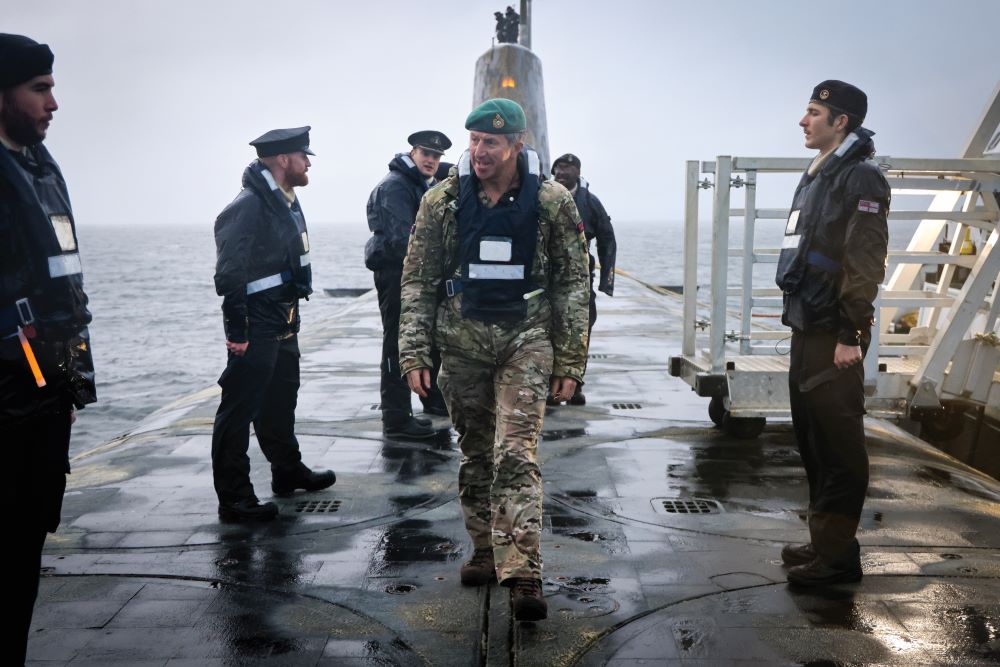 Experts believe the Russians would most likely target military cables in a conflict (© UK Ministry of Defence, Crown copyright, 2025)
He cites the historical example of when a US Department of Defense cable was snapped due to natural causes, resulting in all American drone operations in Iraq being shut down for several weeks.
Which of these cables – data, energy or military – does the First Sea Lord think is most at risk? Does the Royal Navy have the capacity to protect all of these at once?
“We are a long way from ubiquitous, continuous surveillance of all our seabed everywhere, all at once. No nation has that. So, you do have to prioritise,” Sir Gwyn admits.
He refuses to be drawn on the binary choice of energy or data: “The short answer is, there are specific vulnerabilities in both, and they manifest at different times. And we’re really sequencing where we think the threat might come and how we mitigate against that.”
Sir Gwyn notes that there is “quite a lot of resilience in our undersea infrastructure” and insists he does not want to “preach doom” – but he does also warn that “there cannot be any complacency on this – there are definitely rising threats”.
“There is a lot of critical national underwater infrastructure, and we are spending a lot of time surveying all of it to make sure that we understand both the vulnerabilities and whether or not any actors have tried to take any actions against us, as well as malicious intent.”
Atlantic Bastion – the Royal Navy’s plan for protecting the UK and its allies underwater, hailed as the future of anti-submarine warfare – is one method by which the country will look to secure the North Atlantic use of uncrewed escorts operating alongside submarines. It will provide the Royal Navy with a much broader surveillance capability and “track and act against adversaries if needed”.
After Yantar, there are concerns that the Russians have developed a good map of Britain’s undersea cables network. Could the Russians look to place mines on the seabed to damage or destroy key parts of our infrastructure?
“You would obviously not expect me to talk about sensitive operational matters,” Sir Gwyn replies.
But he adds: “I think it is right to take the threat seriously. What we can see, particularly from a range of actors who would wish to do us harm… the proliferation of technologies and the rising awareness of the vulnerability of nations to their critical underwater infrastructure means that we should take this threat extremely seriously.
“Despite the war in Ukraine, we know that the Russians have continued to invest in their underwater capabilities, particularly out of the Northern Fleet, and that’s the one that most directly affects UK security.”
While co-ordination with Nato is an important component of the Royal Navy’s surveillance network, working with industry and the private companies that own much of the undersea network is also key.
In evidence to the Joint Committee on the National Security Strategy, the European Subsea Cables Association and Vodafone said the government should consider developing a sovereign repair capability, a recommendation adopted by the committee in its final report.
We are a long way from ubiquitous, continuous surveillance of all our seabed everywhere, all at once. No nation has that
Asked whether he sees the Royal Navy increasingly working together with those companies for protection and repairs, he says: “We will always look, in the first instance, to industry to repair their own infrastructure, rather than taking on responsibility for that. It’s definitely something I would resist.”
Sir Gwyn says industry has been “welcoming” of the Royal Navy fulfilling that coordinating function. But it is not just undersea cables that pose a likely target: where those cables come ashore at landing stations, as well as wind farms, are also a potential risk.
Does Sir Gwyn think that, as our renewable offshore energy capabilities – such as wind – improve, the Royal Navy is only going to be playing a larger role?
“I don’t doubt it,” he says. “Every year, more communications cables are laid. Every year, more energy cables are laid.”
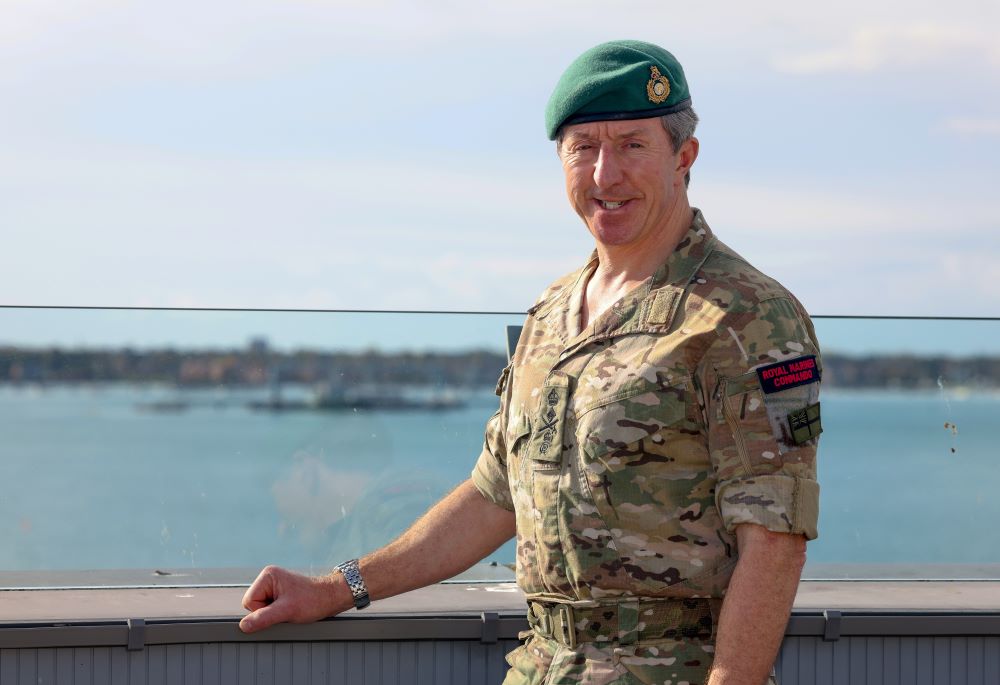 Sir Gwyn believes the challenge will “continue to increase in terms of scale” (© UK Ministry of Defence, Crown copyright, 2025)
In January, the multinational military partnership, the Joint Expeditionary Force, launched Operation Nordic Warden, harnessing artificial intelligence to calculate the risk posed by each vessel in response to increased concerns about the Russian shadow fleet.
Sir Gwyn believes the challenge will “continue to increase in terms of scale” but insists “the awareness is increasing all the time, and the networks are improving, and our ability to share information among ourselves and allies”.
The First Sea Lord recently told The Economist that the government had ordered him to deploy a “hybrid” air wing of drones and crewed jets within the next half-decade.
With drone warfare increasingly prevalent, Healey has announced that the government will be granting troops new powers to shoot down unidentified drones over UK military sites. Underwater drones could also be a risk in the future – does the Royal Navy need to seek new powers to take those out?
Sir Gwyn sees the challenges posed in the subsurface environment as different to the air.
“We are a long way from having a transparency that you’ll often see scientific articles claiming – that the sea is about to become transparent, and that any kind of subsurface ability to hide is almost over. I can’t help thinking those claims are overstated. The physics is really difficult in this, so there will always be unique challenges in the subsurface.”
