The Hidden Story Of My Family’s Link to Jeremy Thorpe – And The Truth It Reveals About Post-War Britain
Jeremy Thorpe was the leader of the Liberal party between 1967-1976 (Alamy)
6 min read
Some 60 years ago my grandmother was reaching the end of her tether. A single mother, abandoned by her husband, she was struggling to raise four young children by herself. In her desperation she wrote to the one wealthy man she believed might feel a sense of obligation to his relative, the prominent Liberal MP, Jeremy Thorpe.
He never replied. Recently I found out why and the truth reveals far more about post-war Britain, and the performance of identity, class, and aspiration than it does about Thorpe himself.
Growing up in Nottingham, I had little immediate connection to British politics, beyond the news blaring on the TV every night. What I did know, however, was that Jeremy Thorpe – the disgraced Liberal leader whose rise and fall shocked the country – was closely related to my father’s side of the family. Indeed I would share the Thorpe surname if I hadn’t, rather unconventionally, been given my mother’s.
My relation to the former Liberal leader was always there in the background, and I was fascinated by not only his fame, but the scandal surrounding him. Somehow, his messy career and life made politicians seem more real and accessible to me – but also inherently fragile and vulnerable. It certainly inspired at least some of my interest in politics and history.
My connection to Thorpe was through my grandfather, Frank Thorpe, though it was always somewhat vague. He was either his brother or his cousin, I was told. Everyone in my family believed it to be true.
Frank, an oil engineer, met my grandmother, Andrée, in London in the 1950s. They married later in the decade and moved to Bahrain in the early 1960s for his work. But then the marriage collapsed, with Frank leaving Andrée for another woman and abandoning her and their three children while she was pregnant with their fourth.
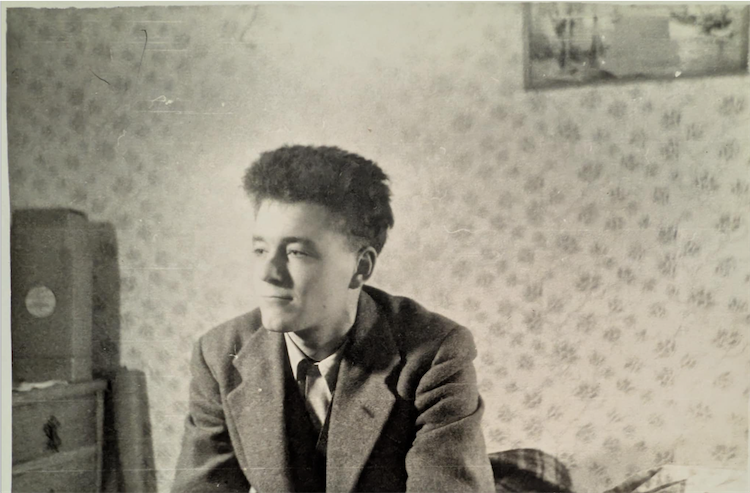 Zoe Crowther's grandfather Frank Thorpe in the 1950s (The House)
Single motherhood was an immense challenge for my grandmother. She worked multiple jobs, but still found it difficult to make ends meet. Writing a letter to Liberal MP Jeremy Thorpe, who she had never met, must have felt like a desperate last resort.
This perhaps explains why my family would not speak much about Thorpe throughout my childhood. The sense of betrayal ran deep, and none of his or my grandfather’s supposed generational wealth found its way to my grandmother and her children.
Jeremy Thorpe was born into immense privilege, descended from a long line of Conservative MPs, lawyers, and clergy, his family even claiming to be related to the Speaker of the Commons between 1453 and 1454. After getting elected as an MP in 1959, Thorpe rode the wave of political success, his career peaking in 1974 when there was a real possibility of him joining the Cabinet under a Conservative-Liberal coalition.
But just a year later, Thorpe was at the centre of one of the most extraordinary political scandals in modern British history.
A young man, Norman Scott, claimed to have had a secret sexual relationship with Thorpe in the early 1960s, when homosexuality was still illegal. In 1975, Scott’s dog was shot dead in what appeared to be a botched attempt on his life. The trail led back to Thorpe, who was charged with conspiracy to murder. Though ultimately acquitted, the scandal destroyed his career and cast a long shadow over his legacy.
So when I started to properly research my family history, I was eager to pin down the true nature of the connection and understand more about my own heritage. And yet as I uncovered more of the family tree, it wasn’t adding up.
I investigated all my relatives bearing the Thorpe surname well into the 19th century – unearthing a mix of bank clerks, mariners, and agricultural labourers, all based in south-east England. All very ‘ordinary’, and a far cry from Jeremy Thorpe’s aristocratic roots. There is no evidence whatsoever that Jeremy was my grandfather’s close relative.
After much head-scratching, I have been led to only one plausible explanation: that Frank fabricated the entire connection.
He was known to have lied about other aspects of his life, and when I shared this possibility with a family member, they paused and said: “Yes… that actually makes sense.”
So why would he have done such a thing? The post-war years were a time of unprecedented social mobility due to expanding education and employment opportunities. Social historian David Kynaston has written extensively about how ‘meritocracy’ became a buzzword towards the end of the 1950s. But this was in conflict with an enduring sense of class hierarchy.
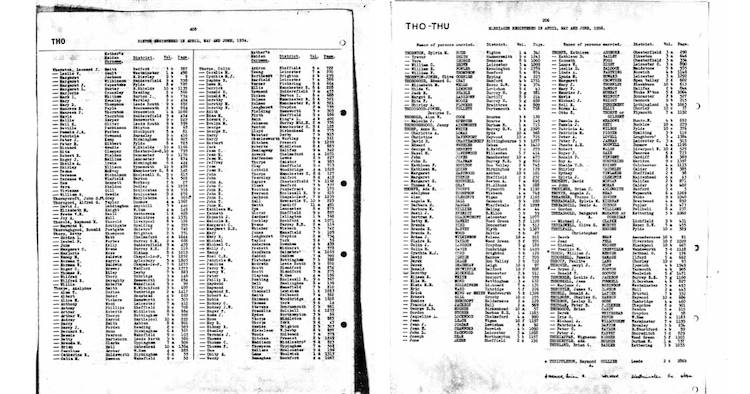 The birth and marriage records of Frank Thorpe (full name Roger Franklin Thorpe) (The House)
In Family Britain, 1951-1957, Kynaston explores how identity and performance – through accents, clothing, and connections – were key to navigating and climbing society in mixed areas of London such as Bloomsbury and Soho.
Working in the growing oil industry, Frank would have earned a comfortable, solidly middle-class wage, but lacked the social and political prestige that came with having aristocratic roots and connections. And in 1950s and 60s London, connections were everything.
My grandmother, in contrast, came from a family of Trotskyist revolutionaries who had fled from the Nazis with the help of Hugh Gaitskell, later to become the leader of the Labour Party (that’s a story for another day). She was educated at the famous Lycée in west London, and, as noted in her obituary, “emerged into a London of mid-1950s coffee bars and clubs, and a social life that took in the likes of [painter] Francis Bacon”.
While Jeremy Thorpe was not well known to the wider public in the mid-to-late 1950s prior to becoming an MP, he did have a public profile in certain circles, particularly in politics, high society, and Oxbridge alumni networks. At the same time, the West End attracted activists, members of the queer community, actors, artists, sex workers, and social climbers: a world where reinvention and performance were part of survival and success.
Having grown up in an ‘ordinary’ family, it is easy to see why my grandfather might have felt he needed to make himself seem somewhat more remarkable. In the days before the internet and publicly accessible archives, claims of famous relatives weren’t easily verifiable, and being “related to Jeremy Thorpe” could have opened doors, given credibility, impressed potential patrons and even made him more attractive to well-connected women like my grandmother.
This deception still feels relevant now. While today’s political landscape rewards authenticity on the surface, it’s still underpinned by social capital and inherited privilege. The impulse to falsify or exaggerate a backstory to gain credibility or social standing has not entirely disappeared.
One might think that uncovering my grandfather’s lie would leave me disappointed, erasing my only tenuous ‘claim to fame’. But the truth is far more revealing, and opens a window onto a Britain grappling with identity, aspiration, and who got to share in the promises of a new era. My grandfather’s possible invention says as much about the country he lived in as it does about him.
And perhaps Frank and Jeremy weren’t that different after all: the late Liberal leader’s biographer believes those claims to have been related to a former Speaker are, shall we say, dubious.
