What Can British Politics Do To Stop AI-Generated Disinformation?
New ‘chillingly good’ AI image tools like Google’s Veo 3 are making disinformation easier than ever. (Illustrations by Tracy Worrall)
9 min read
New ‘chillingly good’ AI image tools like Google’s Veo 3 are making disinformation easier than ever. Toothless and fractured regulators are struggling to keep pace, reports Matilda Martin
In spring 2024, footage of a teacher in the West Midlands who was canvassing for the Labour Party was caught on CCTV. It appeared to show Cheryl Bennett saying a racial slur.
The video was shared on social media by Akhmed Yakoob, an independent pro-Gaza candidate for West Midlands mayor. But the police later said the footage had been doctored.
While Yakoob ended up paying damages and Bennett was eventually cleared of wrongdoing, the teacher told newspapers that she had to take time off work and was unable to leave her house for a period.
The case was thought to be the first in the UK of a political ‘deepfake’ ending in a legal settlement. Experts say that they are encountering more and more AI-generated content every day – and one tool in particular is ringing alarm bells among experts.
We are now talking about having the power of tools that a Hollywood studio could only dream of five or six years ago, in the palm of your hand
Critics say Google Veo 3 – an AI video generator – is a shiny new sweet shop for those hoping to cause mischief. Its developers have managed to not only create photo-realistic visuals, but also paired it with sound, while delivering on improvements in the physics of the content.
“That was something that was previously incredibly difficult to do and generate good results,” explains Henry Ajder, an expert on AI, deepfakes and the synthetic revolution.
“We are now talking about having the power of tools that a Hollywood studio could only dream of five or six years ago, in the palm of your hand,” Ajder says. The tool can currently be accessed for approximately £120 per quarter in the UK.
“It’s not something that many people expected to see right now. Or… they had over-anticipated or overstated their ability to spot this content in the first place.”
While Veo 3 – and other AI tools – do have guardrails in place to protect against outwardly malicious content, such as creating videos of politicians or portraying violent content, users are constantly looking for ways to circumvent these barriers.
One user managed to use the tool to portray a news anchor announcing the death of author JK Rowling by using “Jake Kaye Rowe ling” in the prompt.
Labour MP Matt Western says the videos are “broadcast quality”. “Unnervingly, every element of it has credibility,” he tells The House. “It is chillingly good. For me, it is an absolute wake-up call – if we needed one – about how this needs addressing.”
Chair of the Joint Committee on National Security Strategy, Western says the government “needs to move really quickly on this”. He is concerned about what this tech could do in the wrong hands and thinks there needs to be an intergovernmental approach to the new tools “because of the threats that they pose to society and individuals”.
Asked about worries that Google Veo 3 could be used to fan the flames as an incident is unfolding, Western says he fears things could go a step further: “You don’t even need an incident to take place. It can be constructed.”
Use of deceptive AI-generated inflammatory content has been prevalent in the Israel-Gaza conflict, as well as the Russia-Ukraine war.
This could also apply to situations closer to home, according to Sam Stockwell, a research associate at the Centre for Emerging Technology and Security, part of the Alan Turing Institute.
Stockwell is set to undertake a piece of work later this year looking at the potential impact of AI-generated deepfakes and disinformation in the aftermath of incidents like Southport.
In July 2024, three girls were fatally stabbed at a holiday club in Southport. Days of disorder followed, after misinformation was spread online claiming that the attacker was an illegal migrant.
Stockwell argues: “If you had another similar scenario unfolding, how do you stop those information voids being filled with deepfakes that might seek to mimic the scene of the incident?”
Could this tech – or similar software – be used by Russia or China to influence elections here in the UK?
Western says: “I would have thought that this tech would be readily adapted by certain state actors. Why wouldn’t it be?”
AI expert Ajder asserts there is “no question” that Google Veo 3 will be used to create high stakes political disinformation in the UK. But he thinks the real concern is at a lower level, for example a local candidate or their team in a council race, like the Bennett case.
On how this could be regulated, John Sandall, founder and principal data scientist for data consultancy Coefficient, tells The House he would be concerned if “the solution put forward by platforms is to monitor election-related disinformation at a national level, when elections are won by swing seats in specific constituencies”.
“Come the next election, will anyone be monitoring deepfakes and disinformation that’s going viral only within specific constituencies? If not, that seems to me a very vulnerable spot in our democratic system that bad actors will certainly target.”
Ajder has been fielding questions about whether deepfakes could hijack elections for years. Until recently, he says, bad actor attempts to do so were “pretty crude” and a narrative has subsequently emerged that “deepfakes aren’t a ‘disinformation in politics’ problem”.
“It was as irresponsible to dismiss the potential risk moving forward as it was for the people to overstate its impact over the last few years,” he argues. “But I think this tool [Google Veo 3] is a good example of how the impact can still be felt.”
It is not just bad actors who could take advantage. Politicians could claim that uncomfortable content is fabricated, when it is in fact real.
It is something that the US President Donald Trump attempted in 2017, when he tried to debunk the infamous “grab ‘em by the p***y” tape.
The Turing Institute’s Stockwell is particularly concerned, arguing this could apply to a politician caught in a scandal, a company caught violating human rights, or a regime oppressing its citizens: “anyone can now leverage a form of reasonable doubt”.
Chi Onwurah is the Labour chair of the Science, Innovation and Technology Committee who headed up Ofcom’s technology departments for six years before joining the Commons. She is adamant the government needs to move faster.
In technologies like Google Veo 3, “there is significant potential for it to spread misinformation and genuinely harm people’s lives and democracy”, she warns. And she is concerned that Ofcom is only responsible for misinformation when it is illegal or causes harm to children.
“The government needs to make it clear urgently how it will properly regulate misinformation stemming from tech like this – while not hindering free speech,” Onwurah adds.
 What is being done to police AI-generated content?
Google has launched SynthID technology, embedding digital watermarks directly into AI-generated images, audio, text or video. A spokesperson said: “We’re committed to developing AI responsibly and have developed industry-leading tools to help people understand whether content is made using our AI tools. Any content generated with Google AI has a SynthID watermark embedded and we also add a visible watermark to Veo videos too.”
There is also a current push by the Content Authenticity Initiative, who would like to see a ‘pin’ added to content, allowing you to see whether it is partly or wholly AI-generated.
Andrew Dudfield, head of AI at London-based charity Full Fact, thinks this is a part of the scaffolding needed. But he says challenges may appear if all content becomes covered in labels: “I have the fear that… people become a bit blind to it”.
Ajder acknowledges that while the UK has been leading the way in some AI regulation, it could be doing more to push adoption of “digital nutrition labels”, and “try and lead the way on incorporating that into perhaps government communications and pushing others to adopt it”.
Dudfield also thinks there is a pressing need for more media literacy. While Ofcom already has a large remit, he thinks giving people the tools to navigate the newly-emerging online world could be added to the list.
While concerns about the longevity of the Online Safety Act, which came into effect this year, are already present, Dudfield is concerned that it does not currently engage with areas of misinformation.
Any changes to the Online Safety Act would in theory need to be introduced through an amendment in Parliament, for example through a statutory instrument.
“Technology is always going to move faster than regulation,” Dudfield adds. “We need to regulate appropriately to engage with the fact that this is going to be a changing environment and ensure that the right processes are in place.”
Phoebe Whitlock, a barrister and a director of the Intellectual Property Awareness Network, is also concerned: “The act did introduce duties for platforms to manage risks around harmful and illegal content, but accountability is still a major challenge.”
She tells The House: “Everyone has to shoulder some of the burden, from companies to users and regulators.”
The law is going to have to adapt significantly to deal with deepfakes as there isn’t an immediate logical way to stop them
But who should regulate political deepfakes?
Democracy and technology writer Frances Lasok thinks part of the issue is “we don’t really have a single election regulator”.
“The Electoral Commission’s regulatory powers are limited to finance, and it isn’t an enforcement body. We already have gaping holes in the protection of conduct of elections in the UK…
“The law is going to have to adapt significantly to deal with deepfakes as there isn’t an immediate logical way to stop them, or a logical body to enforce it.”
There are also suggestions that the government could look at liability for spreading misinformation, which could mean it is not continuously trying to play catch up with legislation.
A Department for Science, Innovation and Technology spokesperson said the Online Safety Act had been “deliberately designed to keep up with new and emerging technologies”.
“Platforms that fall under the act must swiftly remove illegal misinformation and disinformation – including where it is AI-generated – as soon as they become aware of it.”
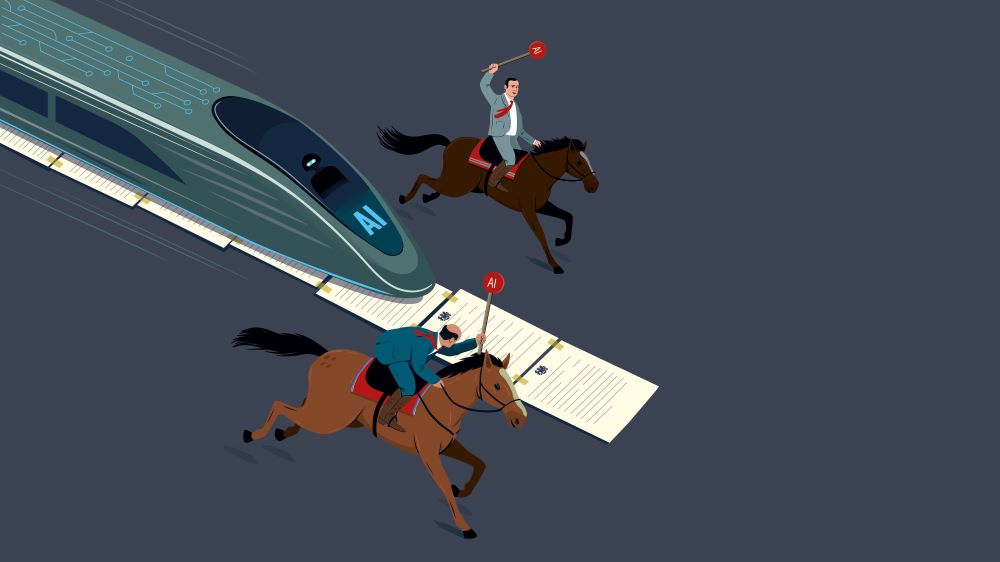
With the race well and truly on, and AI seemingly far ahead in the distance, all eyes will be on how the government decides to regulate this new threat, while pushing for its position as an AI superpower.
