Meet The Royal Ballet And Opera Apprentices Proving Timothée Chalamet Wrong
7 min read
Six times a year, the Royal Ballet and Opera holds school matinees. Matilda Martin meets some of those who went from auditorium to working backstage as it tries to shake off its elitist reputation
Timothée Chalamet claims that nobody cares about opera or ballet. Emma Huntley would like a word.
The 20-year-old loved tailoring but couldn’t quite see how she was going to make a living from it until she was taken on as an apprentice costume maker by the Royal Opera House (now known as the Royal Ballet and Opera) – “a dream come true”.
Some might suspect a cynical attempt to soften its image as an elitist institution but that’s a hard stance to maintain on meeting those like Emma, who are benefiting from a determined effort to widen participation and interest in the art forms.
And the Royal Ballet and Opera points out that it is in its own interests to recruit more diversely to plug the skills gaps needed to keep the show on the road. Each production requires hundreds of technicians, carpenters, costume makers and metalworkers, working alongside archivists and administrators. Among them are the young apprentices training to become the next generation of experts.
Over two years, the apprenticeship courses run by the Royal Ballet and Opera offer trainees the opportunity to learn on the job alongside their studies while receiving the national living wage. Most apprenticeships last two years, with trainees working around 40 hours a week and spending approximately one day of that at college. The House spent an afternoon at the Royal Ballet and Opera to speak with the young people benefiting from the scheme.
“I thought the only way [to here] would be through university, which wasn’t really an option for me,” says Huntley. Today, her work involves sewing sequins to a 1950s dress or fixing the hem on a ballgown for The Sicilian Vespers opera. But she didn’t ever envisage ending up somewhere like this.
For Huntley, a pathway to university would not have been straightforward: “It wasn’t not an option, in that I would never be able to do it. I just knew, because of my financial situation and my family’s, I wouldn’t be able to do it the same way my friends at school were doing it.” While her friends were looking at universities and writing their personal statements, Huntley says she envisioned her path as “either go to college and work part-time or work full-time”.
She later adds: “I thought, best-case scenario, I work as a tailor. I love tailoring, I’m really passionate about it. But this is literally a dream come true.”
Behind the scenes at the Royal Ballet and Opera, a maze of passageways, stretching across multiple floors and four different “core” areas, leads to workshops, the dye room, rehearsal studios and a vast backstage area, stuffed with stage props and scenery, complete with a mechanised floor. So large is the space, and so well organised, that it allows the venue to have up to five shows on rotation at once. The whole space is a hive of activity. Ballerinas hurry past The House to reach the stage where a rehearsal is taking place.
The Royal Ballet and Opera is trying to open the industry to those from all backgrounds. Its schools’ matinee, which is run six times a year, invites pupils to a performance, partnering with funders to subsidise all ticket prices and offer travel grants to schools that need help with transport costs to the theatre. In the interval, pupils receive a presentation about the apprenticeship scheme.
Creative venue technician apprentice Aidan Doswell, 18, once sat in that audience himself. Like Huntley, he never imagined he would one day be working behind the scenes on lighting, sound, and set and stage creation at the Royal Opera House.
“I thought the only way [to here] would be through university, which wasn’t really an option for me… This is literally a dream come true”
“I came from Ashford, so it’s quite a trek away from London, and I was doing a two-year course at my sixth form of tech in theatre,” he recalls.
After attending a school matinee, where he saw Romeo and Juliet, and hearing about the opportunity during the interval, Doswell returned home with his interest piqued and later applied for, and obtained, a place. Now, he sits reflecting on a full-circle moment, a world away from the “tiny” theatre in Ashford.
While the training for the apprentices is funded, and they are paid towards the upper end of the national living wage, accommodation costs are not covered by the scheme. Sarah Waterman, apprenticeships and work experience manager, admits “there is always more to do”.
Waterman explains that the apprenticeship scheme was set up “not only to address skills gaps in the industry, which are not going away anytime soon in certain areas, but also to ensure that we were creating a diverse workforce for the future as well, not just for us, but for the whole theatre industry”.
For the apprentices, seeing a project they have worked on onstage is the ultimate reward. Huntley recalls the first time she saw a costume she had worked on: “It was breathtaking. I felt really blown away.”
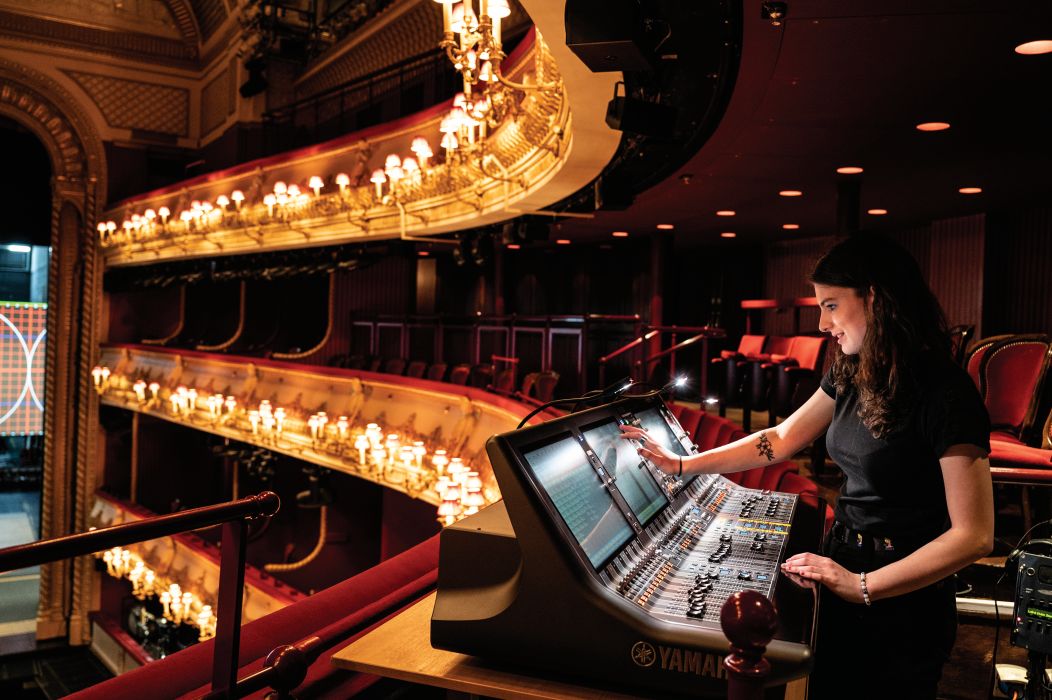 Former apprentice Holly Bell now works in the sound department (Photos by Sim Canetty-Clarke)
Daniel Bugden, 20, a props carpenter technician apprentice who is currently working on a Chernobyl-themed control panel, struggles to find the words. “It’s hard to say. I felt very passionate, definitely very accomplished.” He later adds: “It’s definitely a moment.”
But not every apprentice works directly on the stage. Grace Greenfield, 20, works as an apprentice archives assistant and is grateful that there was an option for her other than university.
It is clear to see Greenfield is in her element, as she naturally rattles off facts and figures about her role, which involves handling photographs, playbills, programmes, negatives, props and even costume collections. She explains how the archives sit across three stores in different locations: one in the Royal Ballet and Opera in London’s Covent Garden; one in Purfleet, Essex; and another in so-called DeepStore that operates from a former salt mine in Cheshire.
Greenfield also easily recalls the opening date of the Royal Opera House in 1732, reflecting that the world of ballet and opera is one that is often seen as elitist and closed off to the public.
She argues that this was not the case many centuries ago: “It was just a musical performance that you could go to, competing with your Shakespeares and everything else out on the market.
“It should be re-examined and maybe seen like that again. The [Royal] Ballet and Opera is trying to do a lot of reputation adjustment to show that it is an accessible art form, and it is just as fun [an] evening out as anything else.”
“What the Opera House is trying to do now is making sure the doors are open to everyone”
Waterman reflects on how they try to break down the barriers between this elitist world and reach the most disadvantaged. “Number one is there’s power in crossing the threshold and, as much as possible, show young people that this is a job backstage, and backstage [here] there’s just lots of skilled people, passionate people. There’s no red velvet or gilt backstage. It’s just a lot of talented people that want to sort of make live theatre happen.”
She also tries “not to lead with the brand”, adding “it is problematic, the Royal Ballet and Opera”. Instead, she emphasises that it is the technicians, electricians, carpenters, tailors that “make ballet and opera”.
The idea that the ballet and the opera are elitist and out-of-touch art forms belonging to another century altogether is something that the industry grapples with, and sometimes finds itself fighting even with those it might hope would be its champions.
Chalamet was met with controversy when he said audiences no longer care about those forms, telling Variety: “I don’t want to be working in ballet, or opera, or things where it’s like, ‘Hey, keep this thing alive, even though like no one cares about this any more.’”
Holly Bell, a former apprentice who now works in the sound department, thinks Chalamet’s assertion reinforces the importance of what the company is trying to do in breaking down barriers: “What’s important, and what the Opera House is trying to do now, is make sure the doors are open to everyone, and try to break down that stigma about the classical world being a bit closed off.”
