Now You Don't: When Espionage Meets Magic
17 min read
Spies and magicians have plundered one another’s box of tricks throughout history but, as Alan White reports, these practised deceivers can’t be trusted to tell the truth about their co-operation. Illustrations by Tracy Worrall
The way he tells it, the great magician was beginning to settle into his retirement when he got a letter he couldn’t ignore. In 1856, Jean-Eugène Robert-Houdin, aged 51, had finally packed up his act, and was to devote himself to his studies and experiments. A glorious future lay spread out before him – free from the stress of performing, he was, in his words, “about to devote myself to my peaceful studies, and enjoy the pleasantest existence man ever had on earth”.
The year before, he’d been approached by a Colonel François-Edouard de Neveu, the head of the political office at Algiers. The colonel had requested that he perform before the leaders of the Arab tribes there. Robert-Houdin turned down the invitation; he was tired of the stress involved in putting on a show, wishing instead to focus on winning awards as an inventor with his “new applications of electricity to mechanism”.
But de Neveu wasn’t to be dissuaded: he contacted Robert-Houdin for a second time and, this time, the magician decided to go. One reason, he said, was the “quasi political” nature of the visit, the notion he might be able to render his country a “service”. The mission involved undermining the Marabouts; Muslim religious leaders regarded by the local Arab population as “envoys of God”, sent to deliver them from the oppression of Christians.
These men, Robert-Houdin wrote, were “no more sorcerers than I am”, yet would “contrive to influence the fanaticism of their co-religionists”, through the use of tricks upon a populace he described as “primitive”. His task was simple: to show that their tricks were not magic but “child’s play”, so that the French could demonstrate they were “their superiors in everything”.
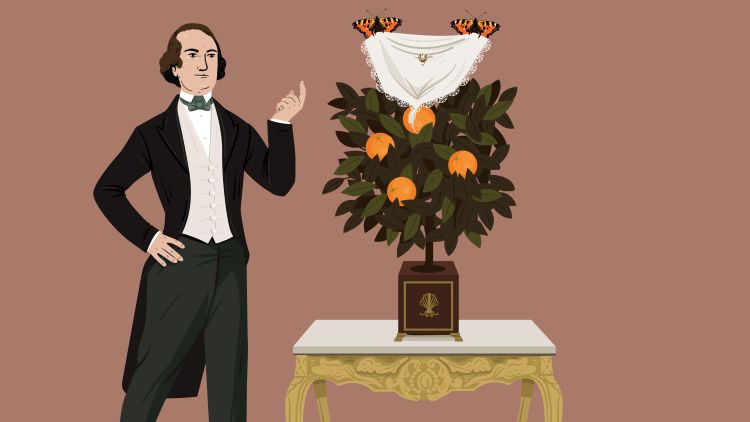
Robert-Houdin was raised in a family that owned a clock-making business. After moving to Paris in adulthood, he’d continued to develop his skills with gadgetry. To understand the man’s work, consider arguably his most beautiful trick, first shown in 1845 at the premiere of his theatre in Paris.
He takes a lady’s handkerchief and places it on a table, alongside an egg, a lemon and an orange. He picks up the handkerchief, rubs it in his hands, and it disappears.
He picks up the egg. The audience know what’s coming; it’s a corny old bit of legerdemain. He’ll crack it open and reveal the object is inside. But he does not do that – instead, he vanishes the egg. He announces that it has gone inside the lemon. He picks up the lemon. It, too, vanishes. Now he picks up the orange, rolling it from palm to palm, showing the audience that it is shrinking. Finally, it is reduced to just a powder. The powder is lit, giving off a blue flame.
Now a small orange tree is brought on stage. It is placed above the flame. Its leaves slowly begin to twist, and spread, and white flowers begin to blossom. With a wave of the magician’s wand, they disappear, replaced by oranges, ever growing in size, until Robert-Houdin can pick them from the tree, and hand them to the audience. The final orange remains on top of the tree. It opens, to reveal the lady’s handkerchief. Two butterflies appear behind the tree and lift the handkerchief by its corners, revealing it to the audience. The magician bows; the curtains close.
Nothing was new – not the sleight of hand, nor less the use of automata. But to blend the three with such elegance, to create a device so intricate: it elevated the art to a new level.
So, the colonel had called upon a man recognised as one of the great magicians of his age. Indeed, he was recognised as such, decades after his death, by the Hungarian-born American escape artist Ehrich Weiss, who borrowed his name to become The Great Houdini.
Robert-Houdin arrived in Algiers in mid-September, lodging with his wife in the palatial surroundings of the Hôtel d’Orient overlooking the Government Square, where he and his wife would sit under the magnificent orange trees, the cool sea breeze wafting over them, as they took in the salad of nationalities that was Algiers at this time. Soon enough, a “military summons” was sent to the chiefs of the tribes. Robert-Houdin described:
“The native camp, an inextricable pell-mell of huts for men and horses, offering a thousand contrasts, strange as they were fascinating; the brilliant cortège of the governor-general, in the midst of which the Arab chiefs, with their stern faces, attracted the eye by the luxury of their costumes, the beauty of their horses, and the brilliancy of their gold-broidered trappings”.
He was to perform at the small Algiers theatre. The Arab chiefs, unused to the setting surroundings, were seen “fidgeting about for some time, and trying to tuck their legs under [their seats], after the fashion of European tailors”.
The audience sat in stony silence. It unnerved Robert-Houdin, more used to the buzz of an audience expecting entertainment. Soon the audience came to life, after he produced cannonballs, then a bouquet of flowers from a hat. Next, a seemingly empty silver cup, which magically filled with sweetmeats, and then boiling coffee, which he poured into cups for the spectators.
These were the entrées. Now it was time for the main event. Robert-Houdin approached the Arabs and, speaking through a translator, said: “From what you have witnessed, you will attribute a supernatural power to me, and you are right. I will give you a new proof of my marvellous authority, by showing that I can deprive the most powerful man of his strength and restore it at my will. Anyone who thinks himself strong enough to try the experiment may draw near me.”
And so a muscular man approached the stage. Robert-Houdin asked him if he was strong. He said he was.
“Are you sure you will always remain so?”
“Quite sure.”
“You are mistaken, for in an instant I will rob you of your strength, and you shall become as a little child.”
Before him, there was a box. Robert-Houdin told him to lift it up. He did. The Arab asked if that was it. Robert-Houdin made a magical gesture, and asked him to lift it again. He grabbed it again, and tugged at it. This time it wouldn’t budge an inch. He grew increasingly angry, and tired. Panting for breath, he broke away, and then returned to the box, the audience cheering him on.
Robert-Houdin described what happened next: “But, wonder of wonders! This Hercules, a moment since so strong and proud, now bows his head; his arms, riveted to the box, undergo a violent muscular contraction; his legs give way, and he falls on his knees with a yell of agony!”
The shocked participant sprinted out of the theatre, yelling “Allah! Allah!” There was no rapturous applause; instead there was silence from the assembled audience, punctuated by the odd murmur of words like “Shaitan” and “Djenoum!”
It is widely understood the trick was carried out through his characteristically cunning use of technology: a powerful electromagnet, hidden under the stage. Further tricks followed; a bullet catch, a disappearing assistant and more.
“The blow was struck,” wrote Robert-Houdin. “Henceforth the interpreters and all those who had dealings with the Arabs received orders to make them understand that my pretended miracles were only the result of skill, inspired and guided by an art called prestidigitation, in no way connected with sorcery.”
That’s how the story goes – pretty much as he told it – and as repeated in dozens of books about the history of magic. But, as is not unusual when it comes to magicians’ biographies, elements of it have been exaggerated. There doesn’t appear to have been any imminent uprising, and if his show had any effect on the politics of Algeria at the time, it wasn’t significant enough to be worth recounting in other historical accounts of the period. In the words of one historian: “He performed his show, and nothing happened.”
It doesn’t matter. Stories are what matter. And Robert-Houdin knew how to tell a story that would stick.
Over 150 years later, in mid-2013, Edward Snowden, an analyst working at the American National Security Agency (NSA) contractor Booz Allen Hamilton, told his bosses he needed time off to deal with a health problem. He flew straight to Hong Kong, where he started to leak thousands of classified files that he’d taken from the NSA to a group of journalists.
The documents were a bombshell. Not only did they reveal the secrets of the NSA’s inner workings; Snowden had taken files belonging to Australian, British and Canadian agencies via the Five Eyes network. They revealed how secret treaties had enabled the agencies to intercept data, how data was being obtained from telecommunications companies; how diplomatic missions were spied on; how internet providers were conspiring with the intelligence agencies, and so on.
One series of slides revealed the existence of a unit in Government Communications Headquarters (GCHQ) called the Joint Threat Research Intelligence Group (JTRIG). The unit, we learned, had initially existed to defend British networks but had, since 2012, gone on the offensive against Britain’s enemies, ranging from computer hackers to hostile nations. Much of JTRIG’s work involved cyber attacks – for example, we learned it had targeted the hacking group Anonymous with exactly the same kind of Distributed Denial of Service (DDoS) attack the group itself had popularised. In Afghanistan, it had disrupted Taliban communications by swamping them with texts, calls and faxes.
But the other strand of its work involved the aim “to manipulate online discourse”. The unit would use “online techniques to make something happen in the real or cyber world”, a practice known in GCHQ as ‘Online Covert Action’. One slide, for example, was headlined “discredit a company”. It said JTRIG would “leak confidential information to companies / the press via blogs etc”. The unit would “post negative information on appropriate forums”, and “stop deals/ruin business relationships”. Intelligence sources said they did this to stop weapons deals and nuclear proliferation.
The JTRIG could send mass emails, place information on compromised computers, fake text messages, change the results of online polls, change people’s social media photos, mount false flag operations, send unpleasant information about people to their family and friends, and so on – targeting individuals, governments, and everything in between. It could spy on journalists, and use sex to lure people into honey traps. Activists were appalled to see that their activities seemed to extend beyond threats to national security and into the realm of standard law enforcement.
One of the unit’s training presentations was obtained by Snowden. It was entitled: The Art of Deception: Training for a New Generation of Online Covert Operations. The presentation was all about how human beings could be manipulated. On one slide, entitled “Gambits for Deception”, a chart listed different actions across the headings of “Attention, Perception, Sensemaking, Affect, and Behaviour” – under “Attention”, for example, were a number of techniques with which sleight-of-hand artists would be familiar: “the big move covers the little move”, “the target looks where you look”, “repetition reduces vigilance”.
In fact, the entire document was suffused with magic. One of the first slides was a picture of a magician springing a deck of cards, and under it: “We want to build cyber magicians.” The next few slides were devoted to “Magic Techniques and Experiment”.
And shortly after that? A slide showing a picture of Robert-Houdin, and a description of his trip to Algeria.
It’s no surprise that spycraft and magic should be seen to overlap throughout history; both of them make liberal use of deception and illusion, of the disappearance of evidence, disguises, misdirection and more. Yet this overlap is also often exaggerated.
Go back to Elizabethan times, and take the life of John Dee; astrologer, mathematician, occultist, alchemist, confidant to Queen Elizabeth and spy. A persistent internet myth claims he signed his letters to the Queen ‘007’ (apparently symbolising the Queen’s eyes, and the alchemist’s lucky number), a sobriquet which was ultimately borrowed by Ian Fleming. The further one digs, the less evidence there appears for this.
Another apparent James Bond inspiration, William Melville, who helped found MI5, has been alleged by some historians to have recruited no less a figure than Harry Houdini as a spy. The claim is disputed; and is offset by other unverified claims that he was a spy not for Britain but for America.
By the Second World War, however, we find what appears to be a more robust example. The story goes that Jasper Maskelyne, a famous stage magician, was recruited to help deceive the Nazis.
Maskelyne was the grandson of the great Victorian magician John Maskelyne and son of Nevil Maskelyne. In 1940, he was added to a small team being trained in the art of camouflage at Farnham Castle. He was then posted to Egypt for the North Africa campaign. He was assigned a job of running an experimental station in Egypt, which was where, so the story goes, he came up with some of his most ingenious illusions to deceive Adolf Hitler. The Daily Mail ran a story in 1941 about how he’d use his magic to render troops invisible.
His subsequent book, Magic: Top Secret, described, among other schemes, a searchlight with whirling mirrors attached to it; 100 of these were designed to render the Suez Canal invisible. Another scheme would see the entire city of Alexandria recreated using decoy ships, ground lights and explosive charges to draw the Luftwaffe away.
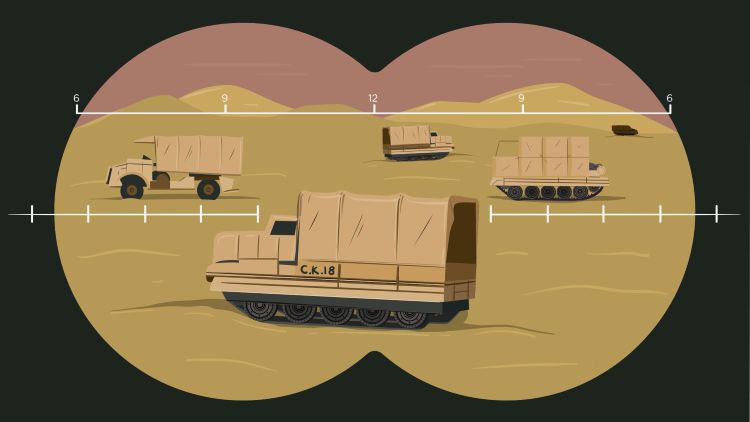
The truth was that only one searchlight was built, and the fake Alexandria never came to pass. Maskelyne’s real role involved helping Britain’s true master of war deception, Dudley Clarke, in smuggling maps and knives to prisoners of war; it appears he was primarily used in that capacity. In his defence, he was responsible, it seems, for one major deception: he devised a way in which tanks could be disguised as supply trucks, which had a significant positive impact on British deception efforts ahead of the battle of El-Alamein. But he actually only spent a year in the camouflage unit before taking up a role far more suited to his skills: entertaining the troops.
Like Robert-Houdin, however, the story stuck.
Not all of the overlap is exaggerated. A few years later, in 1953, the CIA hired John Mulholland, in order to create a manual later republished as The Official CIA Manual of Trickery and Deception. It included chapters on the handling of tablets, powders and liquids, the removal of objects (including, for example, how to put a dab of wax on the side of a briefcase to surreptitiously pick up papers on a flat surface or desk).
The historian Robert Morton describes how, thanks to Mulholland’s guidance, “In the middle of a tense exchange with a Soviet agent, [a CIA agent] dropped a coin on the floor. While the Soviet’s gaze was down, [he] quickly passed a microfilm to his contact.” Away from these close-up style tricks, the manual provides illusions more suited to stage performance, like converting a getaway vehicle into a magical box in which an escaping agent could be stowed. It was thought to be destroyed (it was one of the few unproblematic parts of the controversial MK-Ultra project, which investigated mind control), but copies later resurfaced.
Tony Mendez, the CIA’s former chief of disguise, was also on record as being inspired by magicians in how he chose to use a variety of intelligence operations during the Cold War, sneaking six Americans out of Iran by disguising them as a Hollywood film crew, an audacious plan that made for a successful blockbuster, Argo, starring Ben Affleck.
The magician and historian Jim Steinmeyer has described how Mendez’s deception worked “because the stage had been beautifully set and the scene masterfully presented. It was a demonstration of Kellar the Magician’s famous boast that, once he had an audience under his spell, he could ‘march an elephant across the stage and no one would notice’”.
The truth is that if magic serves as an inspiration for today’s spies, another form of similar but less showy manipulation, which also had its golden era 100 years ago, holds greater sway. We are describing the propaganda techniques born of the Great War, which were subsequently adapted by the corporate world.
JTRIG, mentioned early on, is not the only division of the British government that focuses on the art of deception. On 19 June 2017, a terror attack took place in London. It was the fourth such attack in Britain that year – but unlike the first three, which had been led by Islamic extremists, this one was perpetrated by a recent convert to the far right.
Darren Osborne, a 47-year-old father of four from Cardiff, drove a white van into a crowd of pedestrians close to Finsbury Park mosque. Ten people were injured, and one, Makram Ali, died at the scene. It was widely reported that Osborne was held down and beaten by people at the scene, until an Imam appealed to them to stop.
In the wake of the attack, the hashtag #WeStandTogether appeared on Twitter: it was shared by prominent politicians, police commanders and police forces’ Twitter accounts, the London Fire Brigade and more. Regular social media users joined in, expressing their distaste for hatred born of any kind of extremism. Two years later, the investigative journalist Ian Cobain uncovered a stunning backstory about the way the narrative after the attack had been deliberately constructed.
First, there was the Imam who protected Osborne from violence on the part of the crowd. There is nothing to suggest this didn’t happen. But Cobain learned that journalists who’d reported on the story had been approached at the police corden by a woman called “Gabbie”, who said she worked for a company called “Horizon PR”. She had offered to introduce them to a man called Shaukat Warraich, who explained he was from an organisation called Faith Associates. “It was he who stressed to the journalists the role that the mosque’s Imam had played in protecting Osborne until he could be handed over to police,” Cobain reported.
As Cobain revealed, it was all the work of a team within the British Home Office. Horizon PR, the apparent workplace of “Gabbie”, was created by Breakthrough Media, a communications company in London. And Breakthrough Media was operating under a contract with the Home Office’s Research, Information and Communications Unit (RICU).
This contract was to create pre-planned social media campaigns, designed to look like a spontaneous public response to terror, in order to maintain social cohesion and encourage people to feel empathy rather than anger. According to Cobain, the plans were designed to “corral the Princess Dianaesque grief” that appeared after an attack.
Cobain reported that RICU’s plans had been deployed during every terrorist incident in recent years. They included “I ‘heart’” posters being designed and distributed, according to the location of the attack, and plans drawn up for people to hand out flowers at the scene of the crime”.
The plans, he reported, had been drawn up piecemeal – they dated back not only to the 2012 Olympics, but the previous year “when social media platforms were aiding communications between protesters during the Arab Spring – and when a series of riots were erupting in towns and cities across England”.
After the British aid worker Alan Henning had been decapitated by ISIS in Syria in 2014, RICU had, through Breakthrough Media, been responsible for planting an image of a woman in a Union Jack hijab on the front page of The Sun newspaper.
RICU, Cobain learned, had been deploying its campaigns after every terror incident in recent years, including the 2017 attack on London Bridge by three Islamic extremists, when a team of men in an unmarked van had “plastered walls with a number of posters bearing images of London, and number of hashtags that were already circulating on Twitter: #TurnToLove, #ForLondon and #LoveWillWin.”
A source told him: “A lot of the public’s responses are spontaneous, of course. But a lot are shaped. The [British] government doesn’t want spontaneity: it wants controlled spontaneity.” Years later, PoliticsHome revealed RICU had even gone so far as to create a fake boy band to sing anti-extremism songs in schools with a high number of Muslim pupils.
The future of deception in espionage, one suspects, will take its inspiration less from the lessons offered by Robert-Houdin, and rather more by those offered by Edward Bernays.
