'No Longer A Distant Frontier': How Can Britain Compete In The 'Battlefield' Of Space?
Illustration by Tracy Worrall
7 min read
As hostile states seek to expand their reach in space, how can the UK defend its infrastructure? Noah Vickers reports
In early October, UK space commander General Paul Tedman issued a stark warning. Russian probes are stalking British military satellites in an attempt to collect data from them, while Moscow is also using ground-based systems to jam the UK’s satellites on a weekly basis.
It was a disclosure that offered a rare glimpse into the technological arms race unfolding above our heads, as hostile states search for vulnerabilities in the web of space-based infrastructure on which the West relies.
“It was always a mistake to believe the ‘space race’ was over,” says James WE Smith, a research fellow at King’s College London’s department of war studies. “The space domain, like any other, is just a place in which nations can seek to gain some form of an advantage over another state – whether that be economic control or military power.”
The threat to the UK’s space infrastructure is not unique. Just days before Tedman’s comments, German defence minister Boris Pistorius revealed that satellites used by Germany’s armed forces – operated by US-Luxembourg firm Intelsat – were being similarly shadowed by the Russians.
The tactic – which involves an element of plausible deniability from Moscow – is the same kind of “sub-threshold activity” and “testing of boundaries” that Russia is known for in its military operations on Earth, says Juliana Süß, an associate fellow at defence think tank Rusi.
Space is tied to the China dream. This is not something they’re doing on the side
While Tedman has said Moscow poses the most immediate danger to the UK’s space assets, Süß argues that Russia is “definitely descending” as a space power, as much of its equipment has become outdated. She points instead to China’s growing capabilities in orbit.
“China has thrown everything they have up into space. They’ve invested massively. They’ve kept to all of their timelines that they’ve set themselves over the last 35 years or so,” she says.
“For them, space is tied to the China dream. This is not something they’re doing on the side, it’s not like a luxury item they’re adding to the list… This is something they care about hugely, so obviously they are very much capable of grabbing satellites and putting them in a different orbit, which is all very impressive – and potentially dangerous to us.”
Yet despite these capabilities, kinetic attacks on satellites remain rare – partly because the level of risk involved if any debris is created as result.
“Both sides are averse to matters in space spiralling out of control into classic kinetic warfare, because of the potential military and civilian impact that escalation in space can have on all sides,” says Smith. “In short, it can backfire on the aggressor.”
Instead, hostile states are developing sophisticated methods to spy on western space assets or disrupt their operations remotely. Experts believe these tactics, which stop short of open conflict but are useful in providing intelligence or demonstrating muscle, will become increasingly common.
“If you have a national security asset up in space, you’re quite likely to have Russian and Chinese satellites coming up a little closer to take a look – trying to photograph it, trying to gauge what it does,” says Süß.
Signal interception will also become a more regular threat to everyday space operations, and as those technologies grow more advanced, the UK and its allies will be forced to consider more innovative methods to securely transmit information.
“We’re now talking about inter-satellite links – lasers going back and forth between satellites instead of signals to try and bring information across, because those are a lot harder to intercept,” says Süß. “You’d have to physically get in between those satellites to intercept that signal – which is, in itself, not impossible, so we’re probably going to have to find something new in a couple of years, again.”
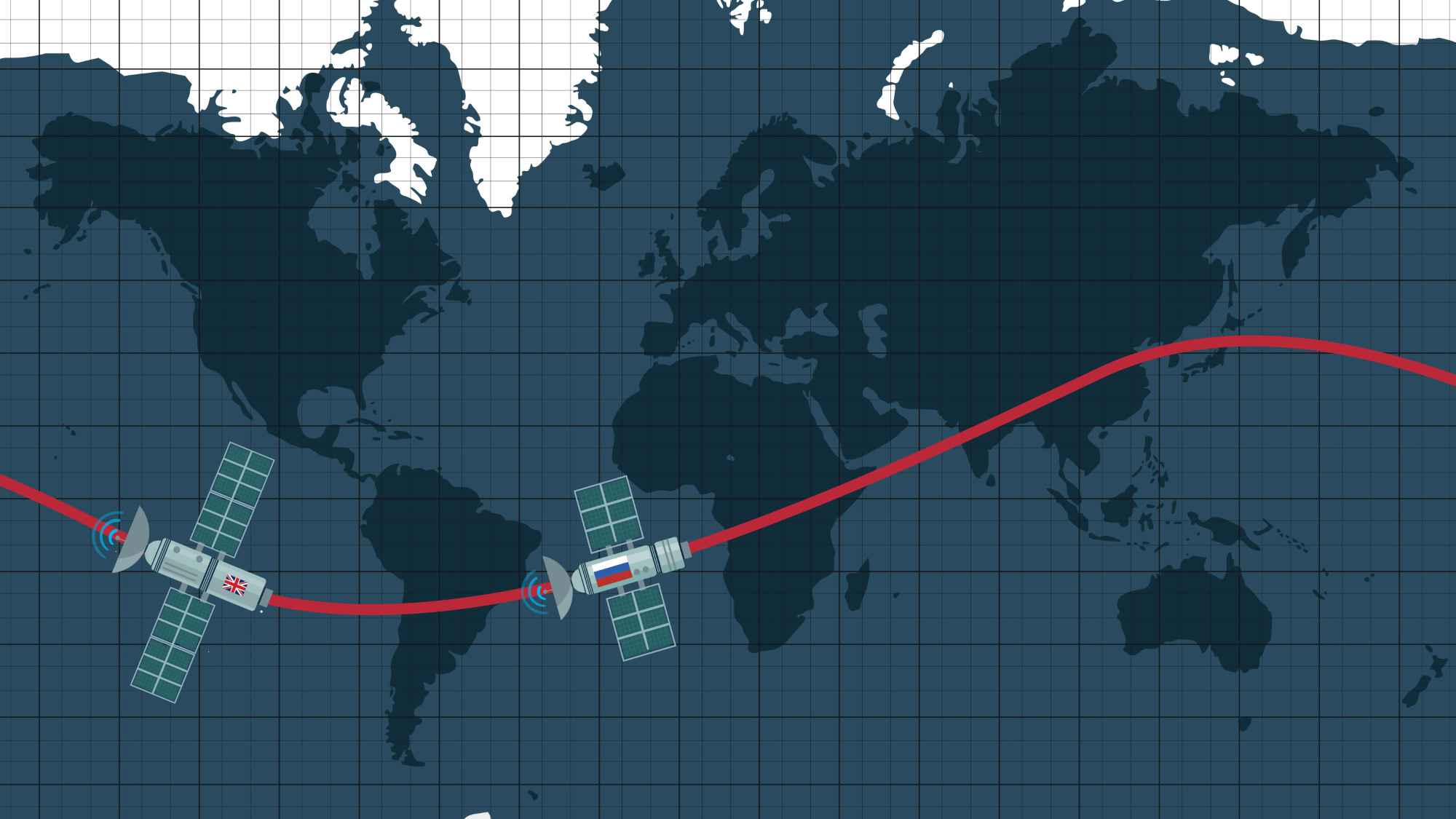 Illustration by Tracy Worrall
This “cat and mouse game”, where each side is continuously developing a new counter-measure against the other, will be a defining feature of space defence over the coming years, Süß argues. “I wouldn’t say the gloves are off completely, but I do think we’re seeing some of those behaviours become more overt.”
Space is also becoming a more commercial arena, as private companies are increasingly getting their own satellites into orbit. On the one hand, this presents opportunities for countries like the UK, as it can provide them with fresh capabilities which can be harnessed much more quickly than building satellites from scratch.
Yet there are also concerns that commercial satellites are being leveraged by hostile states to make up for gaps in their own capabilities. The Atlantic magazine last year reported that Russia may be using satellite imagery provided by American companies, in order to precisely aim its long-range strikes on Ukraine.
The UK has only half a dozen military satellites providing communications and surveillance, while the US, China and Russia each have more than 100. Yet there are signs that Britain is working to build up its resilience in space.
While the last Conservative government’s decision to spend £400m on a stake in bankrupt satellite firm OneWeb was criticised at the time as a dangerous gamble, Labour invested a further £140m into the project in July this year. Under an agreement signed following that investment, OneWeb capacity will be used to provide high-speed connectivity for British embassies around the world, as well as disaster response teams working in remote locations.
When it comes to GPS, the UK primarily relies on the US and, since leaving the EU, no longer participates in Europe’s Galileo satellite network. If the UK were to suddenly lose access to GPS, say for 24 hours – whether due to severe space weather, a technical failure or attack from a hostile state – it would suffer a £1.42bn hit to its economy, according to a 2021 assessment published by the government.
In preparation for such an event, the government has put out a ‘pipeline tender’ for SMEs interested in building an Enhanced Long-Range Navigation (e-LORAN) system. This would consist of ground-based radio towers, which would provide a back-up option if GPS went down.
The government believes this system would be much harder for countries like Russia to jam, and as it would use low frequency bands, its signals could also be transmitted into areas that satellites cannot always reach, such as rooms underground.
In July, to tie in with President Emmanuel Macron’s state visit, the government suggested that the e-LORAN project would be among several on which British and French researchers could collaborate – dubbed the Entente Technologique.
Space is no longer a distant frontier – it is a present-day battlefield
Yet while the UK spends just one per cent of its defence budget on space, France spends three per cent, and the US spends five per cent. In an interview with The House earlier this year, Tedman made clear that Britain has “got to do more if we’re going to have nationally separable capabilities”, though he would not say what proportion of the budget is needed.
In Parliament, this message appears to be filtering through, as Tan Dhesi, chair of the Defence Select Committee, says he and his cross-party colleagues have “heard evidence that the UK is lagging behind our allies and peers in terms of military space investment”.
The Labour for MP for Slough tells The House he is “very concerned” about the issue, adding: “Space is no longer a distant frontier – it is a present-day battlefield. The UK government must unlock our country’s potential in space defence innovation, keeping pace with other advanced nations and reflecting the growing complexity of the threats we face.”
