"We Are The Cavalry": Shiv Malik's Plans To Build A New City Near Cambridge
Artist’s impression of a Forest City
6 min read
Critics dismiss it as a fantasy but Shiv Malik’s plans for a huge new city outside Cambridge has attracted some credible backers. Ben Gartside explores whether Forest City will ever leave the drawing board
“If you want my secret trick,” Shiv Malik teases, “I ask for an impossible task.”
The former journalist, now would-be developer, is trying to build a new city for a million people, and has been working on his skills of persuasion.
Forest City, as Malik and his co-founder Joe Reeve have dubbed the project, is the most ambitious British infrastructure project in a generation. The plan is for the city to be east of Cambridge, and to consist of 400,000 new homes and 18,000 hectares of land developed.
Malik’s stated goal is to combat the housing crisis, which he holds responsible for Britain’s lost growth and pessimistic outlook. Though, as of today, Malik has neither land for the project nor planning permission, and minimal local support. It’s also his first attempt at a development of any kind and the project would require support from Whitehall to stand a chance of success.
The pair are undeterred by their many detractors and present themselves as warriors in the cause of intergenerational fairness. Reeve has said of the naysayers, “The cavalry aren’t coming. We are the cavalry.”
“The journey started for me when I wrote Jilted Generation,” says Malik. “That was in September 2010, and just before the student riots. In that book, what we said [was] if we didn’t sort housing and infrastructure, the country would be much worse-off.
“We were proven right on that – and there was a shrug about it being so. I don’t think people comprehend that in 150 years of economic history this hasn’t happened before. Britain’s lack of housing is an abomination and an existential threat and I got tired of talking about it and wanted to do something.”
The plans are ambitious but lack clarity. Alongside housing, the proposal includes a reservoir and small modular nuclear reactors. In marketing material, luxurious mansion blocks are pictured on empty streets, as are modern timber buildings in pedestrianised areas, intersected by tramways and cycle paths.
He excitedly discusses passenger drones as a possibility for transport, but is less clear on how the project comes about on the ground.
And yet Forest City has some high-profile backers on its advisory board. These include former health secretary Patricia Hewitt, who also happens to be Malik’s mother-in-law. Malik tells The House that the board does not receive any money directly for their work, but will get a “very tiny equity stake” in the project.
He recently managed to persuade Paul Johnson, the former Institute for Fiscal Studies director, to join the advisory board after he completed his impossible task of getting more people with direct experience of development involved. To cajole Jackie Sadek, an influential voice on urban development, he convinced one landowner to support the project. One down, thousands to go.
Despite ticking off some of his impossible tasks already, he has many more ahead of him. Given the project’s 32-year planned timeline, it could well be the 45-year-old’s last too.
The odds seem stacked against success – the project needs to raise £250m in capital from institutional investors in the next two years. Nick Timothy, the local Conservative MP, initially ignored the project, labelling it “ridiculous”, but has begun to organise politically against it.
“Nick Timothy writes about building new towns in the south, but when someone proposes it in his area he says ‘No’,” counters Malik. “Everyone knows a local MP is going to oppose a development in their area, so no one pays attention any more.”
But even former supporters have grown frustrated at the frequent changes to the plan.
“There are definitely not rigid plans – there can’t be,” Malik justifies. “For us, one of the most central things is the cost of a house. Excluding the land costs, where we already have an advantage, can we build a four-bed house for £350,000? The rest of the market is saying, ‘No way’, we think we can. Those things are quite fundamental.”
“Britain’s lack of housing is an abomination and an existential threat”
While the pure numbers sound like a great investment opportunity, it comes with a very heavy caveat. As part of the agreement to buy, a complex financial structure would mean buyers would not be able to profit from future sales.
Currently, the arrangement would render mortgages far more complex in the million-person city complex. Simon Dudley, the former interim chair of Homes England, and briefly Reform UK’s housing and infrastructure spokesperson until his sacking, labelled the project a “recipe for disaster” and raised questions about the land value structure’s impact on mortgages.
Malik acknowledges the existing problem, but believes it can be overcome. “Nationwide already has a mortgage for community land trust housing, it’s not quite the product we need but we’ll get there.”
In spite of his grand plans to revolutionise mortgages, cities and British development, he says his role currently is more akin to that of a door-to-door salesman, albeit selling the biggest urban development in the UK since the Second World War.
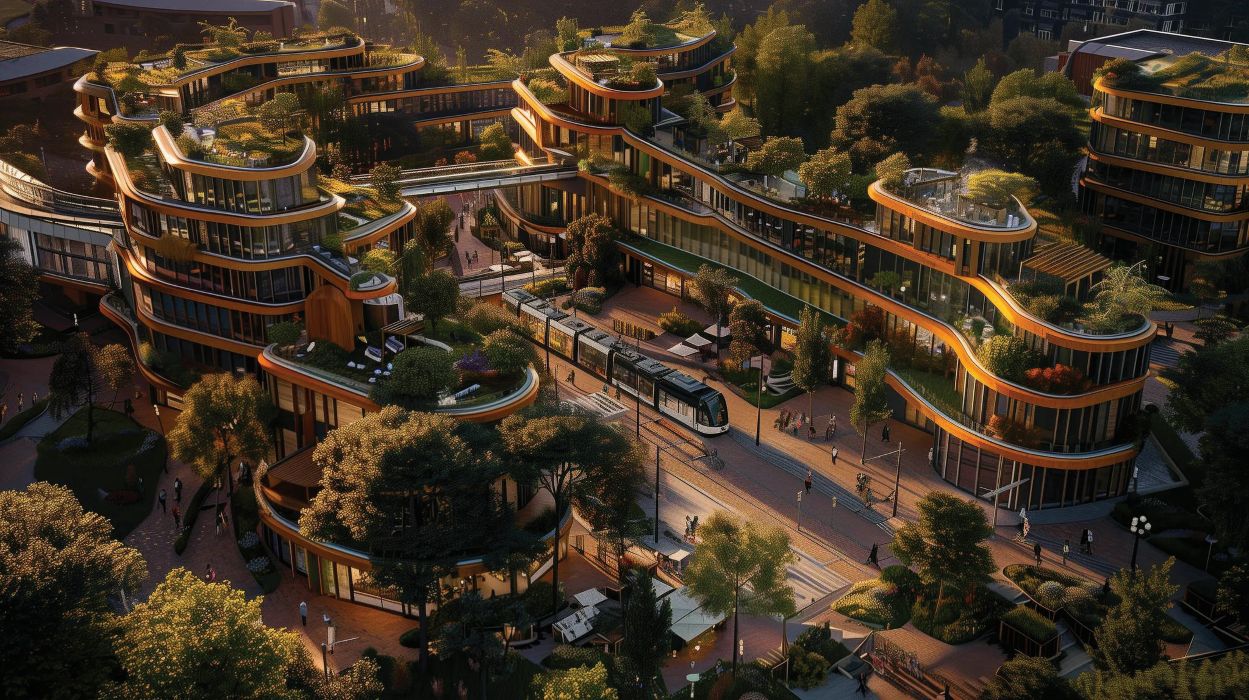 Artist’s impression of a Forest City
“Most of my job is going house by house in a village, they’ll make cake and we’ll talk for two hours and they say, ‘I get why you’re doing it, I just don’t want it here’ – most private developers don’t do that.”
While his attempts to persuade locals and get answers might be regarded as admirable, he leaves the door open to pressing ahead without agreement.
“It is a bit of a dead end… really, then, it’s about… where do we draw the line on democratic consent?
“If you own the land and everyone has a veto, then everyone vetoes it. People in villages know the extent of their remit, and it is a much larger project. It’s a difficult trade-off and it’s one that should be compensated, and you don’t want to get miserly on,” he says, adding another few columns on an ever-inflating mental spreadsheet of potential costs.
As the project develops, political support becomes more important.
He outlines a thesis of how the development is in tune with the sort of politics Andy Burnham has championed in Manchester.
“If the next prime minister is Andy Burnham, what he’s talking about is what Forest City should deliver – place-based politics, thinking about the fundamentals. How to do this differently in a globalised world in a place owned by distant shareholders.”
“We’re very close at this point to moving to phase two – and we must give investors enough confidence that this is a seriously considered project,” he outlines. “At that stage, we need to raise £250m within two years. We need to demonstrate we’re not just stuck in the planning world and that good enough is good to go.”
If successful, the project will likely take more than 30 years to complete, at which point Malik will be in his late 70s. He hopes to be retired by then and living in Forest City.
