Tribute to Lord Taverne: the resilient rebel who was 'too hot to handle'
Dick Taverne: 18 October 1928 – 25 October 2025 | Image courtesy of UK Parliament
7 min read
In becoming the first post-war independent victor of an English by-election, Dick Taverne helped break the dominance of the main parties in 1973. Words by Thomas Chidwick
in March 1973, Westminster was rocked by one of the most significant by-elections in Britain’s recent history. After over a year of “local difficulties” and “irreconcilable differences” with his constituency party – which deselected him for supporting Britain’s entry into what was then called the Common Market – Dick Taverne, the former Labour MP for Lincoln, stormed to victory by over 13,000 votes as the Democratic Labour candidate.
To his supporters, Taverne’s victory over his replacement as the Labour candidate and the national leadership marked the start of a new force in British politics. It was the first time that an independent candidate had won a by-election in England since the Second World War and demonstrated that an independent could overcome the main parties’ long-standing ‘“bully boy” right to sort out who rules Britain without interference from outsiders. One newspaper borrowed Bruce Forsyth’s catchphrase to proclaim, “Didn’t Dick do well!”, while another led with a photo of Taverne skipping past Lincoln Cathedral under the headline, “Rebel Dick gets that happy feeling”.
Taverne was born in a jungle house on stilts in Sumatra to Dutch parents in October 1928. His father, Nicolaas, was a “deeply conservative man” and a professional geologist for Royal Dutch Shell and the family migrated to England in 1939, before Indonesia fell to the Japanese and Holland was invaded by the Nazis. When his mother, Louise, and Nicolaas returned to the Netherlands in 1946, Dick Taverne – who had won a scholarship to Charterhouse School in 1942 – remained in England and became a naturalised British citizen in 1949.
While the Old Carthusian Hugh Trevor-Roper once described Charterhouse as a “thought-free zone”, Taverne was clever and curious and flourished at such a “tolerant and broad-minded” institution, which left him with a “life-long zest for learning”. His contemporaries included “the strange, tall, bespectacled”, “clever eccentric” and future editor of The Times William Rees-Mogg and Peter May, one of England’s most prolific and stylish batsmen. In his elegant 2014 memoir Against the Tide, Taverne recalled batting with May against Eton College, when he made an undistinguished eight runs at one end while May scored a comfortable century at the other.
After Charterhouse, Taverne was educated at Balliol College, Oxford, where he obtained a first-class degree in philosophy and ancient history. Taverne was one of the finest debaters of his generation and was partnered with Rees-Mogg on a speaking tour of the United States in 1951 when the two debated the merits of socialised medicine, the end of the British Empire, Churchill’s return as prime minister and whether the Communist Party of Great Britain should be outlawed. He was narrowly beaten to the presidency of the Oxford Union by the future Liberal leader, Jeremy Thorpe, and forged life-long friendships with Bill Rodgers, Shirley Catlin (later Williams), Robin Day, Keith Kyle, Bryan Magee (the broadcaster and Labour, later SDP, MP) and Ian Gilmour.
After university, Taverne studied for the Bar, worked as a nightwatchman in Oxford Street and taught at Belmont Mill Hill school. After being called to the Bar in 1954, Taverne briefly practised in maritime law, before specialising in constitutional and civil rights cases at Dingle Foot’s Commonwealth Chambers. During this period, Foot was “an ambassador of common law throughout the Commonwealth” and the two men represented “nearly every African nationalist imprisoned by the British in colonial days” and, after the “wind of change” had blown across Africa, regularly appeared for opposition leaders imprisoned by their former clients. They also appeared at the Committee of Privileges of the House of Commons when Anthony Wedgwood Benn, as he then was, tried to renounce his father’s viscountcy in order to return to the Commons as the Labour MP for Bristol South East.
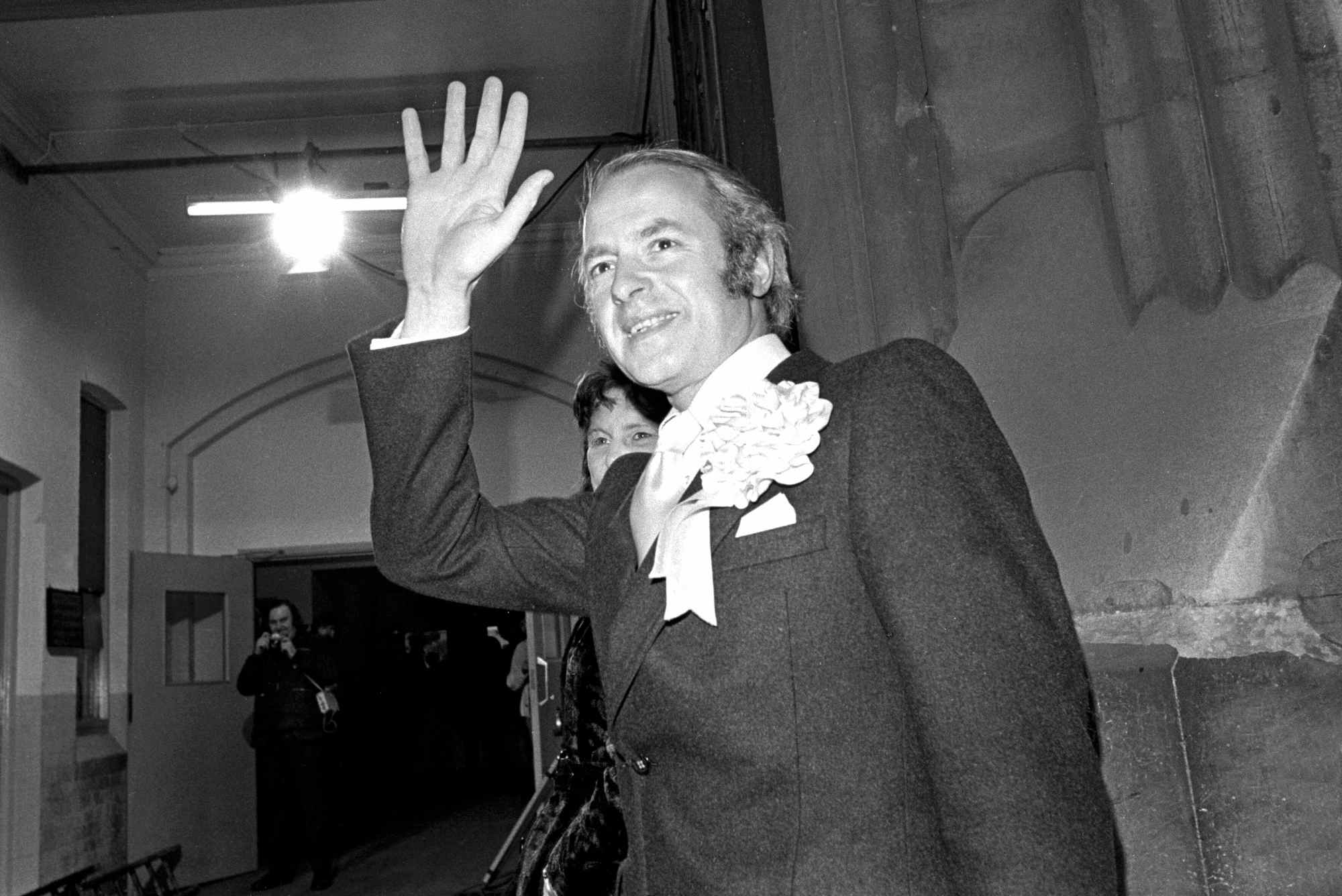 March 1973: Dick Taverne holds on to Lincoln as the Democratic Labour candidate
Image by: PA Images
In 1959, Taverne beat Anne Clark (later Kerr) to the Labour nomination in Putney ahead of that year’s general election and endorsed Hugh Gaitskell’s effort to abolish Clause IV at the party’s tumultuous conference in Blackpool in November. Taverne, who was booed during his speech, joked that the left responded to Gaitskell’s proposal in the same way that a congregation would “if the Archbishop of Canterbury proposed that the Church of England should renounce God”.
Like his mentor, Roy Jenkins, who once described Taverne as his favourite junior minister, Taverne was fluent, amusing and combative
In 1962, Taverne was elected to Parliament after the sitting Labour MP for Lincoln, Sir Geoffrey de Freitas, was appointed as the British High Commissioner to Ghana, defeating the Conservative candidate, Dominic Grieve’s father Percy, who unwisely urged the voters to “Grieve for Lincoln”.
In his early years in Parliament, Taverne helped establish the Campaign for Democratic Socialism – to bolster Gaitskell’s battle against the “pusillanimous” left-wing of the Parliamentary Labour Party – and served at the Home Office and the Treasury during Harold Wilson’s government from 1966 to 1970. While he never climbed higher than financial secretary to the Treasury, he numbered the introduction of the breathalyser, decriminalising private homosexual acts, the reintroduction of prescription charges and decimalisation among his many and varied achievements in office.
Like his friend and mentor, Roy Jenkins, who once described Taverne as his favourite junior minister, Taverne was fluent, amusing and combative and made himself “too hot to handle” because of his unshakable support for Britain’s membership of the European Community. In Lincoln, his refusal to follow Labour’s three-line whip to vote against the European Communities Bill in October 1971 exacerbated long-running “local difficulties” with the Lincoln left, which was led by Leo Beckett who would help his future wife, Margaret Jackson, defeat Taverne in October 1974.
As Taverne later wrote, the Lincoln left “vociferously proclaimed the duty of every MP to toe the party line” and threatened to deselect him if he did not vote against the Conservative government’s attempt to take Britain into the Common Market. Things came to a head during a particularly fiery episode of Granada TV’s World in Action when Taverne told Beckett that, “I take note of your opinions, but I am not a puppet – I do not vote as I am instructed by my party masters.”
While Taverne won the resulting by-election by over 13,000 votes and held his seat at the February 1974 election, his struggle against his “local jihadist management committee” was a precursor to the internal strife of the 1980s when the Militant tendency made life in the Labour Party increasingly difficult for “middle class, legalistic and academic” social democrats.
When Dick Taverne died on 25 October 2025, a week after his 97th birthday, effusive tributes noted the energy and staying power of a man who had entered public life over 70 years ago, had served three political parties and helped to establish both the Institute for Fiscal Studies and ‘Sense about Science’. However, as a new generation of Labour MPs grapple with their own response to both the government’s mounting unpopularity and their unease about its policy programme, Taverne’s example reminds us of the importance of having independently minded MPs with the vigour, shrewdness and elegance of the “Victor of Lincoln”.
A future biographer will stress that his victory was an outlier – both failing to launch a third force in British politics or stopping ‘the rot’ as Labour drifted leftward – but the moral of the story, as Taverne once suggested, could be that “local difficulties” and deselection are not “inevitable political death for an MP who sticks to his or her principles”.
Tom Chidwick runs the Mile End Institute at Queen Mary University of London
