Business must join forces with government and charities to halve violence against women and girls
Kate Osiadacz, Head of Responsible Business
| TSB
Violence against women and girls affects millions – and it’s not a challenge government can tackle alone. With one in five people reporting domestic abuse, businesses must become vital partners in the mission to halve it.
 Click to enlarge
Government’s mission to halve violence against women and girls (VAWG) within a decade is ambitious – and rightly so. But it’s not a mission that can be achieved by government alone. It requires a partnership approach across the public and private sectors.
All businesses, but especially those offering customer-facing services like banks, retailers, utility providers, and transport companies, can play their part in helping the estimated 2.3 million victim-survivors who experienced domestic abuse over the last year.
Employers are uniquely placed to support colleagues experiencing domestic abuse – often providing the only safe space outside the home. By embedding clear policies, offering flexible working, and training colleagues to recognise the signs, businesses can help break cycles of harm.
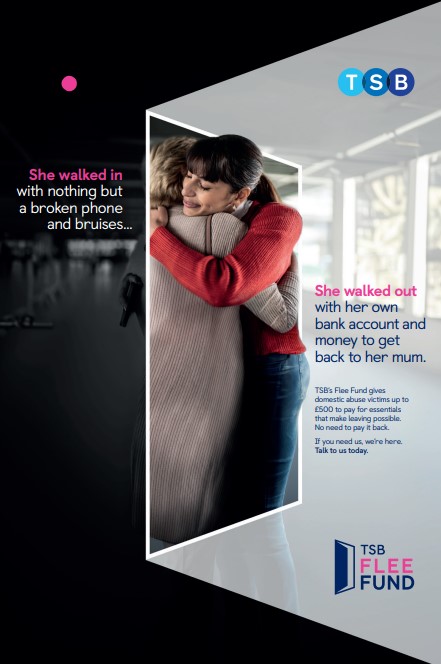
Simple practical, compassionate support can make all the difference. For instance, here at TSB, I’ve been humbled to see the impact that the TSB Flee Fund has had in supporting victim survivors with up to £500 to pay for essentials such as travel, accommodation, and food. Since launching in 2022, it’s been used both by colleagues and customers – through our branches, on the phone, on video banking and our website’s Online Safe Space – to help more than 700 people, with an average payment of £377.
These funds have paid for train tickets, hotel stays, and food – small lifelines that have made a big difference. We’ve also helped survivors open new bank accounts when they lacked the usual documentation – giving people the support they need to regain their financial independence.
But we know that financial support is just one part of the solution. That’s why we made all our branches Safe Spaces, where anyone experiencing abuse can discreetly access help. And earlier this year, we partnered with the Hollie Gazzard Trust to offer free access to Hollie Guard Extra – a personal safety app that turns a smartphone into a 24/7 monitored alarm system. It’s already helped protect thousands of people across the UK.
These initiatives are not just about doing the right thing – they’re about recognising the role that businesses can and must play in preventing domestic abuse. We interact with millions of customers and employ thousands of colleagues. That gives us both a responsibility and an opportunity to act.
Tackling economic abuse must be a central pillar of the government’s strategy to halve violence against women and girls. It is often used as a trap to exploit, restrict, and sabotage the victim-survivor’s financial resources.
Banks like TSB are already offering tailored support for victims of economic abuse through specialist teams, in some cases writing off debts and correcting credit files. And using the Economic Abuse Evidence Form so individuals are believed and don’t have to repeat their distressing story, over and over again.
Victims often face debts beyond the financial sector – including council tax, benefit overpayments, and energy arrears. These can be especially hard to resolve and risk retraumatising survivors. A joined-up approach across banks, public bodies, and utility providers is essential to remove financial barriers and offer fair, compassionate solutions.
I’m pleased to be here at the Labour Conference to talk about the role that we and other businesses can play in helping the government achieve its target of halving violence against women and girls.
We’re proud of the steps we’ve taken – but we know there’s more to do. We stand ready to work with government, charities, and other businesses to help deliver on this vital mission. Because when it comes to tackling VAWG, no one should be left to go it alone.
