Welfare washing: truth on meat labels matters for animals, consumers and farmers
Most people mistakenly believe supermarket labels like 'welfare assured' mean animals have not suffered. Mandatory Method of Production labelling will empower consumers and support better animal welfare in farming.
With bright overhead lighting, flowers at the door and a homely waft from the bakery leading into clean, orderly aisles of products, supermarkets not only invite us in but invite us to trust in their brands and standards.
That trust influences the buying decisions of millions of people, and increasingly, consumers want to shop for products that closely align with their views on animal welfare. But new polling commissioned by Humane World for Animals UK in November 2025 reveals a major gap between what consumers are led to believe about meat products and what the majority of animals endure on intensive farms.
Around two-thirds of those surveyed reasonably, but wrongly, believe that products labelled ‘welfare assured’1 will come from pigs that have not been caged or cruelly killed with CO2 gas.2 That disconnect is at the heart of the labelling muddle.
Labels vs reality
Stepping into an indoor intensive pig farm for the first time, I was physically repelled by the acrid ammonia hanging densely in the air. A lame sow, who had likely given birth to over 150 piglets during the many months of her life she was locked in a cage only fractionally bigger than her body (a ‘farrowing crate’), looked hopelessly at me from behind the bars. She had the word ‘cull’ sprayed in big blue letters down her back, meaning her life of suffering would soon be ended.
This disturbing scene, replicated on intensive farms caging millions of animals across the country, could not be more at odds with the perception offered by meat product labels and adverts. They conjure imaginings of bucolic countryside with animals gambolling across green fields. In reality, the meat industry gives us something else altogether.
Through both propaganda and omission of information, from a playbook disturbingly similar to the one used by the tobacco industry for decades, the industry leads consumers to believe that freedom and high welfare exist for most animals. And in that they are being misled.
UK consumers deserve the truth
UK consumers care deeply about animal welfare in food production. The Food Standards Agency’s latest Annual Animal Welfare Report found that more than 70 per cent of consumers in England and Wales are concerned about animal welfare in the food system, underlining the public’s stake in honest labelling.3
But a lack of both labelling regulation and enforcement of existing advertising laws means it is entirely in the industry’s gift to label meat from pigs born to caged sows as ‘welfare assured’. We believe that needs to change.
So this week in Parliament, we held an event, sponsored by proud family farmer Sarah Dyke MP, together with Compassion in World Farming and The Animal Law Foundation, to build cross‑party support for a transparency agenda that respects and empowers shoppers and drives demand for higher‑welfare farming practices.
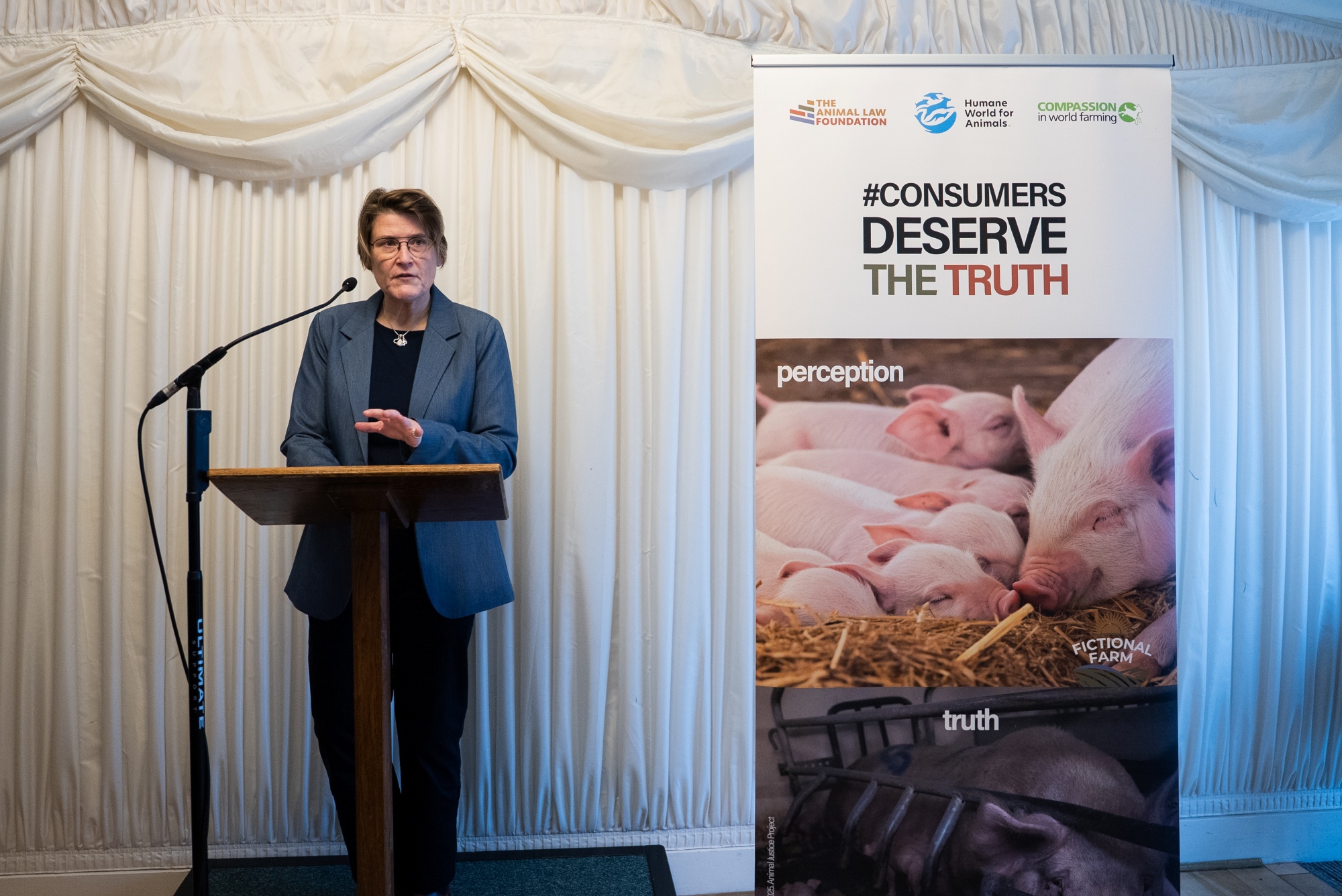 Sarah Dyke MP sponsors an event on transparency in meat labelling.
Animal welfare is too often sacrificed by big agribusiness in the pursuit of profit. But if, as a farmer, you have an ambition to raise welfare standards – to replace your farrowing crates with farrowing pens, for example – what chance do you have of capitalising on the willingness of consumers to pay more for cage-free farming, if the market is already saturated with misleading assurances on cage-produced products?
Mandatory Method of Production Labelling
In June 2024, the Conservative government published a summary of responses to the Fairer Food Labelling consultation, including its recognition of ‘strong support’ for mandatory animal welfare labelling on meat products. A remarkable 99 per cent of respondents to the consultation indicated support for a new animal welfare product labelling law,4 and Humane World for Animals’ November polling revealed that over three-quarters of the public (77 per cent) are supportive.
Defra’s research found that mandatory labelling would help to improve the welfare of 111 million terrestrial farmed animals in the UK and beyond. Defra also quantified the financial benefit such labelling could create for farmers who go beyond the minimum requirements of UK animal welfare laws. The assessment determined that the proposals could increase farmers’ profits by over £46 million a year and deliver a net societal benefit of £140 million over ten years.5
Speaking at our Parliamentary event, MPs emphasised that mandatory labelling must apply to imported products, so that British farmers investing in higher welfare are not undercut by unlabelled, lower-welfare products.
The poll also found strong public support for better enforcement of existing laws, with 75 per cent of respondents agreeing that the Advertising Standards Authority should take action to curb misleading advertisements and brand imagery about animal welfare.6
The government must take action to protect consumers and animals.
The meat industry is not labelling and marketing meat in a way that accurately conveys vital information about the realities of animal agriculture. Lawmakers and regulators must step in and act decisively to provide consumers the chance to make informed buying choices in line with their values.
Tackling welfare washing and ensuring honesty and transparency in the farm-to-fork journey is a vital and urgent first step to drive change for millions of animals. With over 60 MPs in attendance, our event demonstrated a strong cross-party consensus about empowering consumers to drive animal welfare improvements on farms through the products they take to the checkout.
In July, the government said its developing Food Strategy is the start of a ‘proudly patriotic campaign’ celebrating ‘the best of British food’. It is therefore vital that improving animal welfare, a point of national pride, is a key ingredient.
If you would like to know more about our work on misinformation and mandatory labelling, please contact Rob Espin, Senior Manager of Public Affairs at [email protected].
- An own-brand assurance offered by one of the country’s largest supermarket chains
- https://www.opinium.com/polling-tables-archive/
- Food Standards Agency Animal Welfare Report 2024/2025, 7.1: https://www.food.gov.uk/board-papers/animal-welfare-report-202425
- Department for Food, Environment and Rural Affairs ?Consultation outcome: Summary of responses and government response (June 2025): https://www.gov.uk/government/consultations/fairer-food-labelling/outcome/summary-of-responses-and-government-response
- Defra, Fairer Food Labelling Public Consultation Impact Assessment (2024): https://consult.defra.gov.uk/transforming-farm-animal-health-and-welfare-team/consultation-on-fairer-food-labelling/supporting_documents/Fairer%20Food%20Labelling%20Impact%20Asessment%20%20PUBLIC.pdf
- https://www.opinium.com/polling-tables-archive/
