Heathrow, HS2, Homes: How Britain's Infrastructure Projects Will Fare Under Burnham
8 min read
Keir Starmer promised to ‘get Britain building again’ but leaves No 10 with many projects still on the drawing board. Noah Vickers reports on how Andy Burnham might pick up the pace
Andy Burnham inherits a raft of government-backed projects, from a controversial third runway at Heathrow to the massively expensive High Speed 2 rail line, and an ambitious programme of new towns as part of a pledge to build 1.5 million homes before the next election.
As Labour MPs are only too aware, the Makerfield MP’s promise to put “good growth in every postcode” presents an opportunity to change direction on each of those schemes, particularly as he seeks to draw a contrast with his predecessor, Keir Starmer.
On High Speed 2, Burnham has been clear he wants to reverse Rishi Sunak’s decision to axe the line’s ‘northern leg’ to Manchester – though precisely what combination of levers he would pull to pay for it remains unclear.
Ahead of his election in Makerfield, Burnham told the i Paper there is a “cleverer way” of funding the route north of Birmingham, drawing on his experience as the minister who signed off on the funding for London’s Elizabeth line. According to a 2024 report commissioned by Burnham, that could involve money raised from business rates.
“A portion of the net-increase in business rates that is directly attributable to the project (i.e. which would not have been ‘generated’ if the project was not delivered) could be ringfenced over time, and used to repay upfront financing to support the capital works,” said the report, overseen by former HS2 Ltd chairman Sir David Higgins and the engineering consultants Arup.
Henri Murison, chief executive of the Northern Powerhouse Partnership, which contributed to the report, points out that the most expensive parts of the route have already been allocated funding.
“The most expensive bit, which is Manchester Piccadilly underground station through to Manchester Airport, has just been re-branded as part of Northern Powerhouse Rail,” he says.
“So, when we talk about HS2, the thing you’ve got to remember is that the most expensive bit at the bottom and top is still being built. It’s just the relatively cheap bit in the middle that we’re not doing.”
Given that extending the line north of Birmingham would generate a significant increase in passengers, Murison argues that future fare income could be key in helping to pay for the full route.
Burnham has also talked about land value capture as a way of raising funds for it, which Murison believes has been a missed opportunity in the project’s first phase.
“Planning permissions have gone sky-high in Birmingham, the same thing’s happened at Old Oak Common [in west London], but all that uplift in the value of land around the stations and the depots on the route of phase one has been given away by the UK government – and I think that’s scandalous.”
The stage has only been set for restoring the route, he adds, as the land has been carefully safeguarded against attempts to sell it.
“Fundamentally, between the then-chancellor Jeremy Hunt, Andy Burnham, Andy Street, a load of us in the private sector, we have managed to avoid the government and the country doing something really stupid, which was making decisions it couldn’t reconsider…
“That is the real victory. The fact that Andy is one of the people who has been on that side of the debate is obviously a huge help to us when trying to finish the job.”
When it comes to Labour’s housing mission, Burnham inherits a programme of new towns which remains at a relatively early stage. Between March and May this year, ministers consulted on seven proposed sites, with the outcome of that exercise yet to be published.
Sir Michael Lyons, who chaired the taskforce which recommended a shortlist of 12 locations from which the seven have been drawn, is encouraged by what Burnham has said on housing so far.
“Everything that he says points to a further concentration on the housing shortfall in this country and a proper role for government and the public sector in making sure that we move faster towards homes for all,” Lyons tells The House.
“We’ve got a massive task there, years of work ahead of us. It’s not helped by setting targets which you can’t meet. Frankly, the 1.5 [million homes] figure was hope against experience.”
While he acknowledges that the target has prompted “a lot of action” in difficult circumstances, he believes the next PM should replace it with a new 10-year goal, stretching beyond the current Parliament and focused on ensuring authorities meet local quotas.
Burnham’s boosterism, Lyons argues, will itself have a positive impact on confidence in the housebuilding sector.
“We have managed to avoid the government and the country doing something really stupid”
“I do think it makes a difference if the country’s led by somebody who emphasises that you can do things, rather than that ‘it’s all complicated’. That is not to be underestimated, in releasing energy, in releasing innovation and basically building a coalition of people willing to find ways of progressing things faster.”
He also believes Burnham will bring new ways of thinking about funding major developments.
“There’s quite a lot of people talking about the fact that while we are severely limited in terms of public expenditure, that does not necessarily go for long-term investment and that there is scope for government to do more in that area.
“I think we will see Burnham coming forward with sound proposals for patient capital to be invested in housing and infrastructure – I’m fully expecting that.”
While Burnham has promised to devolve new decision making powers to local communities, Lyons warns that this cannot mean allowing councils to “pull up the drawbridge” on new homes.
One of the seven new towns consulted on is at Crews Hill and Chase Park on the northern edge of London. But there, Enfield council’s new Conservative administration has “formally withdrawn” support for the scheme, saying it “reflects the democratic will of the residents we have been chosen to represent”.
As far as Lyons is concerned, Burnham’s government should firmly push back against such resistance, arguing that housing should be viewed through the same prism as defence.
“Defence is an issue of national interest,” he says. “We don’t start debating with local communities whether they want a submarine base on their doorstep. You can’t run the country that way.”
During his taskforce’s work identifying sites, Lyons says that in some cases, he saw “people opposing development in the most offensive terms, really, about keeping out others”.
He adds: “For many more people, it’s about not wanting their quality of life to be damaged by development.
“I think the answer to that is investment in economic and social infrastructure – so that your doctor’s surgery isn’t all of a sudden flooded, your local schools do have enough places to accommodate the homes being built. But this isn’t beyond us, actually. These are things that can be planned for.”
Perhaps most fascinating will be the approach Burnham takes on Heathrow expansion. The scheme, touted by Chancellor Rachel Reeves as a critical growth project, continues to divide Labour MPs, particularly in London, where mayor Sir Sadiq Khan is opposed on environmental grounds.
MPs trying to prevent a third runway are reassured by comments made by Burnham following Reeves’ announcement about the scheme in January 2025, when he told Times Radio that expansion “diverts infrastructure investment away from the North and traps it in London and the South East”.
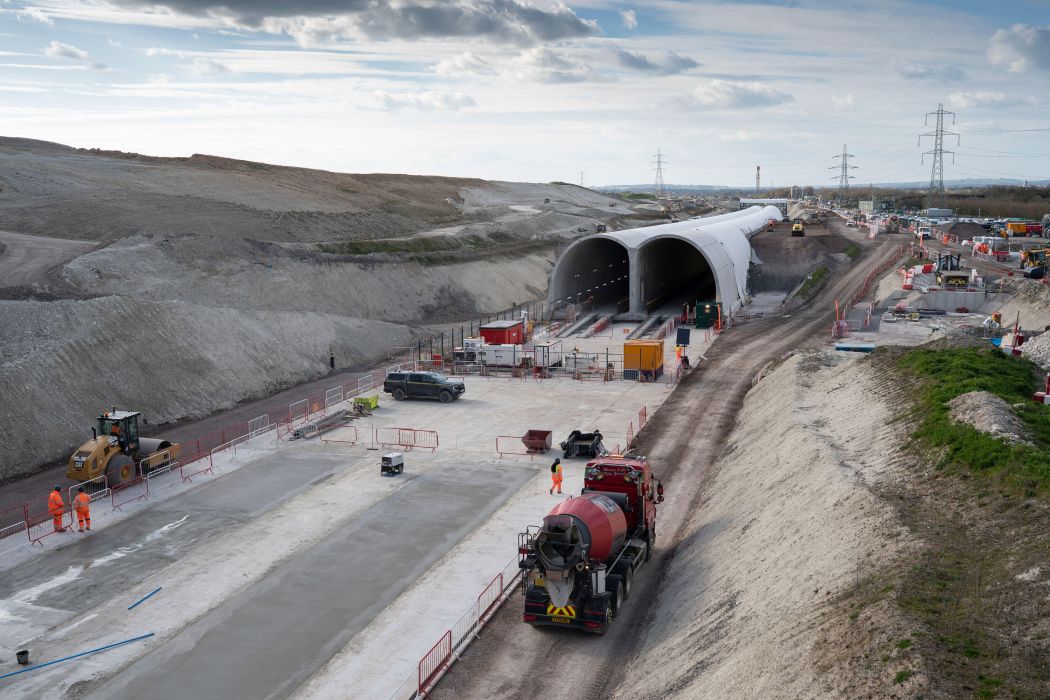 HS2 tunnels at Wendover, Buckinghamshire
Burnham called it “a model for an ever-overheating UK economy, rather than a more balanced, levelled-up economy, which is what we would argue for”.
One London Labour MP tells The House those comments “have not passed us by” and that Burnham’s ascendency brings “an opportunity for a change of conversation” about the project.
“It doesn’t make economic sense – it’s just a financially unviable scheme. I cannot see how it can meet our climate targets, but also I think it would be much better for regional growth [not to build it],” they say.
“If there’s going to be growth in air transport, it’s better to share that out with the regional airports, and I hope to get a good hearing on that from Andy.”
Another London Labour MP argues that if Heathrow expands: “Manchester Airport loses out, currently Birmingham Airport loses out even more and therefore the hinterlands, the economies of those regions around those airports… I wouldn’t put any money on runway three getting any further.”
But Steve Race, the Exeter MP who co-convenes the Labour Growth Group, believes the next PM should press ahead with the work started by Reeves.
“As long as we can do it within our carbon budget, as long as we’re forcing airlines and airports to get to [improved] sustainability as quickly as they possibly can, then I think connectivity, trade and infrastructure development is absolutely key to this economy,” he says.
One well-connected source says that as much as Khan and Burnham “don’t particularly get on” with one another, the new PM will not want to “go to war” with London’s mayor “unnecessarily about something he doesn’t really care about”.
But Burnham, they add, may still “take a more economically minded view of this than people might first assume”.
One option would be to back the rival expansion proposal by the hotel tycoon Surinder Arora. Unlike the airport’s own proposal, Arora’s plan would avoid the M25 motorway needing to be tunnelled under Heathrow, as it would mean building a shorter third runway on the airport’s existing footprint.
“That would be a compromise,” says the source. “Andy is pretty into compromises.”
