Senior Labour MP Says UK Must Not Repeat North Sea Oil Mistakes With AI Wealth
Labour MP Liam Byrne is chair of the Business and Trade Select Committee (Alamy)
5 min read
Senior Labour MP Liam Byrne has warned that the UK must not repeat the mistakes it made with North Sea oil when it comes to the potential wealth generated by artificial intelligence.
Byrne, who chairs the Business and Trade Select Committee, said the UK should look to Norway’s approach to North Sea oil and consider how AI wealth could be captured for the benefit of the public.
“Norway obviously took a very different approach to North Sea oil; they harvested the gains from North Sea oil to build sovereign wealth funds that now fund about 25 per cent of government revenue,” he told PoliticsHome in an interview, having just returned from a visit to Norway earlier this week.
“Whereas we just gave the money away in tax cuts. If we hadn't given away North Sea oil in the way that we did, if we'd done what the Norwegians did, we'd have had a sovereign wealth fund worth about half a trillion pounds now. So we've got to learn from that mistake."
This week at a summit in Scotland, King Charles warned AI executives of the “existential dangers" that could face humanity if artificial intelligence is misused, following warnings from a series of industry insiders over the last few weeks about the rapidly developing technology.
Meanwhile, the Green Party has called for new data centres to not be designated as ‘critical infrastructure’ and take precedence over households for water and energy usage. Green leader Zack Polanski, who has been selected to fight the Holborn and St Pancras parliamentary by-election, asked London Mayor Sadiq Khan for an assurance that data centres in London would be blocked if they threatened clean water and energy supplies.
Byrne said he recognised the backlash against data centres was becoming more widespread, both in the UK and abroad.
“There is too little confidence that the general public will gain a share of the prize from artificial intelligence, and people are right to be worried about this,” he said.
“That's why I'm debating with others the way in which we crystallise some of the assets that we give to those building data centres and keep them in a sovereign wealth fund for the future, so that if there is an upside that is fairly shared.
“Right now, workers don't feel they own a piece of the machine; they think it's all downside risk. If we don't fix that problem, opposition to data centres will only grow.”
Byrne, who is the MP for Birmingham Hodge Hill and Solihull, described AI as a “top three issue” for the UK – because of the opportunity but also the risks involved.
“We can't fix the cost of living crisis unless we become more productive as a country,” he said.
“AI has the potential to transform our productivity as a country, but AI will not be diffused through the economy unless people trust it.”
He said the warnings about the potential existential risks posed by AI technology have “got to be taken extremely seriously”.
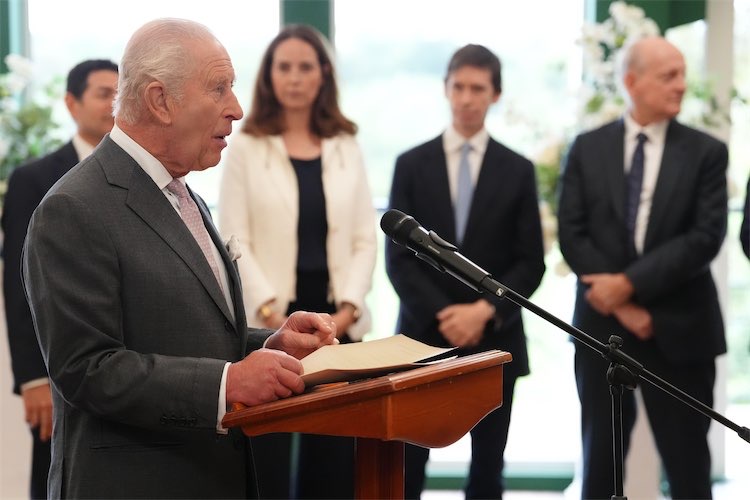 King Charles addressed tech leaders at a summit on Thursday (Alamy)
“When you've got such a wide coalition of people sounding the alarm, then it's absolutely right to pause and ask ourselves whether we've got the right regime to keep artificial intelligence safe and secure.”
The Business and Trade Select Committee has started an inquiry into AI and its impact on business and the future of the workforce. Byrne wants the inquiry to address the challenges it may pose as well as the opportunities, and has invited the AI Security Institute to give evidence to the committee.
“The question that I think we all want to ask is whether they think they actually have the powers in order to keep AI safe for the future,” he told PoliticsHome.
“That's at the heart of it.”
Byrne is concerned that parliamentarians themselves are still not very knowledgeable about AI, despite the tech industry itself having warned for years of the huge risks posed by the technology.
“It is really important that Parliament and our safety advisers work much, much more closely together,” he said.
“We need a much deeper relationship than we’ve got today. If you leave industries to self-regulate, disaster arrives.”
However, Donald Trump’s US administration has talked down the risks of AI and voiced concerns about potential attempts by the UK to regulate the industry more heavily.
PoliticsHome revealed that at a meeting in July days before Andy Burnham became prime minister, British diplomats sought to reassure Trump officials that he would not target US tech firms with regulation.
At the meeting, diplomats said Burnham was aware of the British reliance on US tech firms for growth, as seen in the UK’s response to the Defence Investment Plan.
Asked how the UK should handle this conflict of interests with the US, Byrne said: “One of the superpowers that we have as a country is our ability to generate alliances, and this is something that is a little alien to the Trump administration.
“They will always insist on an America-first approach to business and foreign policy, but actually, what small countries like the UK are good at is building alliances with like-minded friends around the world. And so, the way in which you push back on the United States is not alone, but together with friends.”
He described these “friends” as being the “middle power stack” of Canada, Japan, South Korea, India, European nations and others. The MP and former Treasury minister said the conversations between the UK and these powers have “really accelerated” in recent years.
“That gives me a lot of confidence that actually the middle powers will be able to build together an alliance that harvests the best from AI while keeping safe,” he said.
However, he added that “there's no substitute for China and the US striking an agreement that delivers you some strategic safety in this new technology”.
