Why are animals still in labs?
Photo credit: Animals International
Michelle Masterton-Smith, Head of Campaigns and Communications
| Animal Aid
One year ago, the government committed to replacing ‘animals in science’ with modern, human-relevant technologies. Yet animals continue to be used in laboratories across the country – with over 2.5 million animals used in 2025. Following a major exposé, public concern is growing, parliamentary scrutiny is increasing, and questions are being asked about why meaningful progress has been so slow
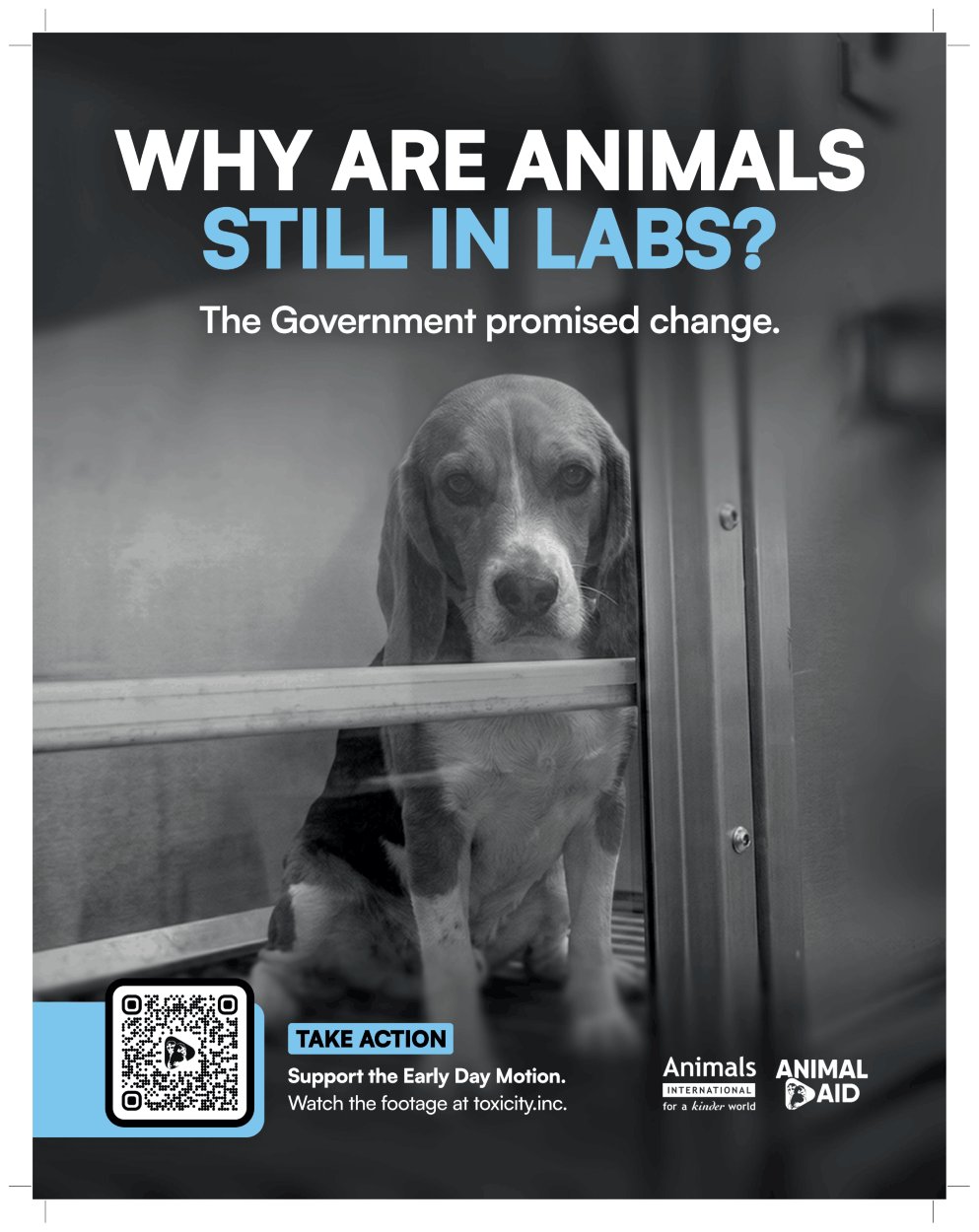 Click image to enlarge
When the government published its Replacing Animals in Science Strategy1 back in November 2025, it committed to accelerate the development and uptake of non-animal methods. The ambition was clear: to reduce and ultimately replace the use of animals in research and safety testing. Yet animals are still being subjected to toxicity tests in laboratories across the UK.
In April 2026, Animal Aid and Animals International released footage filmed by concerned laboratory workers. It showed beagles, primates, pigs, rabbits and rats being used in toxicity testing carried out under Home Office authorised generic service licences. These tests remain legal, even though there is no UK law that specifically requires animals to be used in toxicity testing.
Generic licences may even cover toxicity tests on substances not yet identified – meaning animal suffering is authorised before the substance, or its potential benefits, are known. For decades, toxicity testing has taken place largely out of public view. For many, this footage was their first chance to see the reality of these tests. Regardless of where people stand on the issue of animal experimentation, transparency is essential to inform public debate. Decisions about the future should be made with a clear understanding of the practices currently
taking place.
The exposé prompted a significant response. More than 30,000 people contacted their MPs, urging the government to end animal toxicity testing and deliver on its promise to replace animals in science. Early Day Motion 465 calls for greater scrutiny of ongoing animal toxicity testing and progress towards replacement.
So, if the government has a strategy to replace animal experiments, why are animals still suffering in labs?
A promise yet to be delivered
The strategy recognised what many scientists and regulators already understand: the future of safety testing lies in methods based on human biology. Organ-on-achip technology, sophisticated human cell cultures, and computer modelling can provide data that is more directly relevant to human health, without the ethical cost of animal testing.
Other regulators are moving faster. Earlier this year, the US Food and Drug Administration (FDA) stated that “technological advances are making it possible to move beyond animal testing in drug development”. It described animal tests as having a poor track record in predicting safety and efficacy in humans.2 In September 2026, it removed references to animal testing from its regulations and implemented the FDA Modernization Act.3 By contrast, in the UK the government awarded £300m of funding to research projects involving the use of animals in 2025. Funding figures for 2026 indicate significant allocation of funding towards animal research projects that far outweighs the budget for non-animal methods.4
Without clear targets, regulatory reform and decisive action, a strategy alone is not enough to stop animals being harmed.
From commitment to action
The debate is no longer simply about whether alternatives exist. Scientific advances continue to expand the range of non-animal methods available, public concern is growing, and parliamentary interest is increasing. What remains uncertain is the pace of change.
Animal Aid and Animals International call on the government to:
- Suspend the granting of new generic toxicity-testing licences
- Review existing licences
- Urgently deliver on the commitments in the Replacing Animals in Science Strategy
At its heart, this is a question of leadership. If the UK wants to lead in modern, human-relevant science, it must move beyond aspirations and set out how and when animal use will be phased out.
For further information, please contact:
References
1. UK Government, Replacing Animals in Science Strategy, November 2025
2. US Food and Drug Administration, Draft Guidance on Alternatives to Animal Testing
in Drug Development, March 2026
3. US Food and Drug Administration, Regulations to Advance Innovative Alternatives to Animal Testing, September 2026
4. Obtained by Animals International via Freedom of Information (FOI) - UKRI Funding for research projects that involve the use animals licensed under ASPA, October 2026
