The Building Blocks For Labour's Digital ID Plans Already Exist
Digital ID (Illustration by Tracy Worrall)
7 min read
Doubters say Keir Starmer’s digital ID scheme might never happen. But the building blocks for it largely exist already, writes James O’Malley
It’s finally happened. After months of Westminster whispers, and two decades of speculation, the British government has placed ID cards back on the political agenda.
This time, the proposed system will be almost wholly digital, with ID cards carried on our phones. And whereas back in 2005 Tony Blair focused on how ID cards could (purportedly) fight terrorism, in 2025 Keir Starmer’s government is framing the debate in terms of immigration.
“It will make it tougher to work illegally in this country, making our borders more secure. And it will also offer ordinary citizens countless benefits, like being able to prove your identity to access key services swiftly – rather than hunting around for an old utility bill,” the Prime Minister said.
Unsurprisingly, not everyone is happy. Critics have already lambasted the plan, arguing that it will be expensive, difficult to implement or marks a dangerous authoritarian turn. There are also concerns about how it might prove a tempting target for hackers.
There is almost a sense of unreality about the blowback, though. While the civil liberties arguments are important, and there are still unanswered questions over cybersecurity and how a digital ID system would work in practice (particularly for the digitally disadvantaged), what is striking about the proposal is just how much of the underlying infrastructure for it has already been built.
The digital wallet
Something that may surprise you about the digital ID plans is which minister is in charge. Although the scheme is ostensibly about right-to-work checks and immigration, responsibility lies not with Shabana Mahmood in the Home Office but Liz Kendall, who now heads the Department of Science, Innovation and Technology.
This is because the technological foundation of the system is in the GOV.UK app, which launched earlier this year. Like how the NHS app will eventually become the centre of all our interactions with the health service, the hope is that this app will become the primary way citizens interact with the state.
 Liz Kendall (PA Images / Alamy)
One of the app’s as yet unreleased features, long worked on by the Government Digital Service, is the ‘GOV.UK Wallet’. The idea is that this will act like the existing wallet app on your phone, which can hold virtual credit cards, train tickets, and supermarket loyalty cards – but this new wallet will be for holding all the different ‘credentials’ you might be issued by the government.
Later this year it will be possible to store a digital version of your driving licence in your GOV.UK wallet, for example, and it will have the same legal standing as the plastic card in your real wallet. Similarly, one early test case for the wallet is the digital version of the HM Armed Forces Veteran Card, which is expected to launch soon, making it easier for holders to prove their status and claim the discounts and privileges they are entitled to.
Over time, the plan is that the wallet will become home to other government-issued ‘credentials’ – confirmation, say, that you have been DBS-checked or that you are entitled to a Blue Badge parking permit.
Yet this is not the only thing digital ID will require. In addition to the wallet feature, it will need an underlying database to store everyone’s identity details.
This also already exists: the plan is to make use of the database behind GOV.UK OneLogin, the new system that will eventually mean you’ll be able to use the same username and password to log in to everything from HMRC to the DVLA.
As things stand, OneLogin is currently being rolled out across government services, but eventually it will be a reliable register of millions of people.
And with this in place, all that is needed is, well, an ID card.
Enter the Britcard
The idea of using the GOV.UK wallet and OneLogin for right-to-work checks was most notably proposed in a paper published earlier this year by Starmer-aligned think tank Labour Together. One of its authors has just gone to work for Kendall as her new spad.
Calling the proposal “Britcard”, the authors make the case for what they describe as a “progressive” digital identity that makes right-to-work checks easier. They note that these checks are already mandated by law, and that, as things stand, proving your right can be quite tricky.
For example, the easiest way to prove your right to work is to show your new employer a British passport. But, of course, not everyone – including around eight million Brits – has a passport. For EU citizens with Settled Status, it becomes slightly more complicated, requiring the new employee to log in to GOV.UK and obtain a ‘check code’ – a temporary digital token that the employer can verify.
And for international citizens, if you’re lucky, you may also be able to use a check code with your visa. But if you’re unlucky, it could entail digging through the back of the cupboard, and presenting reams of immigration paperwork or old utility bills for inspection.
The thinking is that, with a digital ID in your wallet, this process could instantly be made easier. Everyone who is eligible to work in Britain would be issued with a digital credential, which gets stored in their GOV.UK wallet. Then, when a right-to-work check is required, it is simply a case of the employee presenting their digital ID by, say, displaying a QR code on their phone and having their new employer validate it using a scanner app. It could turn an existing bureaucratic hassle into something that takes seconds.
The real prize
Implementing any digital ID system will undoubtedly be controversial. In the few weeks after the plans were announced, just under three million people signed a petition on the Parliament website opposing the plans, and every significant opposition party has criticised them. The government is also facing significant internal opposition from Labour MPs.
While there is some scepticism that the scheme will ever materialise, the fact that the system isn’t being built from scratch gives the government all the more reason to push ahead. And there is arguably a greater prize hiding in plain sight.
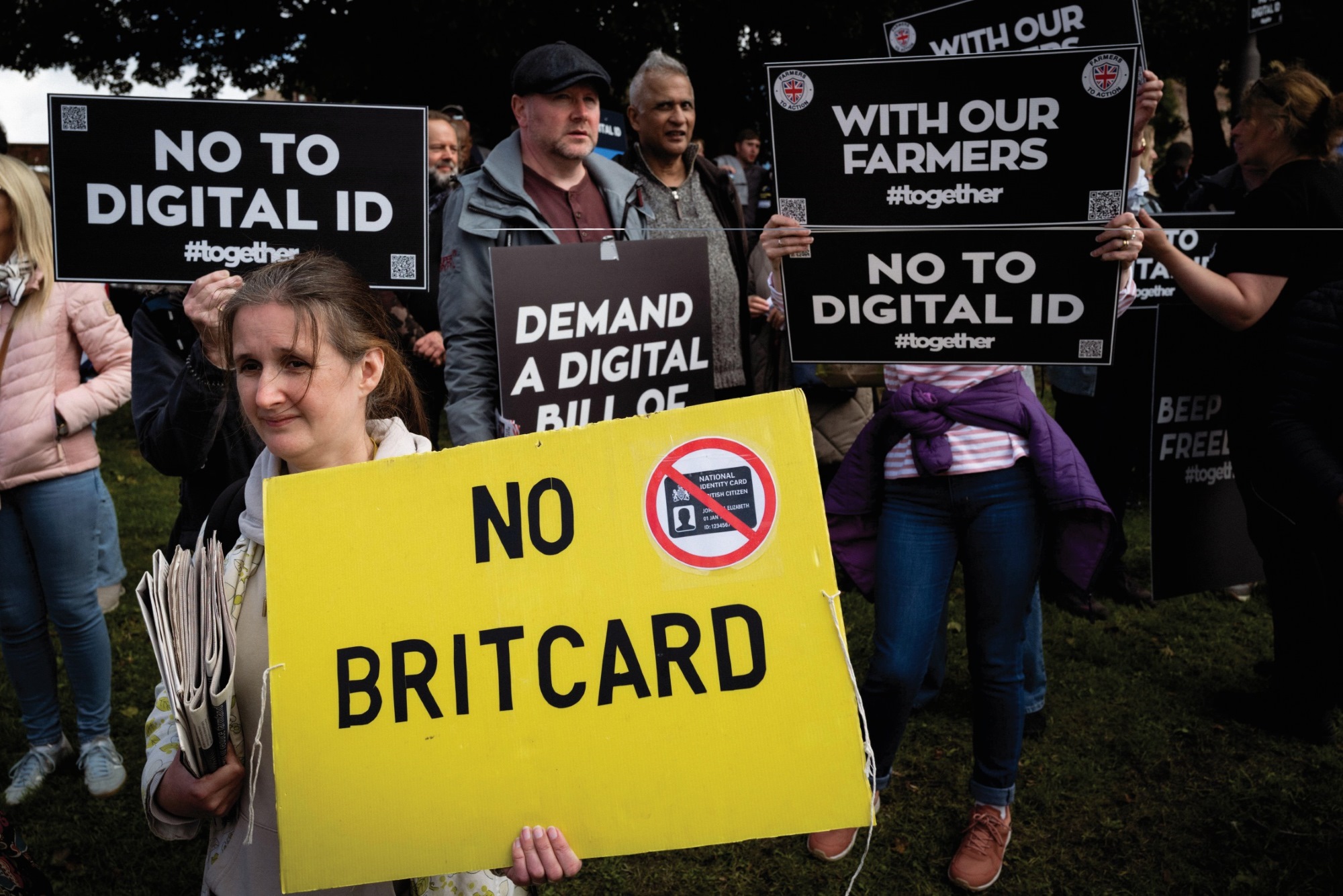 Protest against digital ID outside Labour Party conference, September 2025 (Credit: Andy Barton/SOPA Images via ZUMA Press Wire)
Publicly, the government is committed through its digital government blueprint to gradually joining up government services digitally. If realised, it could mean that public services can more effectively work together, and it could unlock new capabilities, like making it possible to only need to tell one government department when you change address – as it will cascade the information to the other bits of government who need to know.
This is difficult because Britain has never had a central ID database. Though the state holds records on millions of us, there is no reliable way to match National Insurance numbers with driving licences, as we’ve never had a single, unique ID number associated with each of us in our government records.
A mandatory digital ID system would change this. It would mean that, for the first time, every legal resident in Britain will have a unique identifier.
Ultimately, politicians will have to decide – is a more functional government worth the trade-off with civil liberties concerns? As the debate plays out, it’s important to make one thing clear: whatever we decide to do, most of the infrastructure to make it happen already exists.
