Children In 'Supported Living' Are Paying The Price For A Broken Care System
Illustration by Tracy Worrall
13 min read
So-called ‘supported’ living for teenagers in care is supposed to be a last resort or final stepping stone to independence. But Justine Smith finds struggling councils are being financially incentivised to misuse the newly legal provision – and put children at risk
On her lowest days, Jessica would ignore her morning alarm and miss school. There was nobody at home to get her out of bed and nobody her teachers could call to ask why she was absent.
Just after she turned 17, her foster placement broke down. She lost all contact with the parents she had called Mum and Dad and found herself completely alone, placed in so-called supported living, a relatively new, much cheaper option for older looked-after children, open to cash-strapped councils. It offers light-touch interventions instead of the wrap-around professional care of children’s homes or the stable family setting of foster care.
She was placed in a small flat in a rough part of Rochdale – one most parents wouldn’t want their daughters walking through after dark. She studied by day and worked in retail every evening to pay the bills – and to avoid being alone.
“I dreaded going home. It was called ‘semi-independent’ but the only help I got was a visitor one hour a week. I look back now and feel sad for the younger me; that she had to go through all that alone. I struggle to live on my own now I’m 21. No 16- or 17-year-old should be made to,” she tells The House.
Yet her situation was relatively stable compared to some of the thousands of vulnerable young people being placed in such accommodation; children who have severe mental health issues, autism, epilepsy, or who have been sexually and criminally exploited.
These settings have become a largely unregulated destination for thousands of the country’s most vulnerable youngsters – and a much cheaper alternative to extortionate children’s homes for councils scrabbling to avoid both bankruptcy and placing teenagers with complex needs in a broken care system controlled by private profiteers.
Highly vulnerable children can now legally be placed with adults who have recently left prison or have substance misuse and mental health issues
Education Secretary Bridget Phillipson last month admitted to Sky News she would never put her own children in supported living arrangements, which were recently legalised for 16-year-olds in care, and which can include unsupervised bedsits, hostels shared with unstable adults and even caravans and boats.
Providers of these settings are neither required nor even legally allowed to offer care – only advice or support. Introduced in 2023 to bring the two per cent of unlawful, unregistered accommodation into the Ofsted inspection framework, this option was originally meant only for emergencies or those assessed as capable of looking after themselves.
However, a survey conducted by The House of more than 100 English local authorities has found that last year, councils placed more than 10,000 children aged 16 and 17 in supported – also known as semi-independent – placements. This number is greater than that of children of all ages in traditional residential homes.
There has been a huge increase since 2024, when a government snapshot on 31 March showed 2,730 children in such accommodation. With providers applying to register more than 20,000 placements since 2023, figures are likely to rise at an even faster pace this year.
Campaigners say the figures are scandalous and Josh MacAlister, minister for children, admits that leaving so many isolated in such settings is “not good enough”.
Barrister and children’s rights advocate Carolyne Willow, who led the Article 39 charity when it legally challenged the Conservative government’s legalisation of supported living, says: “We warned this would become the norm, and these figures show it has. We are fast getting to a place where the children’s care system as we know it, with parental-style care and protection, ends when a child turns 16.
“Local authorities are required to first assess a child aged 16 or 17 as capable of living with a high degree of independence before they put them in this care-less accommodation. Instead it is being used as a matter of routine to plug gaps in finance and provision.”
Highly vulnerable children can now legally be placed with adults who have recently left prison or have substance misuse and mental health issues – without any requirement for 24-hour staff presence, and with a much less rigorous inspection regime.
“Children are dying, they are being subject to criminal and sexual exploitation, and substandard living conditions persist. The Education Secretary herself has said she wouldn’t put her own teenage children into a flat, bedsit or shared property with adult strangers,” Willow says. “So, why is government still allowing this for children in care?”
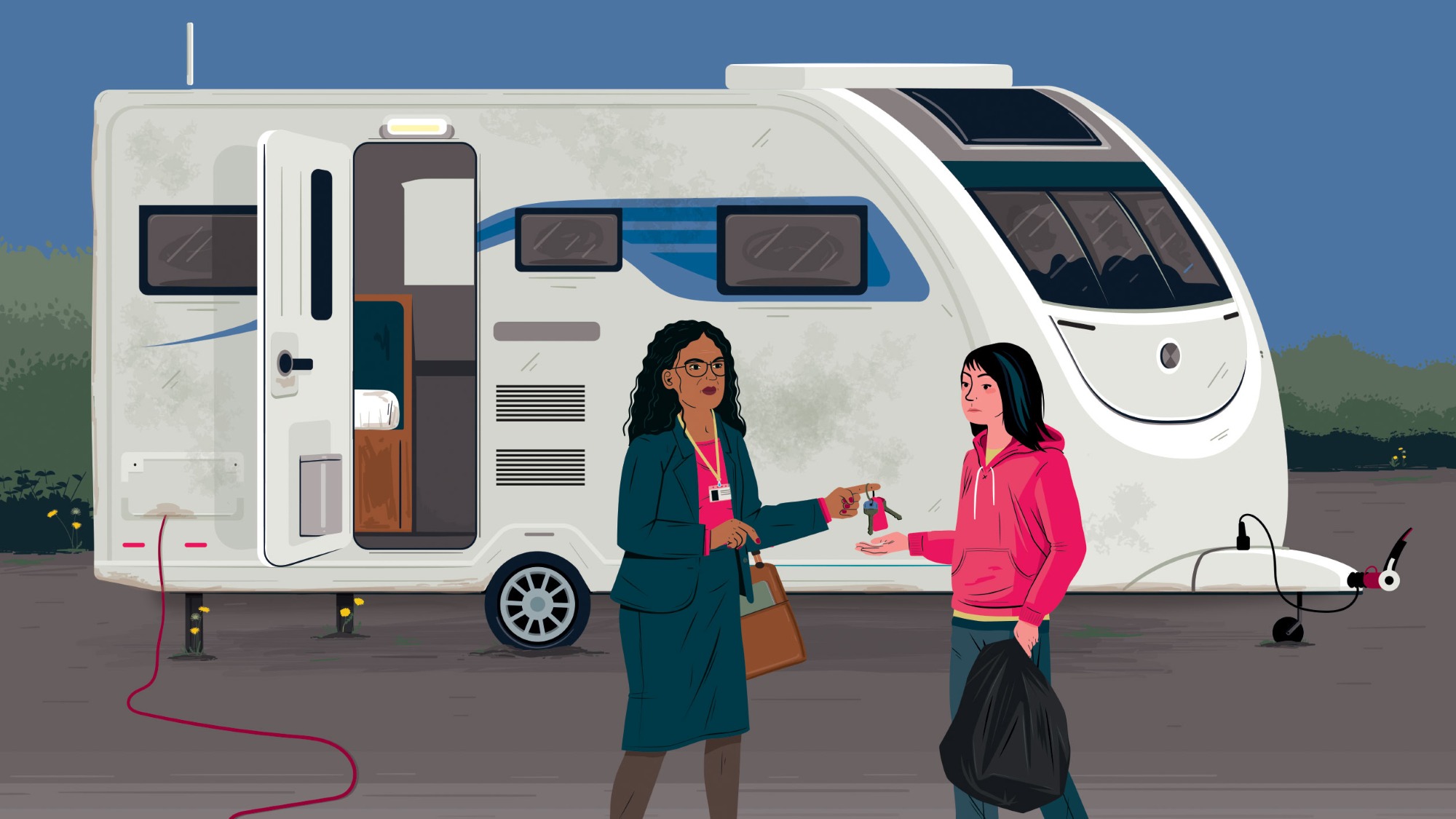 Supported living arrangements can include unsupervised bedsits, hostels shared with unstable adults and even caravans and boats. Illustration by Tracy Worrall
It is likely that intensely pressured council finances are contributing to overuse of this option. The House’s research, based on answers to Freedom of Information requests, has found that children’s homes, which are largely privately run, have increased their charges by a fifth in just over a year since our last survey to £6,615 a week, costing five times more than supported accommodation.
A National Audit Office report warned earlier this year that nearly half of England’s councils face bankruptcy. Children’s residential care spending, which has almost doubled in just five years, is one of the main factors driving them to the brink.
The broken system is clearly financially unsustainable – but it is children who are paying the price.
Only a few dozen of the 1,600 or so providers offering 20,200 newly registered supported placements have so far been inspected by Ofsted, and these inspections revealed a litany of serious issues.
At least three settings were suspended after the deaths of young residents. Half of those visited so far were deemed to be sub-standard or failing. Monitoring visits triggered by whistleblowing found missing bedroom doors, mattresses on floors, widespread on-site drug use, children recruited into criminal gangs and staff hired without any training or criminal record checks.
Thousands more placements that registered before the October 2023 cut-off date are currently operating without any visit as inspectors plough through the mounting backlog of new premises.
Far too many teenagers in care are being left isolated in accommodation that isn’t good enough
Yvette Stanley, Ofsted’s national director of social care, says it is encountering a “worrying number of children who should not be in supported accommodation”, including those with complex needs, and teenagers requiring intensive supervision or personal care.
“As a result of gaps in provision elsewhere, too many children are being pushed towards an independence for which they are not properly prepared,” Stanley says.
MacAlister says the government is investing £2.4bn in the Families First Partnership programme to try to keep families together and will be setting out details of how it plans to expand care available and increase safeguards.
“But there is much more to do, as this investigation shows. Far too many teenagers in care are being left isolated in accommodation that isn’t good enough,” he adds.
“Making sure children in care have loving homes to grow up in is a personal priority for me and the government.”
Children in supported placements are given cash weekly and expected to buy their own food, pay bills, cook, clean, get themselves into school or college and manage their own medication. Disabled children, including those with conditions such as epilepsy, are among those who have been housed in this way. Supervision can range from staff on site 24/7 to a fortnightly hour-long visit.
This “adultification” and failure of care for vulnerable looked-after children, two thirds of whom have come from backgrounds of neglect and abuse, and who are far more likely to have mental health and neurodevelopmental complications, was highlighted as a factor in the grooming gangs scandal by Baroness Casey in her recent review.
Education Committee chair Helen Hayes, who led the inquiry into children’s care currently moving through Parliament, says: “The data obtained by The House paints a shocking picture of the state’s ability to keep vulnerable young people safe and meet their basic needs…
“Our inquiry heard directly from young people about their poor experiences of supported housing – experiences no young person should have to endure.
“The government needs to develop a strategy to ensure there is a sufficient stock of suitable accommodation for looked-after children. It should also follow the recommendation of the Independent Review of Children’s Social Care and introduce universal standards of care that apply to all homes. Bedsits and shared flats should always be a last resort for vulnerable young people.”
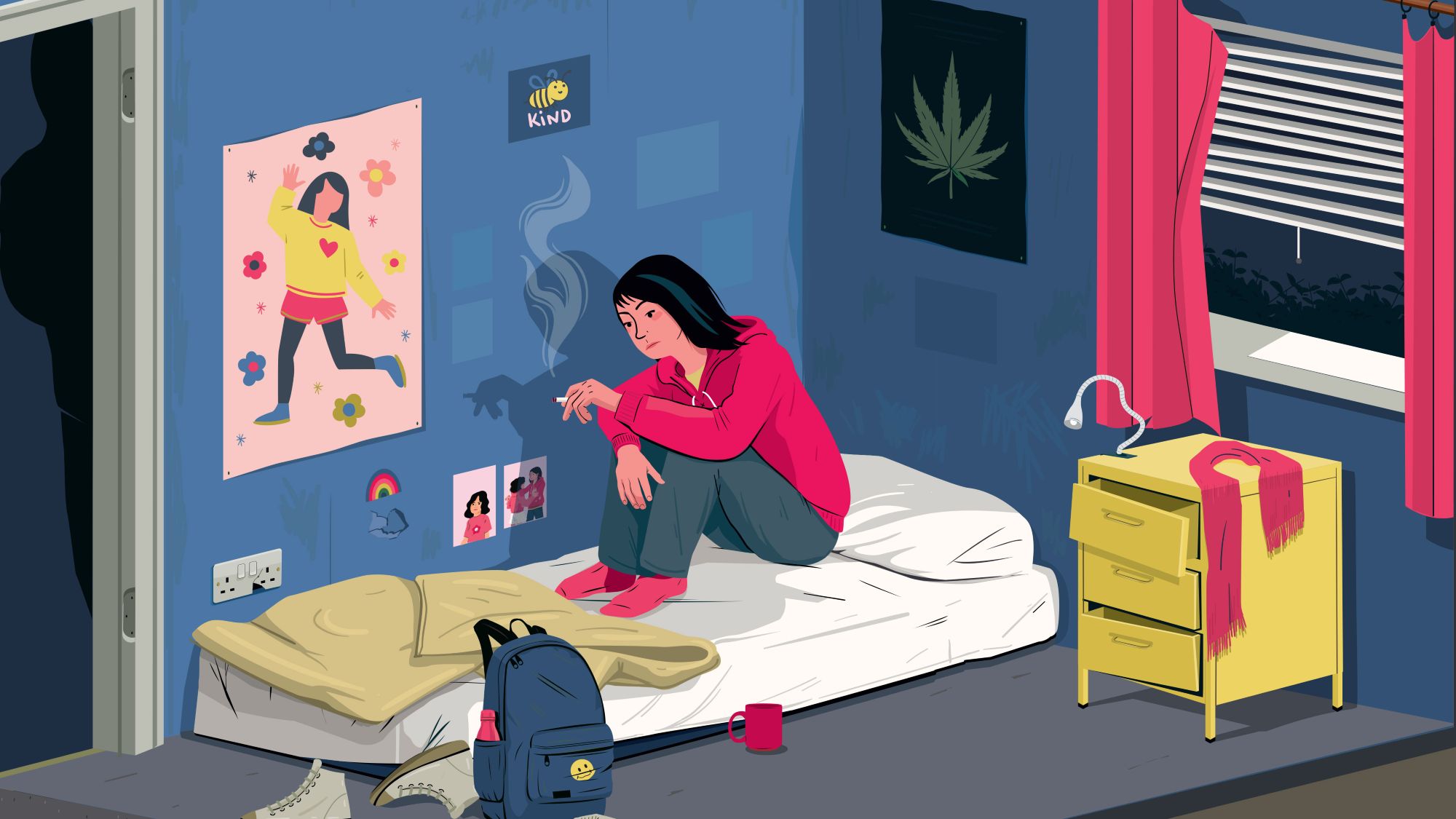 Illustration by Tracy Worrall
The Department for Education (DfE) suggested it was not a priority to bring in the same levels of care and supervision for older children in supported living, saying its focus was on updating “some of the most outdated national minimum standards”. It also highlighted that it has allocated £560m to refurbish and expand residential care and provide more fostering placements.
The UK has a shortage of up to 6,500 fostering placements, while the number of approved adopters has fallen by almost 43 per cent in three years, adding to the crisis.
Private children’s home providers have rushed in to fill the vacuum, and now account for around 84 per cent of the 9,480 placements, with the biggest extracting average profits of around 22 per cent. This type of placement can make around five times more per child than in fostering provision.
Our data shows the average annual sum paid for residential care increased by 22.5 per cent from £281,000, or £5,400 per week, in 2023 to £344,000, or £6,615 per child per week, in 2024-2025. The much lower overheads in supported living mean profit margins can be even higher. Private providers account for around 87 per cent of the 20,200 supported accommodation places that have registered with Ofsted.
Dheeraj Chibber, chair of the Association of Directors of Children’s Services (ADCS) health, care and commissioning policy network, says: “Local authorities are operating in a placement market where demand far outstrips supply. Some providers can choose which children they accept while charging tens of thousands of pounds a week for individual placements. The level of profiteering by some large, private-equity-backed organisations is unacceptable and leaves councils with limited control over the options available.
“The proposals in the Children’s Wellbeing and Schools Bill to curb profiteering and invest in new, publicly-commissioned provisions are therefore welcome. ADCS stands ready to support these reforms so that every pound spent goes towards improving children’s lives, not boosting shareholder returns.”
Munira Wilson, Liberal Democrat education spokesperson, says: “These figures show profiteering in the children’s social care sector is spiralling out of control. It is deeply concerning if local authorities are having to prioritise cost saving over vulnerable children’s wellbeing.
“The welfare of children must always be put first, and it is wrong that profiteering companies are taking advantage of the crisis in this sector. We cannot allow children’s quality of life to be sacrificed because the government can’t get a handle on this crisis.”
Rebekah Pierre, deputy director of campaigning charity Article 39, who has written of her own childhood experiences in unregulated, semi-independent care, says it is a “national scandal” that the number of children in “care-less” accommodation now exceeds the number in children’s homes.
“Previously the government claimed that these settings would only be used as a ‘last resort’ – these figures show that this is categorically false,” she says.
“There would be a national outrage if education standards for 16- to 17-year-olds were relaxed, with unqualified teachers; children sharing classrooms with adults just out of prison; no DBS checks.”
Baroness Longfield, former children’s commissioner, now chair of the Commission on Young Lives, says: “This was supposed to bring existing unregistered provision into the inspection system for the few children who may not need higher levels of care. However, councils that are strapped for cash are incentivised to go down this much cheaper route and it is now being used for the most vulnerable who need higher levels of nurture, care and support, not least therapeutic care, which cannot be provided in a few hours a fortnight. It’s a full-time job.”
She adds that early interventions to keep young families together and wrap-around support for older children, who now account for half the numbers overall, are needed.
Clare Bracey, interim CEO at care charity Become, says: “A shortage of suitable homes means children are being pushed into the wrong settings and left to fend for themselves. The government must act now to create safe, stable homes where every child can get the love and support they need to thrive.”
Nonita Grabovskyte was taken into care at 16 and begged to be placed with a foster family, telling social workers she identified as a child and still played with toys. Diagnosed with autism and severe mental health issues, she had been hospitalised due to suicide attempts.
Despite her obvious vulnerabilities – and repeatedly foretelling how and when she would take her own life – she was placed by Barnet council in an unregulated, privately-run supported living hostel, which provided little more than a roof over her head. It was also close to the railway line, where she followed through with her previously detailed plan days after she turned 18.
Our research found that Nonita’s council, Barnet, which is facing a £55m deficit even after making £22m savings in this year’s Budget, placed 75 children in residential care in 2024-2025, at an average cost of £350,896 per year, and 157 in supported, at a considerably lower total cost of £75,600. Two more 18-year-old recent care leavers have died in the borough in the last two years: one who was living in semi-independent and one in independent social housing.
A Barnet council spokesperson said: “For young people aged 16+ who are not ready for independence, particularly those with high or additional needs, foster care or children’s homes remain the most appropriate options. When this is not possible, supported accommodation with additional support is considered.”
It was the Sky News special investigation into the many failings that contributed to Nonita’s death which put the Education Secretary on the spot and asked her whether she would put her children in a bedsit at 16 with adults they did not know. No, she said, adding that she wanted to “bring down the use of those kinds of placements”.
But Ofsted says it is receiving at least 30 new applications every month. It seems these kinds of placements are becoming irreversibly entrenched at the heart of the children’s care system.
The House sent FOI requests to more than 100 of the 153 English councils providing children’s services. Data may include placements which were short term.
Fifty-five responded with figures for the number of children they placed in supported living in 2024-2025, totalling 8,505, or an average of 155 per council.
Seventy-two councils told us they had placed 7,659 children of all ages in residential homes, an average of 106 per authority.
Another 1,397 16- and 17-year-olds, plus 612 under-16s, were placed illegally in unregistered accommodation by the councils who responded, an average of 25 older and 12 younger children per authority.
Official government data taken on a single day, 31 March this year, found 7,520 in supported and 2,050 children in “other placements”, likely to be supported which had not yet completed Ofsted registration.
The DfE data comes with caveats around its accuracy due to the transitional phase of embedding supported.
With the average support placement costing £74,629 a year, or £1,435 per week, and residential costing £344,000, or £6,615 a week, even just the 55 councils we accounted for could have collectively saved anything up to £2.25bn in one year by using supported instead of children’s homes for each child over 52 weeks.
