"Economy Begins At Home": David Cameron's Attempt To Do Away With Government Cars
Cameron wanted to win back public trust following the scandal (Amanda Rose / Alamy)
7 min read
David Cameron, channelling Jim Hacker, tried to stop his ministers from using their cars in a bid to demonstrate thrift. Matilda Martin recalls how life imitated art
“Economy begins at home,” declares Jim Hacker, the minister for administrative affairs, in an episode of Yes Minister. This early instalment of the hit BBC comedy sees Hacker ditch his government car and chauffeur, along with his grand office furniture, his drinks cabinet, and half his staff, to demonstrate thrift. It does not end well. The comedic climax sees our hapless politician arrive at the French embassy soaking wet and covered in dirt after his own car breaks down en route.
But 30 years later, David Cameron tried on the same hairshirt – or, more exactly, instructed his ministers to don it as he announced a curtailment in the use of government cars.
It was in the wake of a series of bruising revelations about MPs’ expenses, and Cameron wanted to win back public trust following the scandal and the global financial crash by showing we were, indeed, “all in this together”, according to one of his cabinet.
“There was emphasis on finding ways for us to show that we were going through similar choices [to the public] on the back of the financial crisis,” explains Stephen Crabb, who held several ministerial positions in the Coalition.
Cameron was reportedly inspired to end the practice of “politicians swanning around in chauffeur-driven cars like they’re the Royal Family” after reading the diaries of Chris Mullin.
Mullin, who served in several ministerial roles under Tony Blair, tells The House: “When I became a minister, I was told I was entitled to a car and a driver, which I declined on the grounds that the numbers 3 and 159 buses continued to run past my door.
“It was difficult to shake off the Government Car Service,” Mullin says. He soon discovered that the department was being charged £700 a week (the equivalent of £1,350 in 2025) for a car he was not using. The Labour veteran claims that when he tried to get rid of the car altogether, “they threatened to charge £4,000 depreciation for a car which they claimed they would have to sell”.
Cameron pledged that such bureaucracy would be slashed and, under the Coalition, ministers were encouraged to use public transport “where practicable”. The policy did not apply to the most senior ministers in some roles, and protected ministers got a Met police car and driver. Ministers were also encouraged to finish their ‘red boxes’ in the office, saving them the need to take confidential papers home.
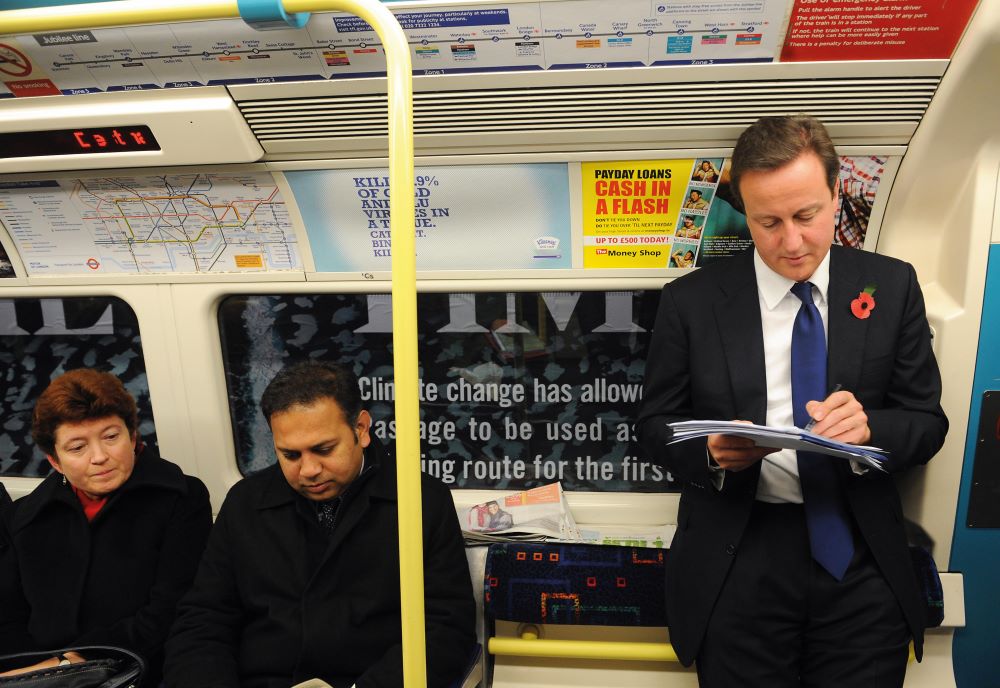 Cameron announced a curtailment in the use of government cars (PA Images / Alamy)
However, just like Jim Hacker, Cameron’s grand scheme soon hit a few snags.
A report in The Guardian in 2010 details that while ministers were being told to travel to their constituencies by second-class public transport, the red boxes would have to travel separately to the constituency in a private car for security reasons.
In 2012, a report by the Evening Standard claimed that ministers were to be forced to carry their red boxes on public transport but would not be permitted to read the confidential contents.
Newspaper columnist and the then wife of Michael Gove, Sarah Vine, reportedly quipped: “My husband is free to travel home by Tube, taxi, bicycle or carrier pigeon, but the red box must arrive in air-conditioned splendour, snug and secure in the back of a locked car.”
One former minister tells The House the policy was a way of “wearing a bit of a hairshirt on the back of the financial crisis”, wittingly or unwittingly reflecting the language of Sir Humphrey Appleby in the Yes Minister episode, who proposes “Operation Hairshirt” – a scheme designed to make Hacker feel the impact of spending cuts personally so he would drop them.
Lord Harper, who was in charge of the Government Car Service (GCS) between 2022 and 2024 in his role as transport secretary, is keen to defend the intentions behind the move, but admits there were difficulties and that it eventually interfered with the effectiveness of government. “I can completely understand why we promised it because of the environment at the time,” he says, but adds: “It was one of those promises made in opposition but done without thinking through the practicalities.”
Ministers’ cars often double up as offices on wheels, Harper explains: “If you’re a minister and you get picked up from somewhere, the second you get in the car, you are doing work.” This cannot be replicated on public transport, he says.
There was emphasis on finding ways for us to show as a government that we were going through similar choices [to the public] on the back of the financial crisis
Crabb, who was a whip before being promoted to Welsh secretary in 2014, tells The House that he did not see the point of retaining a government car in his role, given the Wales Office was “only halfway up Whitehall”.
However, when he moved to the Department for Work and Pensions (DWP) in 2016, Crabb describes a different situation.
“The DWP role, particularly at that time, was something of a lightning conductor for controversy,” and security was therefore much more of a consideration.
While Crabb was a supporter of ditching government drivers where possible 10 years ago, he now takes a more nuanced approach.
“My own views have slightly changed. And this boils down to security. I just don’t think Westminster has felt a very safe place, particularly for senior ministers, to be walking around openly between Parliament and Whitehall in the last few years. I’ve now got more sympathy for ministers needing the car as almost protection.”
Harper agrees: “The context now is people are increasingly more aware of security. But there is also information security to think about, and public transport is not conducive to that.
“We have seen a number of cases, which I don’t think we used to, over people making threats against MPs. That is a relevant consideration, particularly if you are travelling late at night by yourself as ministers.”
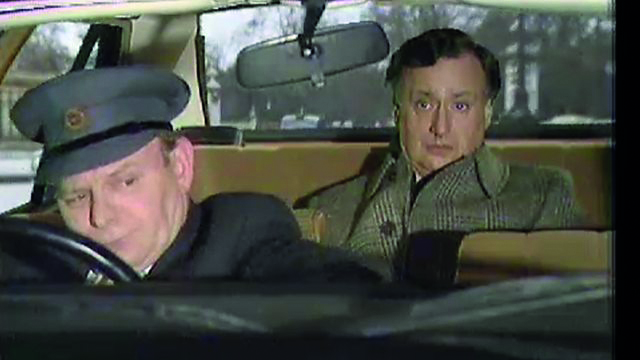 “Economy begins at home,” declares Jim Hacker in Yes Minister (Alamy)
In Yes Minister, Hacker was persuaded to reinstate his car service after triggering a drivers’ strike and accidentally dropping his own car keys down a drain.
But the Coalition’s attempts to cut costs did seemingly work in the long run. By 2017, the Tory government claimed that the GCS had reduced its running costs by three-quarters since 2010.
The government no longer routinely publishes datasets on the GCS as it once did; the information is instead now disclosed in response to parliamentary questions or Freedom of Information requests.
Harper tells The House that he believes the rules on who can use the GCS and when have moved back towards what they were previously.
“People realised it was quite difficult and, over a period of years, the rules went back closer to what they were before,” he says.
“I understand why we did it, but in retrospect, it was one of those things we should have been a bit braver about regarding the point of government cars and why they mattered.”
The GCS has now moved to the Cabinet Office, something Harper sees as a positive development. Under the Department for Transport, it often left ministers in the department solving disputes between other ministers over car usage.
Ultimately, Cameron’s efforts to save money might have had some success, but rising concerns over security and workload steadily pulled the system back towards its pre-2010 norms – leaving many who were there to wonder whether the public ever truly noticed at all.
