New Towns Chair Sir Michael Lyons: Government Must Be "Muscular" In Developer Negotiations
10 min read
The next generation of new towns will follow the work of a taskforce led by Sir Michael Lyons. He tells Noah Vickers that ministers must not slacken the pace – and should play hardball with landowners and developers
In the summer of last year, Sir Michael Lyons found himself turning back to the words and wisdom of Lord Reith.
Both men are closely associated with the BBC: Reith founded it and Sir Michael chaired its trust between 2007 and 2011. But both were also tasked by Labour governments with developing proposals for a nationwide programme of new towns.
“He was very opiniated,” says Sir Michael of his predecessor. “One of the things he couldn’t tolerate was that there would be any greyhound racing in any of these new towns.”
The son of a greyhound track starter, Sir Michael professes to having had a “slightly different upbringing” to the strict Presbyterianism in which Reith – who also warned against the provision of any “drinking saloons” – was raised.
“I don’t think there are going to be any greyhound tracks,” Sir Michael says of the next generation of new towns, “but they have to be places which folks find attractive to go and live in; to buy their homes in; to move their families to.”
The 76-year-old former chief executive of Wolverhampton, Nottinghamshire and Birmingham councils was appointed to chair the independent New Towns Taskforce in the weeks following Labour’s 2024 election victory. After precisely one year’s work, the group published a 135-page report at the end of September 2025.
In it were proposals for 12 new towns across England, each with at least 10,000 homes. While some will be ‘standalone’ communities in rural locations, others will take the form of regeneration projects within existing urban areas.
We'd be bitterly disappointed if only three locations were progressed
In its response to the taskforce, the government said it is “determined to get spades in the ground on at least three new towns in this parliament”, with Tempsford in Bedfordshire, Crews Hill in north London and Leeds South Bank “looking particularly promising”.
But if ministers want to match the transformative impact of the post-war era of new towns, Sir Michael warns they must not limit their ambition for the programme.
“We’d be bitterly disappointed if only three locations were progressed,” he says. “Ministers may want to focus on those three, but there are other players who can come into this, other governments might come back and say, ‘we’re impressed by the progress that numbers four and five have made, let’s get on and do those now’.”
The government has said that beyond its three preferred sites, it is “prepared to progress work on a far larger range of locations if it proves possible” – an assurance Sir Michael took “great pleasure in”. All 12 will also be subject to a Strategic Environmental Assessment, and “preferred locations could change as a result of the process”, ministers have said.
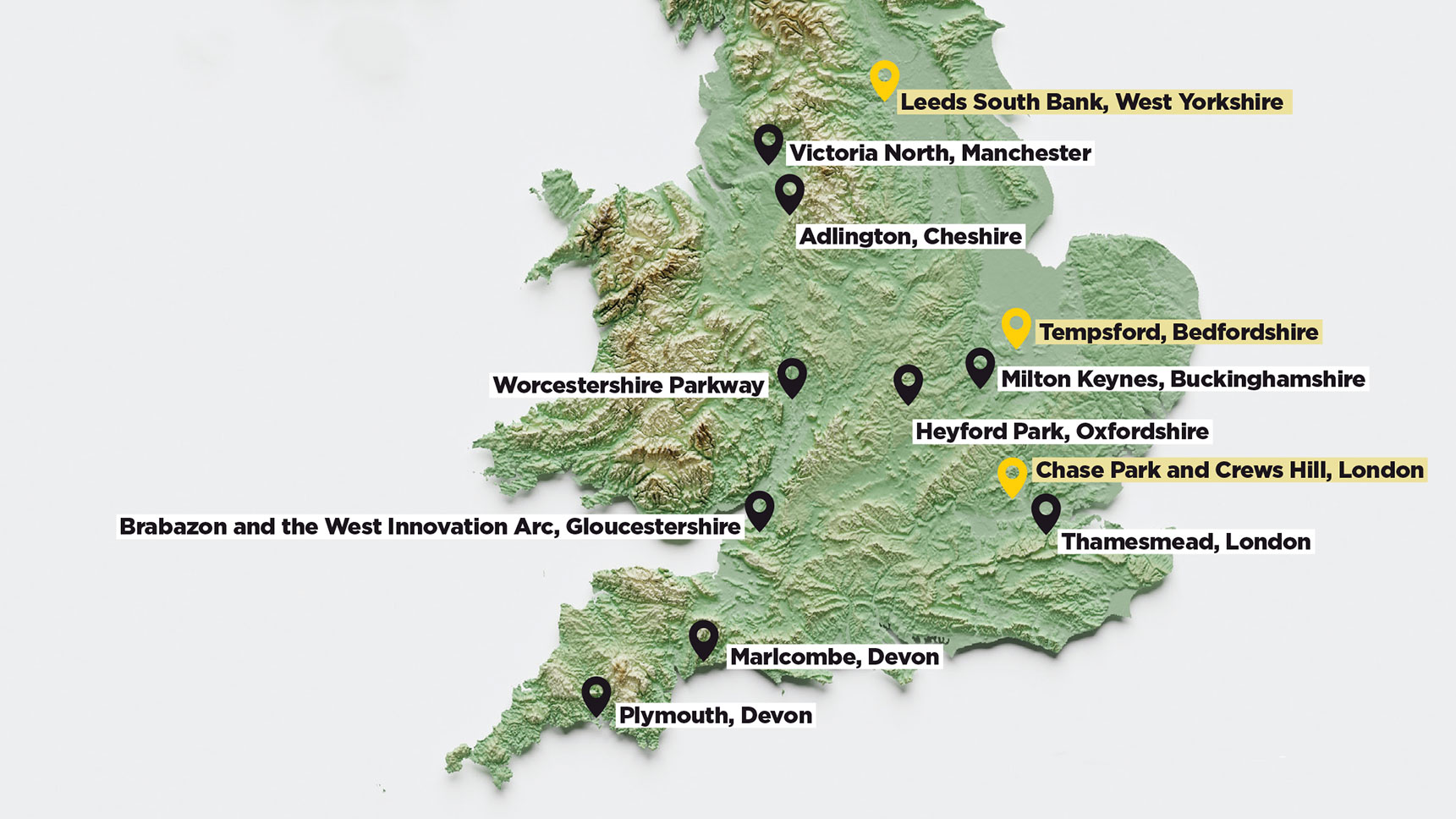 The 12 recommended locations for new towns, including the government's preferred locations in yellow. (Credit: Antonello Sticca)
The fact remains, however, that all of the sites will require significant investment and sustained focus from successive governments in order to be realised.
“There is not one of the sites that doesn’t have substantial infrastructure requirements. In many ways, this is the biggest challenge for government,” says Sir Michael.
“Whereas you can imagine finding those willing to invest in the housebuilding and the social infrastructure that goes with it, [when it comes to] large-scale economic infrastructure – road improvements, additional water and electricity capacity – these are really big issues.”
Neither Reform UK nor the Conservatives have yet made clear how much, if any, support they would give to the programme if they enter government – leaving its fate uncertain beyond the 2029 election.
“We are talking about a 30-year-plus horizon here,” says Sir Michael. “This is not something to be sorted out in one year, two years, or even two electoral periods.”
He later adds: “When we talk to investors and we talk to people who are not currently large-scale investors in housing in this country, they were interested in the proposition and they said there would be two things that they needed.
“The first thing is, they would want a long-term vision and they would want to be assured that that vision was kept to, and [secondly] they’d want to be assured that government was in a strong position and that could last in the long-term.
“So, there is a bit about how do we win – beyond one government, on the 30-year horizon – how do you win support [for new towns]?”
This is not an attempt to shoehorn in someone's idea of what might work well
Architecture and town planning are subjects that can provoke surprisingly strong feelings – not least from King Charles, who has long had an interest in both.
In February, the monarch made a rare joint visit with Keir Starmer and then-housing secretary Angela Rayner to Nansledan – a Duchy of Cornwall development near Newquay, built in the King’s preferred traditional style.
Sir Michael says he and his colleagues did not receive any representations from His Majesty during the taskforce’s work, though the Crown Estate was one of the organisations they consulted with on the principles of town planning and on issues around land ownership.
“We have emphasised the fact that these new towns all need to be distinctive; they all need to be of their location,” says Sir Michael. “This is not an attempt to shoehorn in someone’s idea of what might work well.”
He laughs when asked whether he expects any of the chosen locations to prove contentious with existing local residents.
“The remit didn’t give us the time or the opportunity to do a consultation exercise – nor would it have been appropriate, because actually, that’s all to follow,” he says.
“Some already have progress within the planning system and have already done that, so it would look bizarre if we [did]. Others, it hasn’t started yet – so that wasn’t our job.
“However, we did in every case talk to the landowners, we talked to the local authority, to at least understand their view and the tensions.”
Sir Michael is confident that strong arguments can be made for the growth of housing at each location. He takes the example of Milton Keynes, where the taskforce has proposed a “renewed town” of around 40,000 homes north of the city centre.
“There will be existing residents worried about what this plan means for them,” Sir Michael admits. “On the other hand, this is a city with massive potential… Why wouldn’t you want to reinvigorate the centre, and use it to exploit growth opportunities for the nation as a whole?”
The proposal includes the development of a Mass Rapid Transit system for the city, which the taskforce hopes will reduce car dependency and provide better connections to local employment.
“There’s a clear gain,” says Sir Michael. “You’ve always got to balance some people saying, ‘This isn’t quite what I’d envisaged for where I’ve invested my home’, but actually, that’s what the planning system is for. It’s to try and balance those things.”
He adds: “It is very clear that, as a nation, we need to get rather better at effecting development; effecting the investment in infrastructure. It takes far too long to get these things done in this country – and that is not, in my view, a question that you sometimes hear the housebuilders suggesting, that you ‘just have to get on with it’.
“The truth is you do have to make our procedures more streamlined, but people do have to feel that they’ve had an opportunity to comment if it’s going to impact on their lives and what they’ve already invested – so it is about a better system, rather than no system of planning and control.”
One factor that may play a role in local support for new towns will be whether they are built in addition to, or instead of, other housing projects.
It remains unclear whether new towns will count towards the government’s mandatory housing targets for each local area, with ministers promising to “set out more detail” in “due course”.
According to Sir Michael, this ongoing uncertainty can be traced back to Rayner.
“What the then-deputy prime minister wanted to avoid was folks signing up for a new town, confident that it would never take place at pace, but nonetheless it would count against their targets – and that is a real concern,” he says.
He adds, however, that it should be possible for ministers to determine whether local authorities are serious about delivery.
“Where government is clear that there is real intention, real enthusiasm, that placemaking principles are going to be adhered to, then – as part of the deal – they have to acknowledge that that’s a contribution to the targets.”
No apologies here, I’ve argued for rather muscular negotiation by government
Land ownership is another major challenge for planners striving to create cohesive, well-designed communities. All 12 locations contain mixtures of public and privately-owned space, and the taskforce have recommended that development corporations be used to assemble the land at each site.
“If you had a magic wand, you would say, ‘Let’s find the public expenditure to just buy all the land we need’,” says Sir Michael. “That is absolutely the way to give control, to stand a chance of getting a good return on the public investment involved.
“Is that realistic in current circumstances? It’s not, so it is going to be a mixture of what can you acquire, what can you negotiate with existing landowners.”
In those negotiations, Sir Michael believes the government should emphasise to landowners and developers that the new town designation brings with it a greater certainty that their land will be developed at speed. The developer will therefore get a faster return on their capital, and in exchange the government should ensure that the developer takes on some of the risk involved.
“I personally have been saying direct to ministers: there is a big value on a new town designation,” says Sir Michael. “All these people, and many more, wanted a new town designation. There’s a price for government to pay, but also there’s a price for them to demand, in terms of a deal.”
The government, after all, is offering to incur a lot of the required infrastructure costs, so where they cannot simply buy the land from the private sector, they should “demand an opportunity to share the equity, or to make sure that the developer is really paying a good contribution to those costs – best of all, to be in a partnership of risk and return.”
If they cannot strike a mutually satisfactory deal at a particular location, ministers could simply refuse to grant the new town designation and instead focus their efforts elsewhere among the 12 sites.
“No apologies here, I’ve argued for rather muscular negotiation by government,” says Sir Michael, “and if they can’t get the right terms, then move on to one of the right places.”
The government has said new town delivery bodies “will be able to make full use of their compulsory purchase powers where there is a compelling case in the public interest”, though that process can take time and could be subject to legal challenge.
Sir Michael is not naïve to the fact there is scepticism about new towns and their ability to alleviate the housing crisis. But he insists it is a project that the country ought to be capable of delivering, as it has before.
“One of the challenges which I found most hard to take is when people said ‘Who’s going to build them?’ My answer to that is: the same people who ought to be building the homes now.”
Compared with the average European country, Britain has a “backlog” of 4.3m homes that are missing from the national housing market as they were never built, according to 2023 research from the Centre for Cities think tank.
“This is real market failure, when you’ve got potentially four million households needing homes, and we’re not supplying them,” says Sir Michael.
“If you’d said that in 1946, people wouldn’t have believed that was possible – they would only have seen the future as rosier.”
