Natural England's Tony Juniper: Money Spent On Bat Tunnel 'Could Have Been Put To Better Use'
8 min read
Natural England wants to cast off its ‘blocker’ image and reframe its mission as one that enhances national infrastructure. Noah Vickers speaks to its chair Tony Juniper
For nature lovers worried about the fact that one in six species in Britain are facing extinction, the Labour government’s rhetoric has not always inspired confidence.
In their determination to build 1.5m homes and grant permission for major infrastructure schemes across the country, ministers have lined up to insist that nature will not stand in their way.
Under this government, developers will be able to “focus on getting things built and stop worrying about bats and newts”, said Chancellor Rachel Reeves in January this year.
“We can’t have a situation where newts are more protected than people who desperately need housing,” the then-housing secretary, Angela Rayner, told Sky News a month earlier.
Prime Minister Keir Starmer, for his part, has bemoaned “the absurd spectacle of a £100m bat tunnel” and bewailed the “nonsense” of homes being blocked in Kent due to the discovery of a colony of “distinguished jumping spiders”.
Tony Juniper, the chair of Natural England, may have some work to do therefore in convincing ministers that nature is not an impediment to development.
Does he ever wince when he hears figures at the top of government cast bats, newts and spiders as the enemies of economic growth?
“Oh, I’ve not really heard any of that,” the 65-year-old former Friends of the Earth director replies with jovial sarcasm. Similar arguments, he later adds, have been consistently made over the last 30 years, despite “mounting” evidence of the “fundamental value and dependence of our economy on nature”.
There remain, he says, “some important places where that evidence needs to be landed in a more compelling way, because some people still believe that looking after the environment is hostile to economic development”.
In a bid to present itself as an enabler rather than a blocker of growth, Natural England in November published a new strategy setting out how the “strategic recovery of nature” can “help deliver the homes and infrastructure we need, strengthen national security and reduce environmental risks and costs”.
Juniper insists that growing the economy and safeguarding nature are “highly synergistic” aims, but this claim is likely to be met with some scepticism, particularly from those – like Starmer – who deplore the infamous “bat tunnel”. The tunnel, being built at a cost of £100m, will serve as a 1km-long shield along a section of the HS2 rail line through Buckinghamshire.
It was designed to prevent one of the UK’s rarest bat species – Bechstein’s bats – from colliding with trains travelling at over 200mph. But it has since been lampooned as an emblem of how bureaucracy can pour taxpayers’ money down the drain for questionable benefit.
Natural England were not the ones to suggest the tunnel as a solution. The structure was in fact proposed by HS2 Ltd, who asked Natural England whether it would be sufficient to mitigate any risk to the bats, which are protected by law. Natural England said it would.
We could have finished up with a much better outcome for the bats, without having to spend that money
Far from defending the tunnel, however, Juniper now tells The House it is precisely the kind of project which his agency wants to see fewer of.
“The bat tunnel is the artefact of exactly the species-by-species, site-by-site approach, rather than the strategic approach that I’m now saying is at the heart of the Natural England strategy,” he says.
“Because what we might have anticipated through a more strategic approach is that that kind of money – and indeed quite a lot less money – could have been put to better use through, for example, considerably expanding the habitat of Bechstein’s bats across that area of Buckinghamshire.
“We could have finished up with a much better outcome for the bats, without having to spend that money on that very specific mitigation to avoid harm.”
Juniper says Natural England will work to ensure developers provide “the means to recover nature in a way that wouldn’t have been possible without that infrastructure being developed”.
In the case of HS2, “an investment in the creation of woodlands, which in 20, 30, or 40 years would have been providing a useful habitat for that bat” would have been a better course of action than the £100m tunnel, says Juniper – especially considering how long the rail line is taking to build anyway.
He points to the approach taken at the Sizewell C nuclear power station, where habitats are being created and restored before the station comes online.
“You might regard, therefore, Sizewell C as an example of the modern approach and you might regard HS2 as maybe an example of the historical approach.”
Juniper insists that taking a “strategic” view is “not about trading down the importance of nature” but trying to achieve genuine gains for endangered species.
“Ideally, what we’d finish up with is many more bats, rather than reducing harm to the few that still live there,” he says.
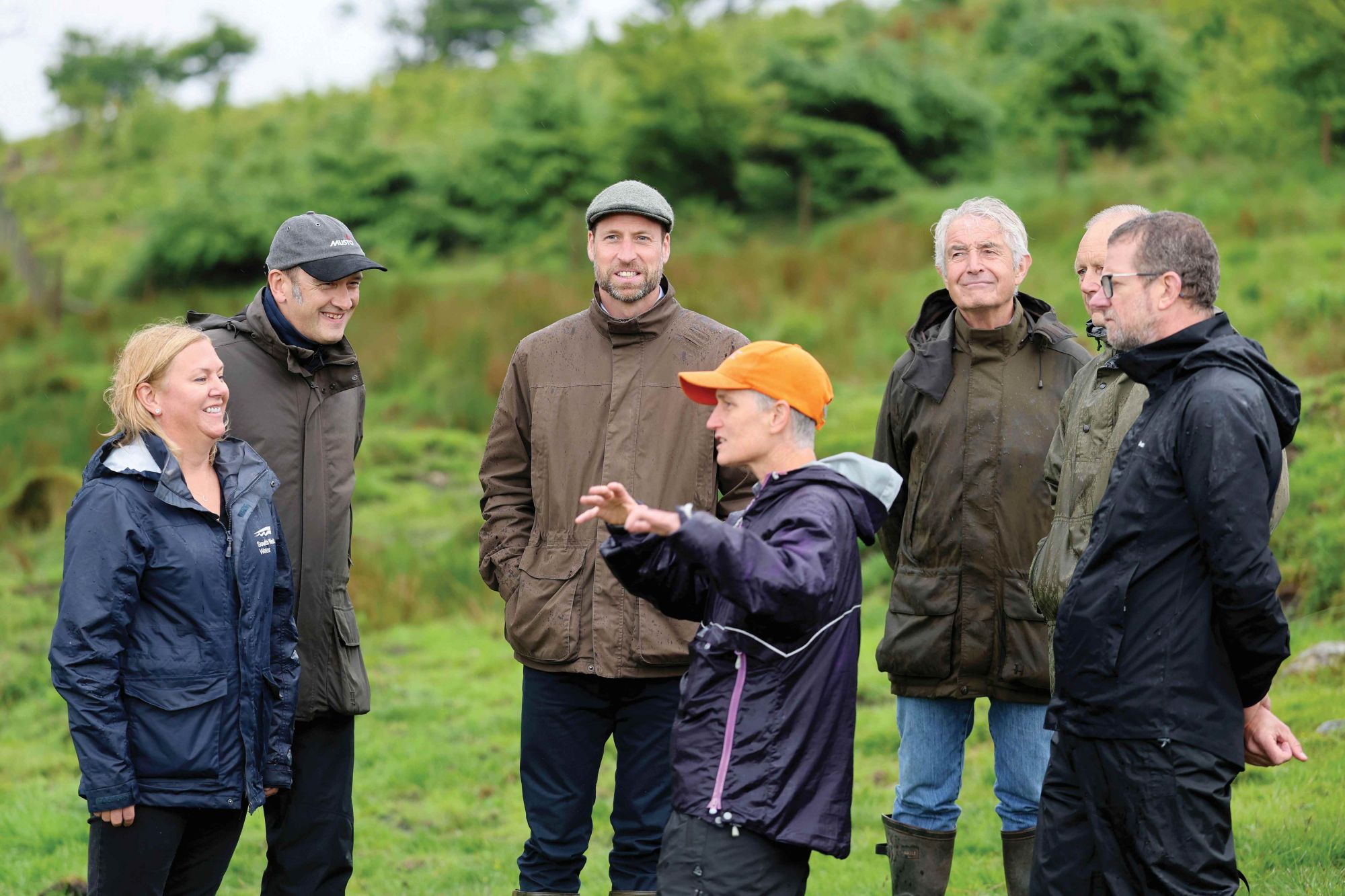 Dartmoor, June 2025: The Prince of Wales (centre) and Tony Juniper (third from right) during a visit to Tor Bog, an area of restored peatland (Credit: PA Images / Alamy)
When it comes to developments approved by local councils, planning permission is already only granted where developers can demonstrate that their project will have a measurably positive impact on biodiversity, compared with what is currently there – a condition known as biodiversity net gain (BNG).
Earlier this year, however, the government consulted on changes to the BNG requirement. While Natural England has welcomed the prospect of seeing BNG extended to cover national infrastructure projects, the consultation also included a proposal to exempt smaller developments from the rules.
“Globally, the work that England has done on BNG has been seen as a real leadership position,” says Juniper. “Certainly, at the biodiversity talks in Colombia just a year ago, I sat on multiple panels where there was huge interest in what we have done, taking an idea and turning it into an actual, operationalised policy.
“I do hope that we will come through the consultation and the decisions that follow in a position where we’re still seen as leaders on the world stage with that particular approach, which is a good one.”
In overall terms, Natural England wants to “reframe nature as essential national infrastructure” in itself, “rather than simply a collection of rare species or interesting habitats”, Juniper explains.
Restoring nature, he argues, is also an issue of national security, as the country’s food security, water supply and resilience to climate change are all dependent on it.
Juniper’s point touches on recent debates over land use, as Reform UK, Conservative and even Labour MPs representing rural constituencies have argued that solar panels – a measure to combat climate change – can pose a threat to Britain’s food security when placed on farmland. According to Juniper, this claim over-simplifies the reality.
“Food is not the only thing we need to get from the square miles that constitute the land area of England,” he says.
“We need houses, we need infrastructure – including energy generation – obviously we need food production, we need places for nature to thrive and also to anticipate the effects of climate change, as well as to catch carbon. All of those are essential land uses, so saying that one trumps all of the others, I don’t think necessarily takes us very far.”
Far more land than is currently occupied by solar panels, he points out, is being used to grow maize for anaerobic digesters.
“If you look at the electricity per hectare, it is much more beneficial in land efficiency terms to use solar panels than it is grow maize for anaerobic digestion, bearing in mind that maize can be quite disruptive of soils, thereby limiting future food production prospects.
“So, there’s quite a lot of complexity in what is apparently a very simple choice – is it food or is it solar panels? The truth is that our land needs to produce a lot of very important and essential benefits for society, and one of them is linked with how we will achieve energy security long into the future.”
If you can imagine a ‘wild belt’ replacing the green belt, at the same time as houses being added there… you could see a real benefit
In its mission to get more homes built, meanwhile, the government has promised to redesignate “lower quality” parts of the green belt as ‘grey belt’ land.
Perhaps surprisingly, Juniper sees this as an opportunity, as he agrees with ministers’ rationale that the green belt – despite its name – is “not necessarily that brilliant for nature”.
Since its inception in the 1930s, the green belt’s main purpose has not been to provide outstanding beauty or host delicate eco-systems, but rather to limit urban sprawl. Juniper argues that home-building on this land should therefore be carried out in tandem with enhancing it for wildlife.
“Certainly, many of the green belt areas I’ve known over the years, they’re pretty poor for nature, and even though they are next to towns and cities, very often not accessible to people,” he says.
“So if you can imagine a ‘wild belt’ replacing the green belt, at the same time as houses being added there, with new areas of woodland, new wetlands, areas of grassland rich in wild plants, with footpaths and cycle paths, you could see a real benefit for nature at the same time as enabling housing provision close to existing transport hubs and town centre facilities…
“Some areas of green belt are not important for nature, but they could be made so much more valuable for nature in places where it really matters – namely, close to where people live.”
