"We're Not Squeamish": Westminster Is Slowly Waking Up To The Birth Rate Crisis
The total fertility rate in England and Wales dropped to 1.41 in 2024 (Alamy Live News)
13 min read
Parents of pre-school children in London are delighted: thanks to our collapsing birth rate, it seems the catchment areas of good local state schools keep getting bigger.
But there are major downsides to declining fertility – the small question of how to sustain our economy and public finances with a rapidly ageing population, for example.
With the total fertility rate in England and Wales continuing to drop – reaching 1.41 in 2024, well below the replacement rate of 2.1 – the reality of a shrinking workforce, reduced tax revenues and unaffordable state pensions is looming.
We are looking not just at a one-off population contraction but at each generation being smaller than the one before. The newly published American national security strategy lists “cratering birthrates” as one of Europe’s major problems and a contributing factor to the “stark prospect of civilisational erasure”.
While Westminster dwellers might be expected to take an interest in this crisis, it often seems to be the problem that cannot be named, for politicians do not want to appear anti-feminist or overly interfering in people’s personal lives.
“I’m not going to lead a, sort of, birth plan,” said Keir Starmer last year. “I've spent my whole time saying I'm not going to tell people how to live their lives – I'm not going to start by dictating whether they should or shouldn't have children."
When The House interviewed Kemi Badenoch in September, asked about solutions to plummeting fertility, she said: “I'd like to think that I was setting a good example with having three, but I don't think that the government can mandate these sorts of things.”
“A lot of the reasons why people don't start families are economic,” the Tory leader added, citing good jobs and housing as necessary answers. “Some of them are also not meeting the right person at the right time. That's very hard for the government to do; to help. You can't set up a government dating agency.”
One party leader did recently raise the issue: the Green Party’s Zack Polanski. In a Question Time appearance earlier this month, he stressed that immigration is needed because “we have an ageing population, a declining birth rate, and we have pensions to pay”.
“One in five care workers are foreign nationals. I don't know about you, but I don't particularly want to wipe someone's bum,” he added. This framing was widely criticised for being more exploitative than progressive, but the idea that demographic problems should be solved by migrants is common on the left.
Reform’s surging popularity with women should be a warning
The House can reveal that the other insurgent party, Reform UK, is now basing its policymaking around the birth rate issue. Naturally, it is not looking to migration as the answer.
Defector MP Danny Kruger, who is leading the party’s preparations for government, James Orr, the academic and theologian who is now a senior adviser to Nigel Farage, and Zia Yusuf, the head of policy, are all keen on a natalist agenda. “We’re not squeamish about it,” notes one Reform source.
They are conscious, The House understands, that the pro-immigration argument is driven in part by the UK’s demographic imbalance. “The answer is, import young people or grow our own. We’d rather grow our own,” says the same source.
Those who believe the immigration solution is impractical argue that migrants may initially tend to have more children but drop toward the national average within one or two generations, which leads to a “treadmill” as continual escalation is needed. They also contend that immigration usually requires immediate infrastructure – most notably housing – whereas the newborns of families already living here do not. Above all, though, of chief import in Westminster is that immigration is out of favour politically.
Reform UK insiders recognise that the current economic model makes it difficult for families to have children early and to have more than one or two. One cause, they believe, is that our higher education model means young men are not enabled to take responsibility early enough in life.
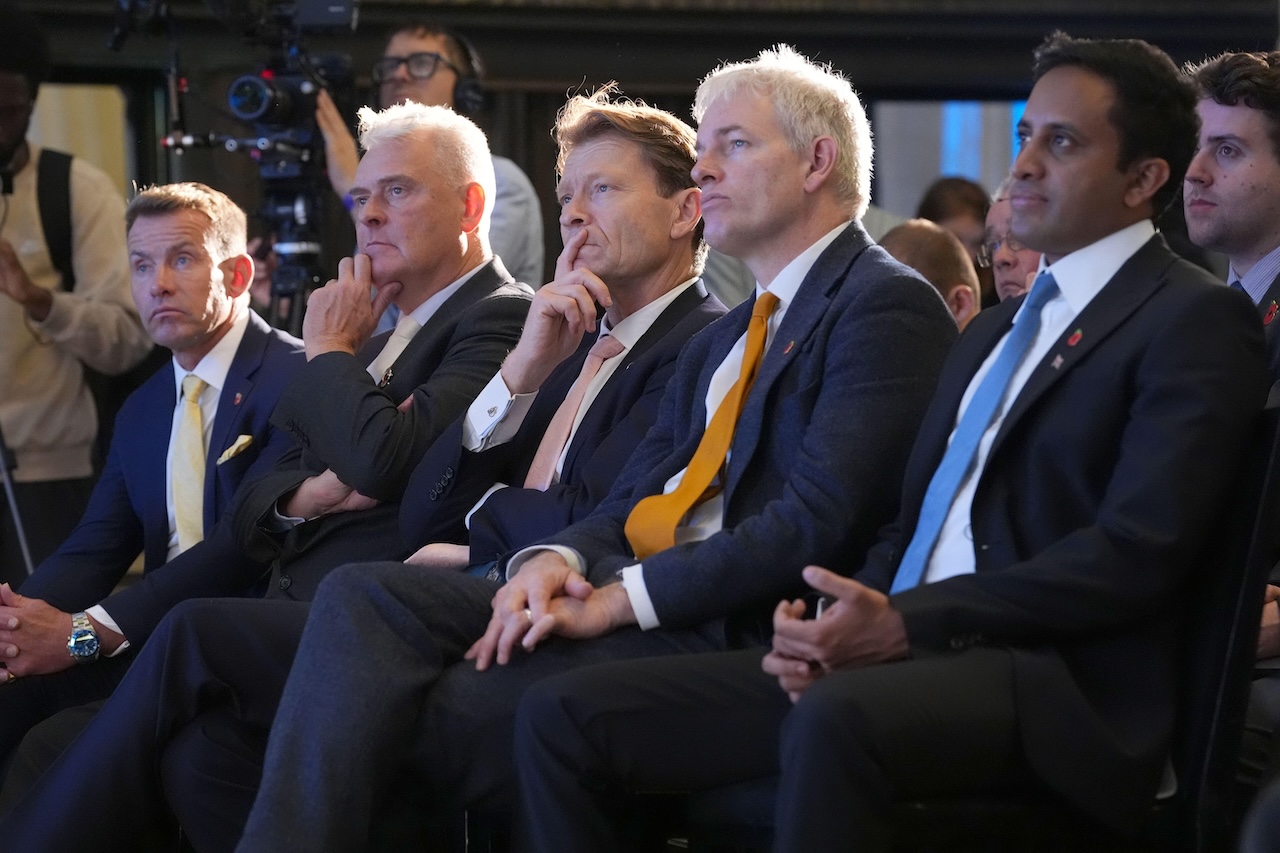 (L-r) David Bull, Lee Anderson, Richard Tice, Danny Kruger and Zia Yusuf listen to Reform UK leader Nigel Farage, November 2025 (PA Images / Alamy)
So, how should the government make it easier for people to have the children they tell researchers they already want?
The evidence about which initiatives are effective is still unclear, but Reform thinkers have concluded that pro-family policies in Hungary and, to a lesser extent, France seem to have some effect, if marginal. (Viktor Orbán’s expensive pro-natalist policies were credited with increasing Hungary’s total fertility rate from 1.4 to 1.6 – still far short of the level needed to prevent population shrinkage.)
Reform’s support of tax breaks for married couples does not stand now that their economic policy slate has been wiped clean, but sources say meaningful support for married couples will be part of their new plans. As for childcare, there is deep scepticism of the approach taken by both the Conservatives and Labour, which put expanding funded hours for more and younger babies at the heart of their early years plans. A senior Reform source calls this “disastrous” and “really expensive”, and says parental choice will be prioritised by their party instead.
This will appal some feminists and delight others. Education Secretary Bridget Phillipson had appeared wary of venturing into this topic until, in June, she expressed concern about the falling birth rate. “I want more young people to have children, if they so choose,” she said, suggesting that opening new nurseries would help with this ambition. A source close to her says the trend is obviously a concern, but it is a complex picture.
Fiona MacKenzie of The Other Half, a non-partisan think tank that focuses on policy for women, says the New Labour government “offered ambitious support for families” via Sure Start’s first mission of supporting parents to parent and funding for grandparents to provide childcare. But the consensus has since shifted towards professional childcare, despite research that shows mothers want more – not less – time with their children.
“The modern SW1 offer is now largely aimed at getting parents – mums – to work more after a baby, and using cheap childcare to do it. Those on middle incomes no longer get a choice about how they look after their young children: being a stay-at-home mum for a few years, or working part-time, are seen as a luxury afforded by those who can afford not to work,” she says.
“In the 1990s, Germaine Greer called for mothers to be funded to look after their children as an alternative to paid work: it’s wild that Nigel Farage is the closest thing today’s women have to this feminist ideal.
“Caring for others is held in contempt by some in SW1 – and it’s more than wiping bottoms, Zack Polanski! – and of zero value by the rest. Reform’s surging popularity with women should be a warning that Westminster has taken the wrong track in thinking that motherhood is a valueless activity.”
I wouldn’t be surprised if the Conservatives do develop something. The difficulty they've got is their pensioner vote
Miriam Cates, the former Conservative MP who is now a GB News host, has similar views. She has long campaigned on the fertility rate issue and bemoans the UK’s lack of interest in it.
“We are one of the few countries in Europe that aren't talking about this at all, and where it's still seen as a marginal issue that only traditional conservatives are interested in – and even then, only a handful of people are actually talking about it or understand anything about it,” she tells The House, pointing to Hungary, France, Italy, Poland and Finland as proof Britain is an outlier in this regard.
“Severe ignorance in Westminster is our key problem. Many people in Parliament and in Westminster do not understand how desperate the situation is, and we've still got people on the right saying, ‘We just need to deregulate a bit, then we'll get our economic growth’.
“Growth has partly slowed down because we're not producing enough young people to drive it. One of the things Margaret Thatcher benefited from in the ‘80s was the baby boomers coming of age, joining the labour market and being dynamic.”
Will the Tories find the political motivation to confront the fertility rate head-on? “I wouldn’t be surprised if the Conservatives do develop something. The difficulty they've got is their pensioner vote. Because unfortunately, in my experience, pensioners don't seem to understand how important it is that people have children,” says Cates.
“If they come out and say, ‘We're going to scrap the triple lock and use it to fund family allowances’, that's going to hit their vote, so they’re in a difficult position politically.”
Cates is in favour of offering incentives through tax breaks rather than state-funded childcare, which she describes as “the last thing that women want and the last thing that children need”.
“There's no evidence that more childcare pushes up fertility rates. Scandinavia has got some of the most generous childcare policies in the world, and they've also got some of the lowest birth rates. If that's the only lever that government thinks is useful, then it's not a good one.”
She also believes that the two-child benefit cap – now being dumped, following Rachel Reeves’ backbencher-focused Budget – was harmful in terms of public attitudes to fertility.
”I'm not convinced the two-child limit has had a big impact on the birth rate, but I think that framing of having children as a private pursuit rather than a public good has had a big psychological impact on the nation,” she explains.
“I absolutely do not think there should be a two-child limit. Either you shouldn’t get any additional benefits from having children, or it should be unlimited. Because it's absurd that the government should say two children is enough. Enough for what?”
 Georgian babies are baptised at the Holy Trinity Cathedral in Tbilisi, Georgia. Many of the parents said Orthodox Church Patriarch Ilia II was instrumental in their decision to have a third or fourth child. May 2012 (AP Photo / Shakh Aivazov / Alamy)
While no Labour MP was heard making the case for ditching the cap on this same basis, there are signs that some – particularly among those who came in at the last general election – are starting to turn their attentions to the birth rate.
Cabinet Office minister Josh Simons has noticed the normalisation of two children or fewer in daily life. “I’ve got two kids at the moment, and our third is due in April. It has been fascinating,” he says.
“When telling people about the fact that we're having a third, the reaction compared to saying you're having one or two is strikingly different. When you have one or two, people go, ‘Oh, great, that's amazing!’. When you have three, people are like, ‘Whoa, what were you thinking?’”
Simons is interested in the birth rate because “I care about big, slow problems that our politics is not very good at thinking about”, he explains. “There are few better examples than the fundamental incompatibility between the things we want our state to do, our birth rate of 1.41, and a clear preference to reduce migration. Those things cannot all remain true. One of them has to give.”
“Policy is a necessary but not sufficient answer to this problem,” he adds. “It is definitely too expensive and exhausting to have kids in this country, and we should change that. Partly, we should change that, not just to increase the birth rate, but because it sends a signal about valuing children.”
“We should acknowledge this as a major challenge that our country is facing, and one that should shape policy,” Fred Thomas, the backbench Labour MP for Plymouth Moor View, tells The House. “That national conversation has not been happening, and yet it's a symptom and a driver of many of the systemic challenges that successive governments have spoken about and tried to deal with.”
Asked what he identifies as the root causes of the falling fertility rate, Thomas replies: “I think it's mainly due to factors that affect both men and women, such as how unaffordable life feels and looks, how unaffordable the future looks,” before also pointing to changes in coupling.
Experts disagree on the explanation for falling global birth rates. The crash has been linked to the introduction of the contraceptive pill, the decline in religiosity (the religious tend to have more children than the secular), and our fortunately low infant mortality rate (people have more children when they are under threat, partly explaining both Gaza’s and Israel’s high fertility rates). None of these accounts, even if true, is very helpful for UK policymaking.
We’re running this giant Ponzi scheme to fill the void being left by the declining birth rate
The rationale Labour politicians are typically most comfortable with is personal finances. It aligns with their politics, which centres the cost of living, and often their own experiences. Indeed, The House understands that some ministers have looked at not taking their full salary entitlement, so they do not breach the £100,000 salary cliff-edge at which eligibility for most funded childcare hours is lost.
Other accounts are not materialist ones but cultural: from factors like the widespread increase in ‘intensive parenting’ – the child-centred, sometimes emotionally draining, approach now taken to child-rearing – to coupling changes, which have seen a rise in singlehood. The Economist has calculated that the world has at least 100m more single people today than if coupling rates were still as high as in 2017.
Writer Johann Kurtz rejects conventional explanations and instead argues that status-seeking behaviour is fundamental. He points to a cheap initiative that appears to have been highly effective: Georgia became one of the few countries defying fertility trends when the spiritual leader of the Georgian Orthodox Church, Ilia II, announced that he would personally baptise and become godfather to all third children onwards. Fertility, he writes, is subject to strong mimetic effects: there is evidence that a person’s chances of having a child increase significantly after a close friend has one.
While valuing children and parenthood more does not seem very controversial, it is tricky for politicians to take aim at cultural trends even if they want to. Jonathan Hinder, a 2024 intake MP who belongs to the economically left, socially conservative Blue Labour tradition, is happy to give it a try by resetting norms – and dismisses immigration as a solution.
“We’re running this giant Ponzi scheme to fill the void being left by the declining birth rate, and a lot of progressives seem to want to lean into that: ‘We need to pillage the developing world for workers.’ It is very odd that so many assume that it is a good thing.”
For him, the birth rate problem can be addressed with a quintessentially Blue Labour narrative.
“The whole policy framing should be: how can we get back to a stage where – man or woman – one person can spend most of their time looking after small children and the other partner be at work, and they still have a good life? Rather than what we seem to be going towards, which is: let's make it as easy as possible for you to have children, but never spend any time with them.
“Take the childcare policy to its logical conclusion, and it seems to be about getting mums back to work, paying taxes, as soon as possible. I’m not advocating for a return to the gender stereotypes of the 1950s family here – far from it. This is about parents, men and women, getting to spend time with their children.”
