The Professor Will See You Now: Opposition
Illustration by Tracy Worrall
4 min read
Lessons in political science. This week: opposition
George Tierney, leader of the opposition in the Commons between 1818 and 1821, has two main claims to fame. The first is his duel with William Pitt the Younger, after the prime minister had accused Tierney of insufficient patriotism. And second, it is from him that we get one of the most famous expressions of the role of the opposition: to propose nothing and to oppose everything.
Up to a point, Lord Copper. Because it turns out the principle of most pieces of government legislation is not opposed by the opposition.
Richard Rose demonstrated this back in 1980 by examining the votes on bills’ Second Reading (the vote on the principle of the bill) and Third Reading (the vote on the bill as finally constituted). Rose showed that, despite all the talk of knee-jerk opposition, the opposition rarely voted against more than a quarter of government bills.
Even at the height of adversarial politics between 1979 and 1983, with the gulf between the two parties at its widest since the Second World War, the official opposition, then Labour, voted against just over a third of the Margaret Thatcher government’s legislation at Second or Third Reading.
Or look at the last time Labour were in government. In the 1997 parliament, the Conservatives opposed 41 per cent of government bills at Second or Third Reading. That fell to 32 per cent in 2001, and 20 per cent between 2005 and 2010.
In other words, William Hague’s Conservative Party voted against the principle of about two out of every five bills. Under Iain Duncan Smith and Michael Howard, that fell slightly, to just under one in three. And under David Cameron it fell yet further, down to just one out of every five pieces of government legislation; at one point, Cameron’s Conservatives failed to vote against the principle of a government bill for a full six months.
Despite all the talk of knee-jerk opposition, the opposition rarely voted against more than a quarter of government bills
And now? Of the 37 government bills that have had their Second or Third Readings in the Commons since the election, the Conservative frontbench has opposed the principle of 16. I include here all reasoned amendments – of which there are currently a lot – and votes at either Second or Third Reading. That’s 43 per cent – not far from the figure seen in the first session of the 1997 parliament, at 36 per cent, with the caveat that we are not yet through the full session and there is more legislation coming down the tracks.
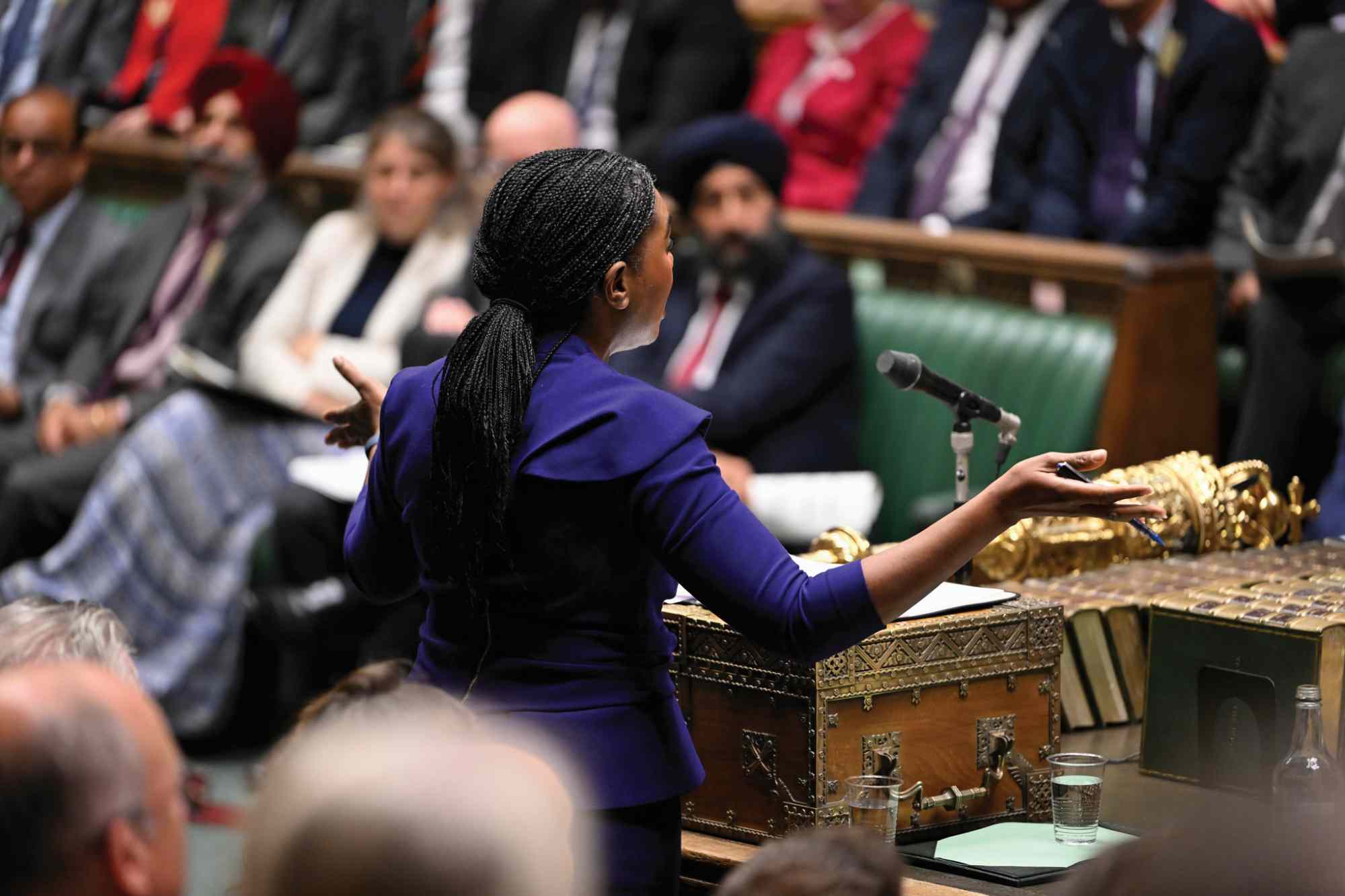 Kemi Badenoch at PMQs, September 2025
(Image courtesy of UK Parliament)
There’s a further three bills where parties other than the official opposition forced a division, but where the Conservatives abstained, and I’ve also excluded the Tobacco and Vapes Bill, where Conservatives and others on the opposition benches had free votes.
Of course, many of these bills have been opposed in Committee, at Report, or in the Lords – but that’s detail, not principle. If there was universal knee-jerk opposition, we would expect to see it at Second or Third Reading.
A new research paper, just out in Government and Opposition, examines the patterns of opposition in four established democracies – including the United Kingdom – over 75 years, attempting to work out the conditions under which parties decide to oppose (or not) government legislation. Comparisons across countries are difficult, both because different parliaments have different procedures, but also because the incentives will differ. In multi-party parliaments, with coalition governments, votes like these can be a way of signalling potential partnerships to government.
For the most part, life is simpler at Westminster. Based on analysis of just over 1,000 bills here, the authors conclude that the larger the differences between the positions of an opposition party and the government on a policy area, the lower the probability that the opposition party supports the government. Not every research finding needs to be counter-intuitive, I suppose.
Further reading: R Rose, Do Parties Make A Difference (1980); R van Well, To Oppose or Not to Oppose? Strategies of Opposition Parties’ Parliamentary Support for Government Legislation, Government and Opposition (2025)
