Gambling firms harm our men and boys. It’s time to stop their advertising
Image credit: Nathan Daniels
Nick Harvey, Director of Communications
| Coalition to End Gambling Ads
From football shirts to social media, gambling brands are normalising betting for generations of men and boys. The evidence of harm is clear, and the case for ending gambling advertising cannot be ignored, says Nick Harvey
Allegedly, the controversial adult content creator Bonnie Blue recently auctioned the name of her newborn to the highest bidder. An unlicensed gambling website reportedly bought it for $1.2 million. If true, Bonnie Blue’s boy is now called BetBolt. The operator didn’t mince words about the alleged business opportunity.
“We feel our brands have many things in common,” the site’s spokesperson told the media. “She quite literally f**ks thousands of men physically and we f**k thousands of men financially.”
Across the pond, actor Sydney Sweeney caused a furore of her own by appearing naked in ads for a gambling “prediction” site emblazoned across Times Square.
Here, ex-footballer Peter Crouch, wide-boy actor Danny Dyer and others frolic in ads for gambling sites that saturate television and the internet.
The sexualised, laddish tone of this advertising appears designed to appeal to men, and inevitably to the boys who will become men.
It’s no surprise, then, that men and boys are more likely to gamble, and men who do are twice as likely to be harmed than women who gamble.
The risk of suicide is also higher for men. Look at the heartbreaking “Remembering” page of the charity Gambling with Lives, which supports families bereaved by gambling-related suicide, where the men who’ve taken their lives outnumber the women 10 to 1.
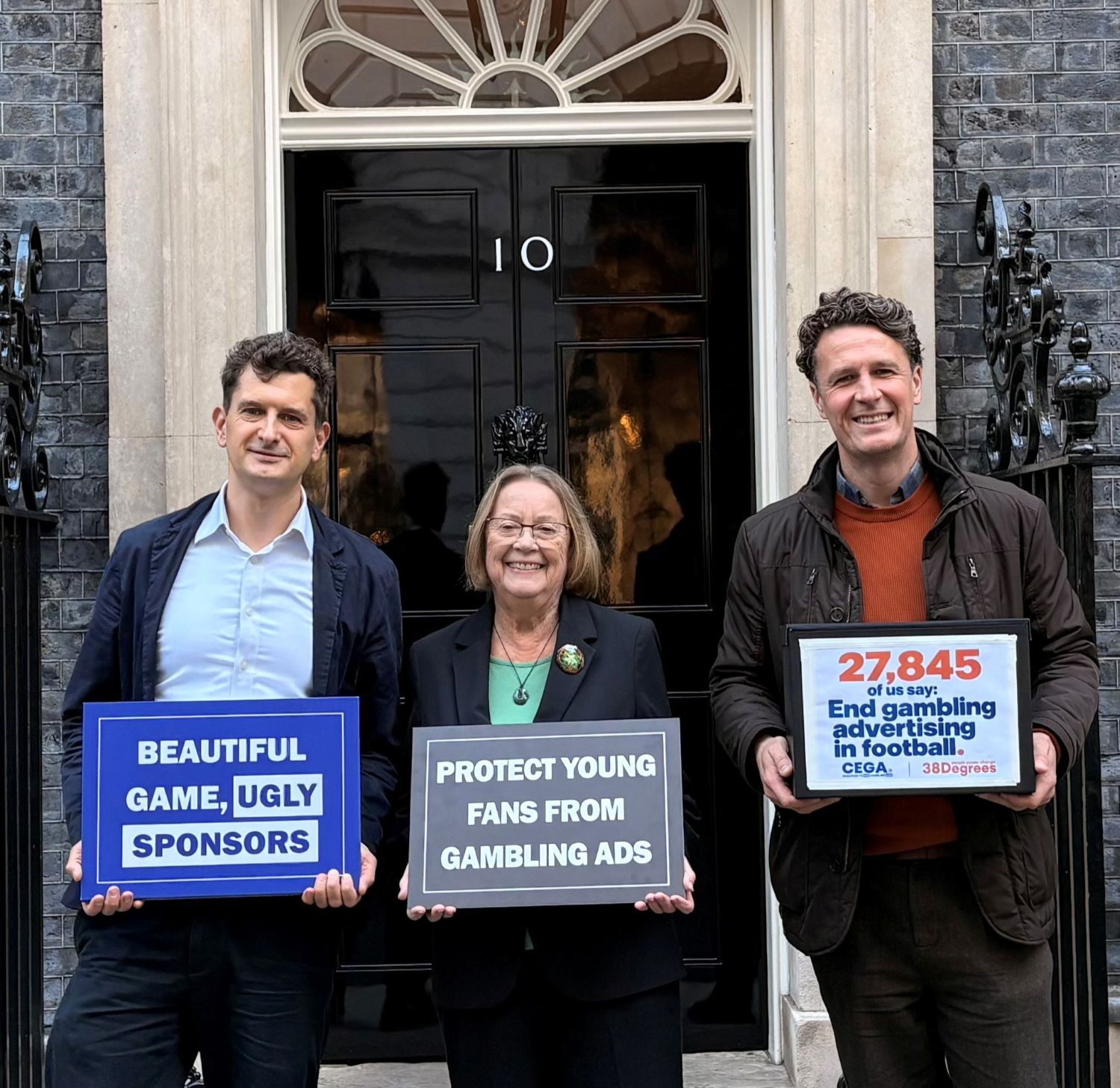 Will Prochaska and Nick Harvey from the Coalition to End Gambling Ads hand in their petition to 10 Downing Street with Baroness Bakewell (centre)
Last month, I gave evidence to the All-Party Parliamentary Group on Men and Boys in Westminster to explain why so many men and boys are harmed by gambling.
The explanation is simple. Research shows that a small percentage of customers drive the lion’s share of gambling revenues, but this creates a problem for the gambling companies when your best customers run out of money.
Some will go bankrupt. Others will suffer mental health problems. More than 600,000 people – roughly one per cent of the UK population – have self-excluded from gambling sites. Hundreds each year die by suicide.
These customers must be replaced, which is arguably why the gambling industry spends around £2bn a year on advertising, much of it male-focused.
Young people are particularly at risk, with more than 10 per cent of British gamblers aged 18–24 having a serious gambling problem. Tens of thousands of children in Britain experience gambling problems, while 34 per cent of boys aged 11–17 have gambled with their own money. Gambling premises are also disproportionately located in areas of high deprivation, where there are higher levels of people not in education, employment or training.
Football also exposes children to thousands of gambling ads during top-tier matches. Video games also familiarise children with gambling-like features, from lights and sounds to uncertain rewards such as loot boxes.
In the popular game Roblox, the problem goes further where children can earn “Robux”, an in-game currency that can be taken out and gambled in unlicensed casinos before being imported back into the game. Roblox told the media that the casinos are "in no way endorsed or authorised by Roblox" and that the company has taken "numerous steps to disrupt their activity”. Despite complaints, the Gambling Commission has not geo-blocked the illegal Robux casinos targeting young gamers.
Weak regulation is clearly part of the problem. The Advertising Standards Authority (ASA) rules against adverts that “appeal strongly” to children but often only retrospectively after investigating a complaint. Ex-footballers and ex-Eastenders actors do not strongly appeal to children by default, according to the ASA who assess it case-by-case, so they fill their boots.
When boys turn 18 they can legally gamble with the brands they know. Placing a bet on your team to win once or twice a week is one thing. But many are then cross-sold into the more harmful slot games, via free-spin offers, where they can bet every 2.5 seconds.
Stewart Kenny, Paddy Power's co-founder, believes this cross-selling is a major driver of the gambling harm which he calls “the biggest problem facing society for young males.” Interviewed last month, he said promoting slot games is like ordering “a shandy at the age of 18” and being offered “a triple-strength brandy on the house”.
The answer to all this is to end gambling advertising. The Coalition to End Gambling Ads (CEGA) brings together 67 organisations, including sports clubs, charities, credit unions, faith groups and 23 local authorities including Liverpool, Sheffield and Bristol, to campaign for a ban.
Before becoming Prime Minister, Andy Burnham signed a letter calling for an overhaul of gambling advertising. Last month, CEGA handed in a petition addressed to him to 10 Downing Street calling for an end to gambling advertising in football, a position he’s also supported when Manchester Mayor.
Critics once said Formula One would struggle without tobacco advertising. It went on to thrive, and football can too without gambling sponsorship.
For the sake of our children, including Bonnie Blue’s boy, that could be a crucial first step towards ending all gambling ads.
CEGA has a petition to end all gambling advertising in football.
