Two northern cities now lead the call to end gambling ads – offering Andy Burnham a quick win
Will Prochaska, Director
| Coalition to End Gambling Ads
This year’s Local Government Association conference was awash with councillors of all political stripes calling for action on gambling. For an incoming Prime Minister looking to signal change, reconnect with local politics, and boost “good growth”, action on gambling would be a popular policy
Gambling harm is no longer a side issue for councils. Last week the Local Government Association conference had no less than four gambling harm organisations in the exhibition hall.
Perhaps they were there because the financial and other costs of gambling harm – including homelessness, mental health problems, domestic violence, and suicide – are too often borne by local authorities, whilst central government takes the tax revenue.
Or perhaps it was because the independent harm prevention charities, frustrated with feeling ignored by the Department for Culture, Media and Sport, are turning to local politicians for help. Culture Secretary Lisa Nandy has spoken about how she wants the gambling sector to “thrive” whilst gambling lobbyists have maintained close engagement with her department.
Whatever the reason, the response from local government is striking. Councillors are channeling their residents’ anger over gambling premises taking over high streets, and the bombardment of gambling ads, and are standing up to call for change.
More than 80 councils in England have already banned gambling ads where they have the power to do so, and now Sheffield City Council and Liverpool City Council have joined 17 other local authorities in calling for a national ban. In the coming months the numbers of those joining the Coalition to End Gambling Ads (CEGA) is expected to swell, representing millions of residents, as well as parties across the political spectrum.
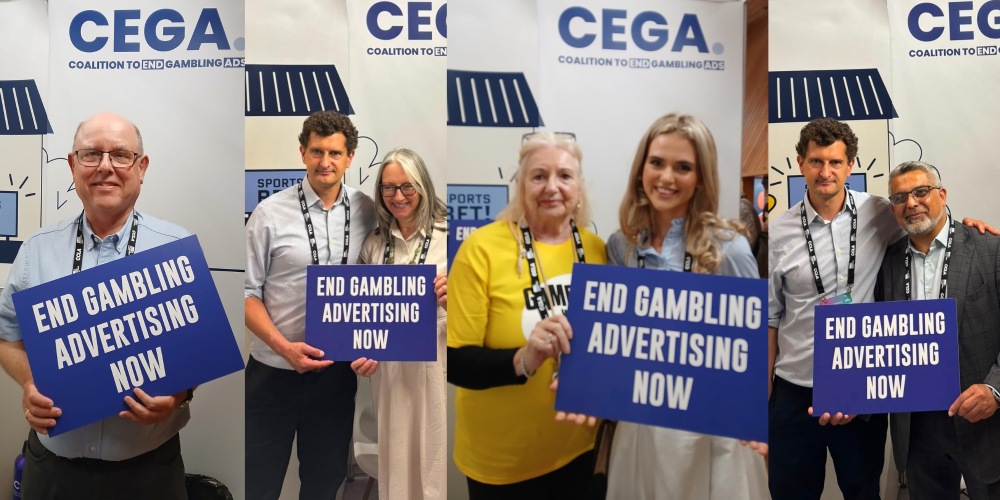 Left to right, Councillors Andrew Jarvis (Lib Dem), Caroline Topping (Green), Annie May O'Neill (Reform), and Muhammed Butt (Labour), at the LGA conference in Bournemouth
Andy Burnham has been one of the most vocal regional politicians calling for change on this issue. Last year he attended a meeting of the All Party Parliamentary Group on Gambling Reform to lament the rise of slot machine venues on the High Street.
Along with over 40 other local politicians he signed Brent Council’s letter to government asking for the end of Aim to Permit, a statutory principle that makes it almost impossible for councils to refuse licences for gambling premises. Crucially, that letter also demanded a prohibition on gambling advertising.
Chapter One is a leading gambling harm prevention programme delivering lifesaving information that was co-developed with Greater Manchester Combined Authority under Andy Burnham. In a video for Chapter One declaring his support for change, Burnham says:
“Greater Manchester has always been a leader in tackling the biggest challenges facing our communities and gambling harm is no exception. This is a serious public health issue, with consequences that extend far beyond finances. It affects mental health, strains families, and impacts entire communities.”
As Mayor, Burnham also supported two campaigns to get gambling advertising out of football. A keen Everton supporter, he will no doubt be dismayed that his club is sponsored by a casino that lost its licence after action from the Coalition to End Gambling Ads.
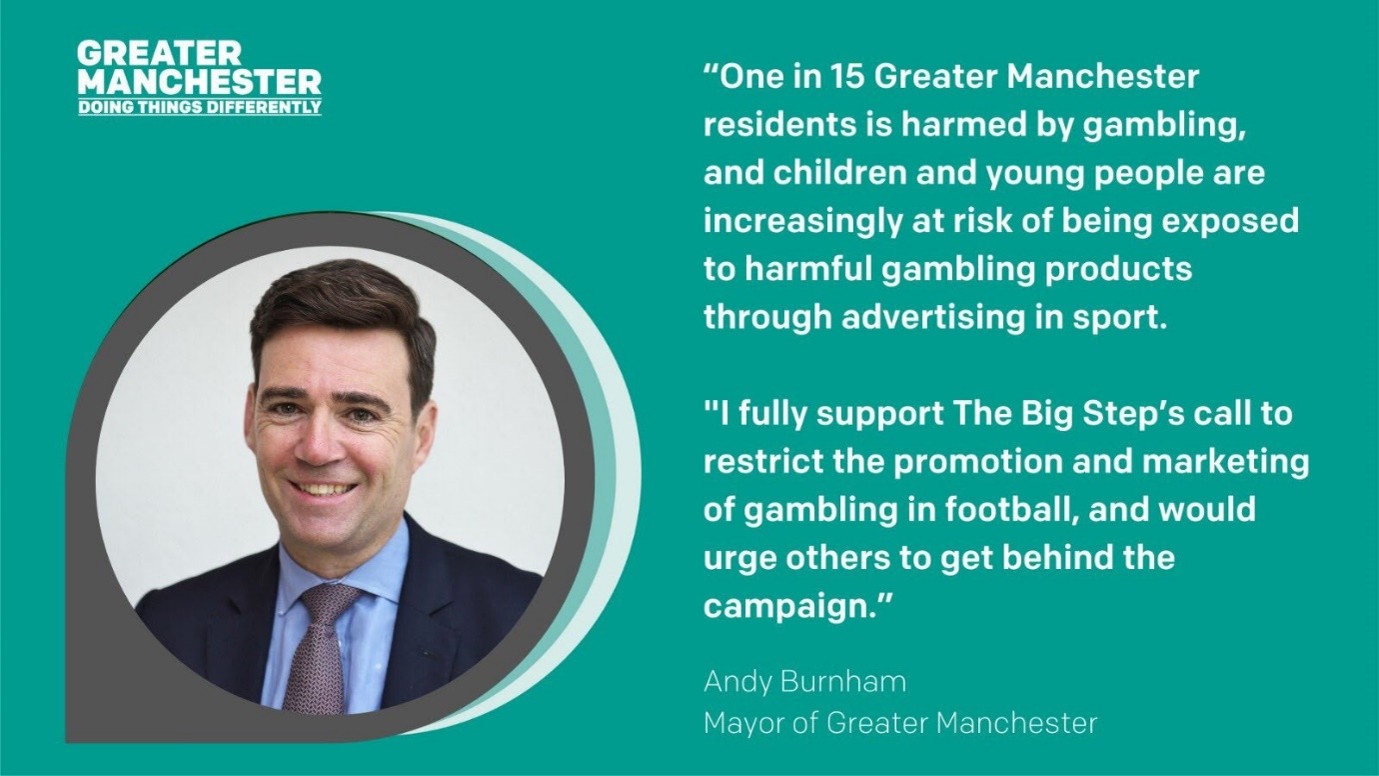 Andy Burnham has supported several campaigns against gambling advertising in sport
The good news is that once he’s in government this is a policy area that offers a quick, popular, and cost-free opportunity to break from the past. The economic case to clamp down on an out-of-control gambling sector is clear.
Sheffield University research this year found that a 10 per cent reduction in gambling would lead to a £1.25bn boost to the economy and over 22,000 new jobs. Many of the benefits of that growth would be felt in the most deprived areas that Burnham is so keen to support.
A new Gambling Act is desperately needed to fundamentally change Britain’s relationship with gambling, and that should be the goal for this parliament. But there are plenty of opportunities for a Burnham government to get on with change through rapid secondary legislation and alterations to licence conditions, not least delivering restrictions on gambling ads.
If Andy Burnham delivers on Manchesterism’s approach to gambling, then Britain is in for a popular boost.
