What Can the UK Government Do to Cut Energy Costs?
With household energy bills set to rise again, the challenge facing government goes beyond providing immediate relief. At a discussion hosted by EDF and Nesta, policymakers and energy experts explored how Britain can tackle the pressures facing households today while building a more affordable and resilient energy system for the future.
What if Britain's energy crisis isn't just a short-term spike? What if the repeated shocks, rising bills, and uncertainty facing households are becoming a permanent feature of the country's energy landscape?
It is an uncomfortable question, particularly as millions of households prepare for a sharp rise in the costs of energy this winter. But it was one of the underlying challenges explored at a recent discussion hosted by EDF and Nesta that brought together parliamentarians, policymakers and energy experts to examine what government can do to tackle persistently high energy costs.
The event highlighted the twin risks of Britain's continuing exposure to volatile global energy markets, alongside the substantial costs of transforming its domestic energy system. For millions of Britons, the immediate outlook is bleak. Despite measures announced in the Autumn Budget to ease the pressure on households, further increases in energy bills are on the horizon.
Josh Buckland, Director of Strategy, Commercial and Policy at EDF, gave a stark assessment of the outlook, forecasting a 26% rise in the energy price cap from January 2027, equivalent to around £450 on an annualised household bill. He warned that bills could remain above £2,000 throughout the year, highlighting that this has become a structural challenge, not simply a temporary spike.
 Josh Buckland, Director of
Strategy, Commercial and Policy
at EDF.
“This is an immediate affordability challenge, but also one that we will be stuck with for at least the next 18 months or so,” Buckland explained. “Clearly the price of gas is very uncertain, and that will be the key determinant, but there are reasons to think it won't come down that quickly.”
EDF is providing £30 million in support this winter, helping vulnerable customers with energy debts and essential appliances in partnership with charities including Age UK and Scope. EDF also believes there is a case for introducing a permanent, targeted social discount on energy bills from 2027 to support those most in need.
Ravi Gurumurthy, Chief Executive of Nesta, acknowledged that the absolute level of energy prices is a key issue for households, but he also highlighted the challenge caused by a growing sense of uncertainty.
“What is killing us right now is actually the incredible volatility due to geopolitical events, and that's what underlines the need to get off dependence on importing energy from abroad and decarbonisation,” he said.
One potential policy response to address that volatility was set out by Madeleine Gabriel, Mission Director for Sustainable Future at Nesta. She outlined a gas price stabiliser designed to protect households from sharp fluctuations in wholesale prices. Nesta has modelled that approach over five years, calculating that the intervention could be broadly revenue-neutral over that period. The objective would be to give households greater certainty about their bills without requiring permanent public subsidy.
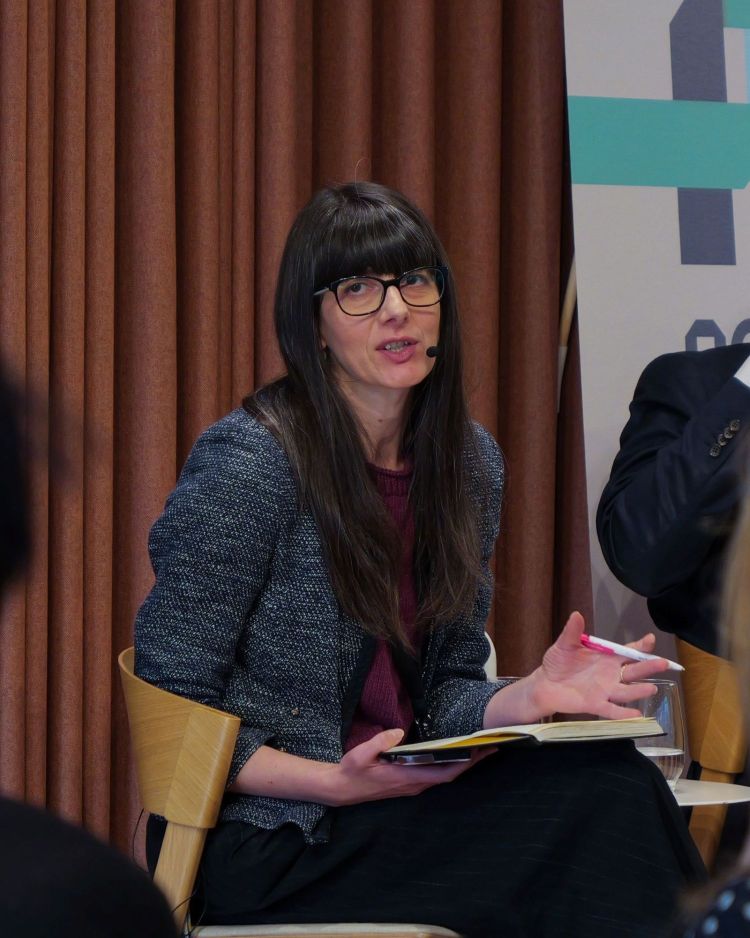 Madeleine Gabriel, Mission
Director for Sustainable Future
at Nesta.
“This would in effect subsidise gas when prices rise,” Gabriel argued, “but recoup that cost when prices fall to basically fix the cost of gas for a certain period.”
However, addressing long-term affordability and market volatility also requires a structural change in how we generate, store, and use energy. The discussion repeatedly returned to the importance of reducing Britain's dependence on volatile fossil-fuel markets through greater domestic clean-energy generation, electrification, and more flexible use of electricity.
Buckland argued that investment in new generation and network infrastructure must be matched by growing demand, allowing the fixed costs of building a cleaner energy system to be spread more widely.
“We have to better align our investment in clean power, principally renewables, nuclear and other forms, with the rates of electrification,” he explained.
Gabriel agreed, saying that the test of government intervention is therefore whether it can simultaneously address both immediate pressures and longer-term reform.
“When government is making interventions that are intended to give some short-term breathing space, I think a really important test is whether it also sets the direction for the longer-term path to electrification as well,” she told the event.
That twin-track approach sits at the heart of the challenge. Reducing the cost of energy and making it affordable for households are not necessarily the same thing. Wholesale prices, infrastructure investment and market reform all matter, but so do household incomes, existing debts and people's confidence in what they will be paying next month or next year.
Scarlett Maguire, founder of Merlin Strategy, set out how those pressures are being experienced by the public. Her focus group evidence suggests that marginal relief was widely perceived as inadequate against the scale of the increases that consumers expect to face.
“The Budget went down pretty well with the public,” she explained. “The thing that stood out to people the most was the £100 of relief on energy bills. This was seen as a nice gesture, but very much just a gesture. There was a lot of talk of, ‘This won't touch the sides.’”
That sense of insecurity in the face of rising costs is rapidly becoming an issue of politics, not just economics. Maguire suggested that energy costs are now central to a wider perception that living standards are deteriorating, even among households that would not traditionally consider themselves financially vulnerable.
 Dr Jeevun Sandher,
Labour MP.
It was a point echoed by Dr Jeevun Sandher, Labour MP for Loughborough. He told the event that energy affordability is contributing to a wider sense of insecurity and social division within some communities. That, he believes, is having a corrosive effect on our politics.
“Energy bills are now fundamentally one of the defining issues of our time,” he told the audience. “There are people who can't afford these bills who are poorer, they're angrier, and our nation is more divided as a result. You're seeing that on your screens, you're feeling it as you're speaking to people everywhere we go.”
That sobering assessment means that, in the longer term, success cannot just be measured in lower prices or cleaner generation. What matters most is that it is felt by people who are able to heat their homes without anxiety and plan their spending with confidence.
As one participant in a focus group conducted by Scarlett Maguire had said, “Putting heating on is like a treat these days. It shouldn't be like that.”
