EHRC Chair Mary-Ann Stephenson: "The Code Could Be Blocked – The Law Remains The Law"
Dr Mary-Ann Stephenson (PA Images/Alamy)
12 min read
When Dr Mary-Ann Stephenson became the new Equality and Human Rights Commission chair, she inherited one of Britain’s most bitter public debates. Speaking to Sienna Rodgers, she urges her critics to grasp that the regulator is simply applying the law on sex and gender – and dismisses Reform’s proposed bill for women as ‘motherhood and apple pie’
Taking on the job of chairing the Equality and Human Rights Commission (EHRC), Britain’s independent equality regulator, is no easy task in the current climate. Although the quango is responsible for enforcing non-discrimination laws on all protected characteristics, from race and disability to age, sexual orientation and belief, there is just one focus right now: the highly contentious matter of sex and gender.
Both the landmark review by Hilary (now Baroness) Cass of gender identity services in 2024 and the Supreme Court ruling in For Women Scotland Ltd v The Scottish Ministers, which established that ‘woman’ and ‘man’ in the 2010 Equality Act refer to biological sex, marked a turning point. This is when the ‘gender-critical’ perspective was perceived by many on that side of the debate as having become the establishment view and the concept of ‘self-identification’ was most clearly rejected. But these assumptions are still fiercely disputed by opposing activists and MPs.
So, when Dr Mary-Ann Stephenson succeeded Baroness Falkner as EHRC chair, she was fully aware that she was willingly stepping on a hornets’ nest.
“This is a debate that has become incredibly polarised and incredibly febrile,” Stephenson tells The House. “If we’d been able to have some of the discussions 10 years ago,” she posits, “we would potentially be in a better position in terms of the debate now.”
She has sympathy for those who steered clear, however: “It’s been quite hard for people who maybe want to find solutions that work for everybody but don’t want to get involved in that very heated debate. They have tended to leave the area and not take part in the discussions at all, or felt driven out. So, we are where we are.”
“I got really sick of being asked if I was Mrs, Miss or Ms, and I just thought ‘Dr’ would be a better answer”
Stephenson, 56, had “no ‘aha’ moment” upon becoming a feminist because she has always thought of herself as such. There is a photograph of her aged three or four wearing a T-shirt with the words: “I’m a new feminist”. Her mother, while not an activist, was the sort of person who shouted at the radio when she disagreed with what she heard. Feminism was simply part of their household culture.
Born in Wales to a mostly stay-at-home mum who had a master’s in demography (later going on to work at Oxford’s international development-focused Queen Elizabeth House) and a dad who worked in the motor industry, the family lived in Greece until Mary-Ann was seven. Families who worked at Ford formed an expat enclave. Returning to England, they moved around the South a lot.
Before turning to the EHRC, Stephenson was director of the Women’s Budget Group UK and previously of the Fawcett Society. She had joined Labour in the early 90s, once acting as constituency secretary. Her first degree was in English and media studies at Sussex, before she did a PhD in law at Warwick – mainly out of interest, appropriately for her current job, in the public sector equality duty. Also, because, “I got really sick of being asked if I was Mrs, Miss or Ms, and I just thought ‘Dr’ would be a better answer.”
Women and equalities minister Bridget Phillipson’s pick to replace Falkner was controversial from the start: both the Women and Equalities Committee and Joint Committee on Human Rights refused to endorse Stephenson.
“I was obviously disappointed. I wouldn’t have applied for the job if I didn’t think I was qualified,” she says, reeling off her CV – jobs at Liberty and Article 19, writing papers for the UN and Scottish Human Rights Commission, etc.
Her recent appearance at the Women and Equalities Select Committee made clear that, save for the two gender-critical MPs on it, the majority of members are fuming about the EHRC Code of Practice.
The updated code – finally published by government in May, nine months after ministers first received it – details how service providers must comply with the Equality Act, taking into account the Supreme Court judgment. It ruled that single-sex spaces are lawful only if they are defined by biological sex, meaning the ability of trans people to access them – regardless of whether they have a Gender Recognition Certificate (GRC) – must accord with their sex, not their gender identity.
“All the code does is explain to service providers how they can follow the law in a way that prevents them from both inadvertently discriminating against people, which we don’t want to see, and also being taken to court, which they don’t want to see,” says Stephenson.
Yet almost 150 MPs, at the time of writing, have signed a motion calling on the code to be disapproved by Parliament. One parliamentarian critic of the code describes it to The House as “unworkable with cruel results”. How does Stephenson respond to that charge?
“The code reflects the law,” she says. “If people are unhappy with what the law says, we are in a democracy, and they can argue to change the law.”
“It’s not clear to me yet what people find specifically unworkable about the code,” she adds.
Labour MP and former nurse Kevin McKenna has argued that single-sex wards in hospitals are a good example: in practice, you cannot staff a female ward, a male ward and a separate third one for a trans patient. If there is a side room available, he says, clinical need would dictate its use, so the code is “not going to survive contact with reality”.
Stephenson counters: “That is a problem because the NHS is overstretched. There is often a shortage of provision. Hospitals can be crowded. There can be problems finding beds for people. That is not a problem specific to our code of practice.”
Could those who want to change the law be successful in doing so? Stephenson argues they would have to contend with the “detailed reasoning” in the Supreme Court judgment that explained how accessing services based on legal sex – i.e. respecting GRCs – “would make those services unworkable, would make the definitions of sexuality incoherent, would take away protection for trans men who were pregnant”.
The alternative would be removing entitlements to single-sex spaces altogether, she concludes, which would be hard. “If you look at where public opinion is, all the studies – and there’s been multiple polling on this area – show a very high degree of support for single-sex services, and for those to be provided on the basis of biological sex. So, I think an attempt to change the law that would remove the right to single-sex services would be extremely unpopular.”
Either way, she thinks MPs mounting a rebellion are misdirecting their focus: “The code of practice could be blocked – the law would remain the law. All it would mean would be that service providers wouldn’t have proper guidance and might be more at risk of breaking the law and inadvertently discriminating against people.”
What, now, is the point of holding a GRC? Stephenson points to purposes such as marriage and pensions, as recorded legal sex still determines which gender is listed on your marriage certificate and how the state calculates your pension age.
But there is currently no legal documentation you can ask for to prove somebody’s biological sex as defined by the Supreme Court. Is that not a problem that needs resolving? Should legislators be looking at that?
“I mean, it does create an issue, right?” Stephenson acknowledges. “However,” she adds, “in most circumstances where we operate single-sex services, we don’t use legal documentation.”
She gives the real-life example of having been on a train station platform late at night when a man entered the women’s toilets.
“The woman washing her hands next to me at the scene said, ‘Oh you’re in the wrong room,’ and he left. Then, about five minutes later, we were on the other platform, she came up to me and said, ‘Is that the man we saw in the toilets?’ I looked, and it was: we saw him hanging around outside, then going back into the women’s toilet, at which point we went and told the guard.
“There are white men who have won cases under the Equality Act for both sex and race discrimination”
“The guard called for somebody to go and deal with it, and he had been hanging around, trying to get in and out. That was the sort of behaviour where you would expect people to take action. But people going about their day-to-day life, clearly massively disproportionate [to ask for legal documentation].”
The organisation Sex Matters, which intervened in the Supreme Court case, believes nonetheless that the discrepancy between legal and biological sex in official documents needs addressing.
The Sullivan Review, commissioned by the last Conservative government to look at sex and gender data, found that “the meaning of sex is no longer stable in administrative or major survey data” and that this “poses risks to individuals”, particularly in health settings.
Here, Stephenson does not agree with the gender-critical side of the debate.
“I don’t think there’s any plans to change those recordings of sex, because what the Supreme Court was looking at was the definition of sex in the Equality Act, not what documentation people have,” Stephenson says.
“I think, generally speaking, humans are incredibly effective in identifying the sex of strangers, which we do through multiple points of information, and there’s not a single indicator that we use.
“For example, there’s academic research showing that where you recreate 3D models of people’s faces, using photographs, taking out all the things like hair that might be an indicator, there is 96 to 98 per cent accuracy in identifying sex. Just on a 3D model of a face, where you’re not adding in anything else – height, gait, build, voice, all of those other things.
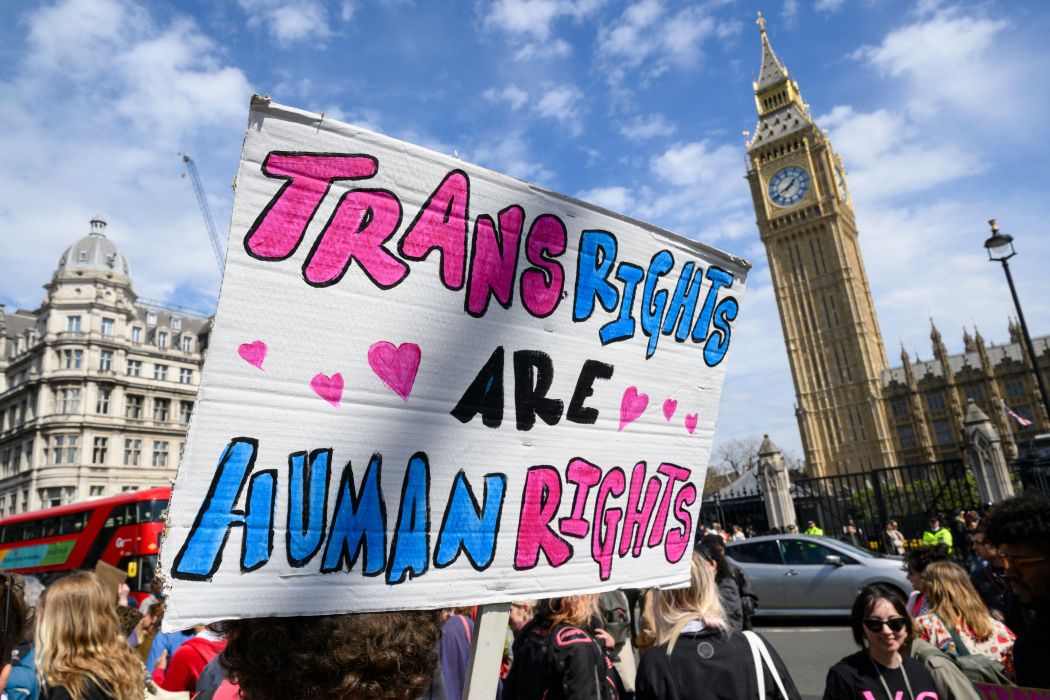 Trans rights protesters gathered in Parliament Square (Alex MacNaughton/Alamy)
“So, the idea that somehow something that we have done for decades, which is provide single-sex services, is suddenly no longer going to be workable, I don’t think that’s true.”
Stephenson certainly does not agree with those who would scrap the 2004 Gender Recognition Act altogether, as they think it is absurd that someone can acquire an official legal document that has what they would see as the wrong sex recorded on it.
“I think the Gender Recognition Act fulfils an important role,” she says. “It was identified at the European Court of Human Rights that trans people do have Article 8 rights to privacy, and that does include, now established in case law, a right to change your documentation.”
The other major challenge facing Stephenson is that Reform UK, currently the highest-polling party, has vowed to repeal the Equality Act – the legislation that created the EHRC. On this subject, the organisation’s chair sounds exasperated.
“When my mother was a young woman, after she’d had me, she went to the local council to inquire about jobs, and was told that it wasn’t their policy to employ married women because they wanted to keep the jobs for men. That was perfectly legal. It’s not legal now,” she says.
“Reform has said that the Equality Act doesn’t protect white men. There are white men who have won cases under the Equality Act for both sex and race discrimination,” she notes. “We all have protected characteristics.”
Removing the public sector equality duty, as the Conservatives have proposed, is met with a similar reaction.
A key purpose of the 'PSED' is “taking away the burden on individuals”, Stephenson explains: “Most people, when they have a problem, don’t complain, and they certainly don’t take legal cases, because it’s difficult and expensive and time-consuming.” The requirement for public authorities and organisations to consider equality before such problems arise is, for the EHRC, the sensible approach.
Reform has come back with a proposal for new legislation that would partly replace the Equality Act: the 'Women and Motherhood Protection Act'. “Motherhood and apple pie, yeah,” Stephenson interjects, with a flash of irritation.
“The Equality Act abolished all the predecessor bits of legislation. That’s how acts work,” she continues. “If you get rid of the Equality Act, it’s not like we could suddenly go back to the Sex Discrimination Act. You’d have to reintroduce the Sex Discrimination Act and the Race Relations Act and the Disability Discrimination Act.
“Then you would have to think about how most people accept that it is not right to discriminate against people on grounds of sexuality. That was something new brought in in the Equality Act.”
The EHRC’s budget has been cut drastically over the years – from over £70m in 2010 to £17.8m as of last year. Does that make her work difficult to undertake?
They are able to meet their legal requirements, Stephenson insists, but she adds: “Are we able to do all the work we would like to do? No. There is an awful lot more that we would like to do. If we had the same budget as we had when we were first founded, £70m, that would be worth over £100m. Now, I’d be happy with the 70.”
The Labour government intends to put into effect the socio-economic duty in the Equality Act that has never been enacted. This would place a duty on certain public bodies to consider how their strategic decisions might help to reduce inequalities arising from deprivation or low incomes. It would also be yet another responsibility for the EHRC. Is that going to be problematic given these budget constraints?
“We’ve also been clear to government that if we are to regulate those other areas – the socioeconomic duty, for example, or action the government wants to take on the race pay gap or the disability pay gap – we would need additional resources to do that.”
Before we part, Stephenson wants to reiterate that the body she chairs does far more than litigate arguments over sex and gender. “At the moment, there is a tiny focus on one tiny little area of our work. Actually, the extent of what we do is huge,” she says. “The EHRC is like an iceberg.”
It is clear Stephenson would rather spend our half hour talking about, say, the meeting on disabled people’s rights to transport that she has just come from. For now, though, the EHRC’s most visible identity will remain bound up with the bitter arguments over sex and gender. Whether she likes it or not, that is the hornets’ nest she has inherited.
