Violence Against Women And Girls Rises Despite Labour Manifesto Pledge
7 min read
A data investigation by The House has revealed a rise in violence against women and girls despite Labour’s 2024 pledge to halve it. Cristina Lia Trujillo reports
The Labour government is on a mission to halve violence against women and girls (Vawg) in the next 10 years – one of its most ambitious manifesto policies at the last general election. Yet a data investigation by The House has revealed that since 2024 Vawg has actually increased in the UK – despite a downward trend before that.
There were eight per cent more sexual offences in the UK in 2025 than in 2024, according to Office for National Statistics (ONS) data, with stalking and harassment and domestic abuse also increasing. Although the Home Office tells The House that an increase in reporting to the police does not necessarily mean that Vawg has also risen, the self-completion Crime Survey for England and Wales (CSEW) also shows some metrics increasing.
The news comes after Jess Phillips resigned as safeguarding minister last month, publishing a scathing letter that laid the blame for inaction over online child sex abuse squarely on Keir Starmer. It is “deeds, not words” that matter, she warned, using the suffragette refrain.
Birmingham City University criminologist Dr Max Hart says the increase in police-recorded offences and growing use of specialist services likely show different systems capturing different parts of an underlying rise.
“Schools, workplaces and online spaces are key sites whereby gendered harms are both produced, recorded and consumed. While we may have seen some formal progress in gender equality, the everyday production of misogynistic harms within these institutions remains,” he says.
“Thus, apparent changes in reporting behaviour, institutional responses and help-seeking can all impact data simultaneously as these underlying harms persist or intensify.”
Kevin Hoffin, a senior criminologist at the same university, adds: “I do believe there to be an increase in Vawg incidents over the last year, and I believe that a contributing factor [to] this is the experiences of immigrant women.”
A recent study by Women’s Aid showed that immigrant women were at an increased risk of domestic violence due to a range of structural factors, from barriers to advice to a national shortage of refuge spaces.
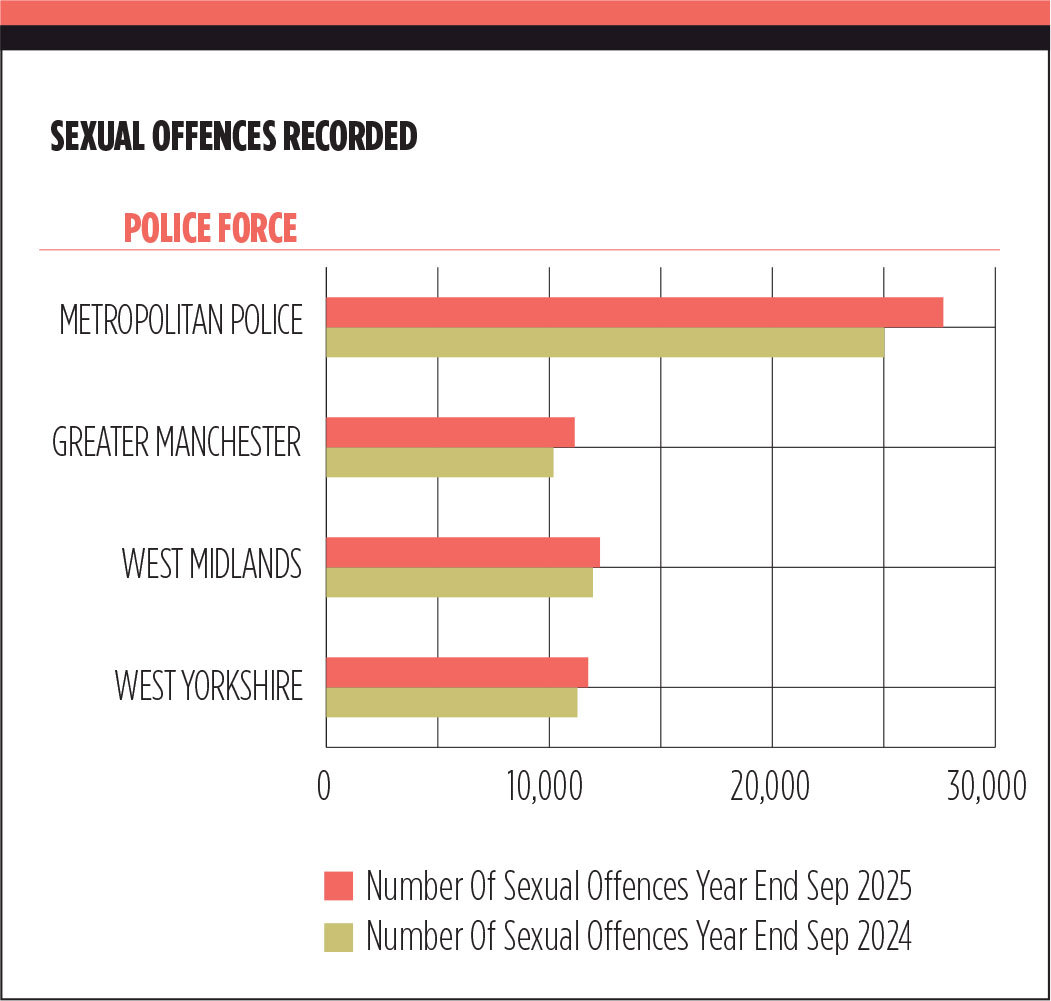
Hoffin points out that 31 per cent of Gen Z men agree that a wife should always obey her husband, according to a King’s College London study of 23,000 people released in March. Among Gen X men, the figure is 21 per cent – a difference of 10 percentage points. Sex offences went up in all of the UK’s Vawg hotspots – London, Greater Manchester, the West Midlands and West Yorkshire – which have seen more sexual offences than anywhere else in the UK consistently since 2022, according to the ONS data.
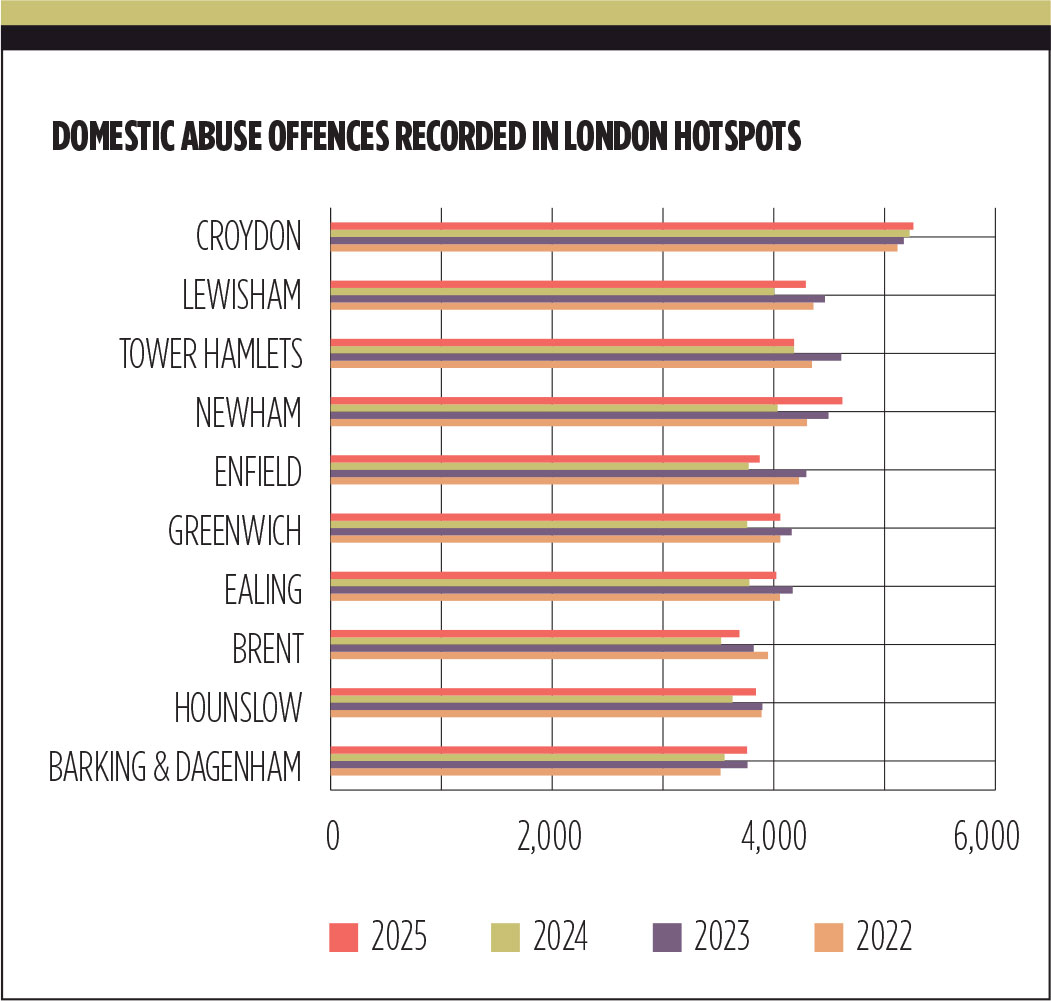
Reports of Vawg crime are highest in London, where domestic abuse rose in problem areas from 2024 to 2025 – 14 per cent in Newham, eight per cent in Greenwich, seven per cent in Lewisham and six per cent in Ealing, Hounslow and Barking and Dagenham.
Figures obtained by The House via the Freedom of Information (FOI) Act show that in Greater Manchester in 2025, there was a reduction in rape and sexual offence crimes with female victims recorded since 2018. However, both have increased in the area since 2024, along with violent crimes against female victims. Another FOI request revealed that femicide, domestic abuse, sexual offences and rape have gone up since 2024 in the West Midlands overall, and Birmingham in particular.
Meanwhile, the CSEW estimates increases of six per cent and 45 per cent in some types of Vawg, while trialling a new survey process and split sample to combine the different types of Vawg, which estimates a decrease in certain areas.
Jo Lovett, senior research fellow at the Child and Woman Abuse Studies Unit of London Metropolitan University, says: “The combined measure for Vawg is very new and still being developed and trialled, and it has a number of limitations, such as excluding certain forms of Vawg.”
While the new process is intended to foster a better understanding of Vawg in the long run, the ONS says the statistics produced are “subject to change as we evaluate future data and finalise methods”. While many ONS stats rose after 2024, domestic abuse, violent attacks against women and stalking and harassment fell between 2023 and 2024 in Vawg hotspots.
If there is a link between Labour’s work on tackling Vawg and an increase in reporting, it could be seen as a testament to the success of initiatives like Raneem’s Law, named after a woman who was murdered by her ex-husband in 2018, which was spearheaded in 2025 by then-home secretary Yvette Cooper. It placed domestic abuse specialists in nearly 1,000 control rooms across five police forces, aiming to increase specialist support for victims and improve emergency responses.
In 2023, Starmer made his promise to halve Vawg in 10 years following the publication of Baroness Casey’s review of policing, commissioned after the murder of Sarah Everard by a Metropolitan Police officer in 2021. Lovett called this “a laudable but ambitious target”.
Confirming its pledge after its landslide 2024 electoral victory, Labour proposed the Crime and Policing Bill in February 2025, which will be the main legislative vehicle in its Vawg strategy and is now undergoing the final stages of approval.
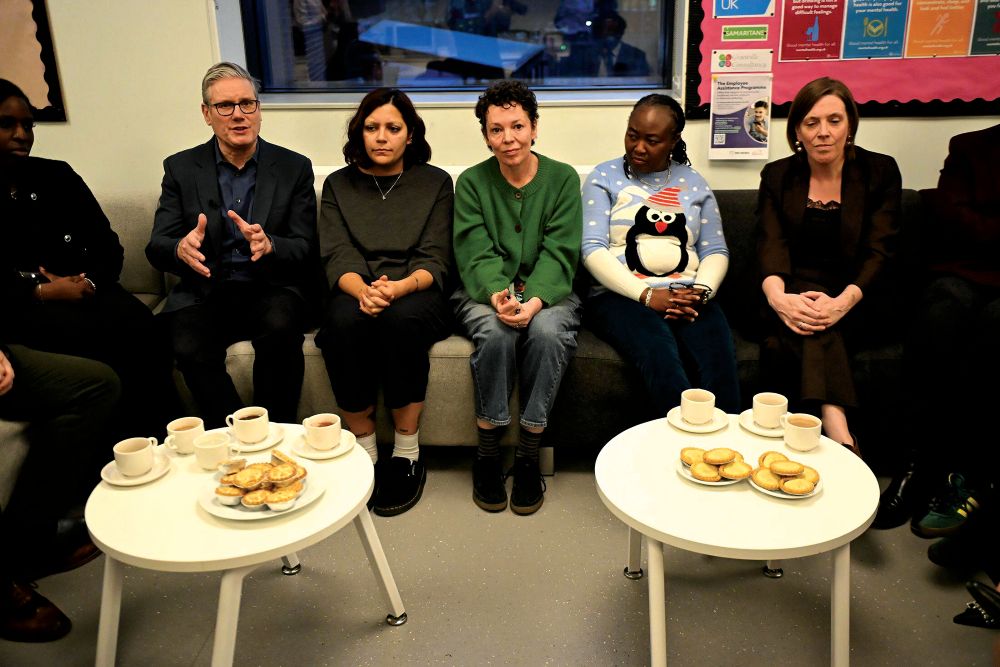 December 2025 Keir Starmer (l), with Olivia Colman (third from left) and Jess Phillips (r) at a school visit to discuss Vawg (Credit: Eddie Mulholland - WPA Pool/Getty Images)
The Online Safety Act 2023 criminalised cyberflashing and intimate image abuse, accounting for about 10,000 new crimes recorded in the year ending March 2025, while March 2026 saw Raneem’s Law finish its one-year pilot.
Labour then launched its Vawg strategy in December 2025, including new legislative proposals and funding and raising awareness around abuse, against the background of the MeToo-style discussion triggered by the Epstein files.
While this focus on Vawg may well be improving reporting rates, by empowering victims to inform authorities or police to respond, experts still cite funding and policy roadblocks.
The Vawg strategy asserts, for example, that “well-lit streets, accessible transport, and thoughtful urban design can deter violence”. But there is no mention of Vawg in the December 2025 amendments proposed to the National Planning Policy Framework, overhauling urban planning, transport and housing.
Solace Women’s Aid CEO Nahar Choudhury says: “While we welcome the fact that the government has committed more funding than ever before, there is still a long way to go to provide the sustainable support this sector needs.
“Unfortunately, the number of survivors isn’t decreasing; last year alone, Solace supported more than 17,000 women and children.” The year before, the organisation supported 14,435.
Women’s Aid CEO Farah Nazeer says: “We welcome the publication of the government’s strategy. It contains many welcome interventions… particularly in health and education, which will be critical for meeting the government’s own goals on prevention. However, the reality [is] that the sector remains in a funding crisis.”
She adds: “Services supporting Black, minoritised and migrant women have faced unacceptable rhetoric by certain politicians, which is further entrenching a hostile environment for migrants, including victims or survivors of abuse.”
Laura Riley, vulnerable victims co-lead for the British Society of Criminology’s Vulnerability Research Network, says: “Countless cases of police misogyny have also been exposed, and this has clearly impacted women’s ability to feel safe and protected.” She also raised cultural threats from “toxic narratives from the likes of Andrew Tate... to a desire to return to a more overtly patriarchal family structure”.
“There is evidence that those who weaponise the idea of ‘protect our girls’ may also be furthering ideas that contribute to keeping women and girls from feeling safe to express their needs and views,” Riley adds.
The Home Office welcomes the increase in reporting of violence against women and girls, saying: “It is vital that victims feel empowered to come forward, knowing that they will be supported and their cases taken seriously.”
It highlights tougher restrictions on registered sex offenders and strengthened protections for victims implemented by Labour, but continues: “Violence against women and girls is a national emergency… We know there is more to do.”
