"It's About Earning Consent": Inside The Labour Government's "Difficult Tightrope" On Immigration
Prime Minister Keir Starmer and Home Secretary Shabana Mahmood visited Peacehaven Mosque in Sussex after an arson attack on the site earlier this month (Alamy)
10 min read
Government insiders believe there is political space to set out a more positive case for legal immigration. But even Labour MPs who support a progressive shift admit that it comes with significant risk.
The government sees getting the number of illegal small boat crossings under control as being essential for Labour to stay in power at the next general election.
“The only thing that will restore trust among the British public is ultimately tackling illegal migration first and foremost, that's what's most visible in people's minds,” a government source told PoliticsHome.
Keir Starmer's decision in September to move Shabana Mahmood to the Home Office was seen as evidence that the Prime Minister is prepared to take a harder line to secure the country's borders.
But simmering under the surface is the perceived need for meaningful reform of the UK's long-term approach to legal immigration, which government ministers widely recognise is needed after nearly 4m people entered the UK following Brexit under visa relaxations implemented by former prime minister Boris Johnson.
The Labour government's challenge is to balance both the need to prioritise British jobs and appear tough in the face of right-wing political pressure on immigration, while also contending with the reality of business interests and stagnating economic growth.
Summarising the difficulty of the balancing act, one minister told PoliticsHome: “We need to do something on this, but it makes me nervous."
When it comes to legal migration, "contribution" is the word increasingly used by ministers.
It was a major theme of Mahmood's speech to Labour Party conference in late September, and, according to the government source, it is a thread that will “definitely run for the next few months”.
The Home Secretary announced that people seeking long-term settlement in the UK will have to meet new contribution-based criteria, including being in work, paying National Insurance, not claiming benefits, speaking fluent English, having a clean criminal record, and giving back to their community. The qualifying period for Indefinite Leave to Remain will also be extended for many migrants, rising from five to ten years.
PoliticsHome understands there will be announcements in the coming months about further reforms to the immigration system based around “contribution”.
“That is where we have support with the British public on migration,” the government source added.
“When people come to our economy, they pay their taxes, they contribute, they integrate well into communities across the country… that is where there is a positive net impact for Britain.”
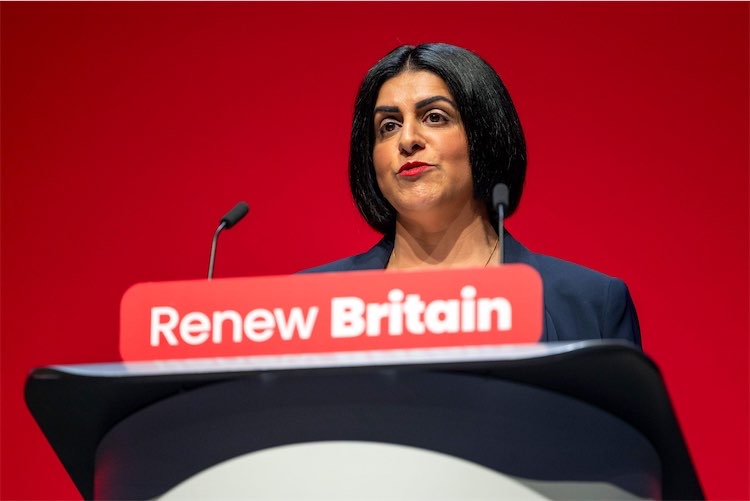 Home Secretary Shabana Mahmood told Labour conference in Liverpool that "contribution is a condition of that welcome" for asylum-seekers (Alamy)
Government figures believe there is a gap which they can fill in the centre-ground of immigration politics, which they think is being vacated by the Conservatives and Reform: being tough on illegal migration, but taking a more “balanced” and compassionate approach to overall immigration in the long run.
“There’s a dividing line that's coming out with both the Conservatives and Reform around Indefinite Leave to Remain, and what is a very disastrous policy to apply that retrospectively, which we think is horrific,” the government source said, referring to Conservative Party proposals to significantly tighten Indefinite Leave to Remain policies, including retrospectively for certain groups who arrived in the UK after 2021.
“There are many people in this country who have contributed over many decades, whose futures are now up in the air because of the very harsh rhetoric coming from them.
"So we understand both sides of the argument, and we've got to have a balanced approach here.”
A source close to No 10 agreed, saying that the tough rhetoric from the government on bringing migration numbers down was about building credibility to allow for future reforms to the immigration system.
“You don’t do that because you want to be the toughest people on migration,” they said.
“You do that so, at that point when inevitably the Tories and Reform end up in a death match over who can be the most hardline on immigration, you have earned your own permission to set out a sensible position on it.”
They added that it was not the case that Labour was primarily chasing after people who voted Reform in 2024, but were instead considering a huge group of traditional swing voters in the “middle of politics”.
“The Conservatives and Reform are fighting their own battle for a different voter than the Labour Party,” they said, but added that this “Middle England” voter still considered bringing down illegal immigration as a top priority.
Joining up the immigration strategy with a domestic skills agenda is seen by the government as key to finding this middle ground, which they began to set out in the immigration white paper published in May.
A report by the Good Growth Foundation (GGF), which came out in October, could offer some clues as to policies being weighed up by the government. The GGF report included polling which showed that while 74 per cent of the public are concerned about overall immigration, 68 per cent are comfortable with highly skilled immigration. It argued that voters’ concerns are not just about migration numbers, but about perceived pressure on jobs, housing and public services, and a lack of investment in British workers and domestic skills.
The report proposed a linked skills and immigration strategy with the aim of “rebuilding trust by turning immigration from a perceived pressure into a visible partnership” – including a “work to teach” proposal, which would require skilled migrants to train and mentor British workers.
“You can’t out-Farage Farage,” GGF director Praful Nargund said. “We need a progressive vision on immigration which welcomes contribution and commitment to our country while opening up opportunity here in Britain too.”
Another guiding influence for the government came in the form of a report by the Starmerite think tank Labour Together, published ahead of Labour conference. It argued for making the social democratic case in favour of controlled, legal migration, and for a National Migration Plan that sets out the level of immigration needed in each sector of the economy.
 Labour strategists and ministers told PoliticsHome that securing the borders would help the government "earn permission" for future immigration reforms (Alamy)
Could this be the start of the government making a deliberate, more positive case for skilled immigration to the UK? Another minister, who asked to be kept anonymous, told PoliticsHome it was “pretty simple”: "We either increase our birth rate, slash the state in half, or make the positive case for migration."
They insisted that this would need to be done alongside demonstrating control over borders and illegal migration: “Consent for a positive argument about migration is rooted in clarity about control.”
The source close to No10 said: “Rebalancing this migration system to improve the economy and improve the country would definitely be a welcome thing, but it depends on what that looks like."
As migration is a “weakness of public perception for Labour”, they said it was essential for the government to focus on “building credibility”. Home Office officials visited Copenhagen last month to study the strict immigration and asylum policies of Denmark, with the UK reportedly considering reforms modelled on the Danish system, such as granting only temporary residence for many asylum seekers and tighter rules on family reunification.
The source close to No 10 added that the thesis behind Starmer’s conference speech was that “migration can still be good, it just needs to be done properly”.
“This was the inevitable flight path for this Parliament; it was always going to be.”
Labour MP Chris Curtis, who is co-chair of the Labour Growth Group, told PoliticsHome: "There is a lack of nuance around migration discussions, and we need to change the economic and political conversation to being about how you become a more pro-growth migration system.”
He argued that taking a “skills conscious and growth conscious” approach could “quite dramatically alleviate voters’ concerns”.
This path towards a more positive case for migration could also be hastened by increasing anxiety around Labour losing voters to left-leaning parties.
Green Party membership has surged in the last month since Zack Polanski was elected as leader, overtaking the membership numbers of both the Conservatives and the Lib Dems. The party has also hit new heights in the opinion polls. The launch of Jeremy Corbyn and Zarah Sultana’s Your Party, while overshadowed by internal chaos, presents left-leaning voters with yet another alternative to Labour.
A survey by Thinks Insight & Strategy in May, shared with PoliticsHome, showed more than half of people who voted Labour last year say they are considering switching to the Liberal Democrats or the Greens at the next general election. Research by More in Common in June found that half of Labour’s remaining voters (48 per cent) believed that Reform’s policies on immigration are too strict, while two-thirds (65 per cent) of voters who have abandoned Labour for the Green Party or the Liberal Democrats believe that Reform’s policies are too strict.
PoliticsHome understands that some No 10 strategists have read a recent academic working paper that stated there is “no evidence that Labour’s adoption of nativist rhetoric diminished Reform’s appeal”.
Curtis said: “If you put more money in people’s pockets between elections, they vote for you.
“If you don’t, they don’t. So, actually, a pro-growth immigration policy is good for the economy, which is then good for the thing which drives more support.”
However, others are cautious of how this “pro-growth” approach could play out with voters.
Another anonymous pro-Starmer MP described the government’s approach to migration as a “really difficult tightrope”.
“You're trying to juggle the political and the economic narratives here,” they said.
“Keir’s conference speech was phenomenal, but still, there is an inner search for the political philosophy at the moment.”
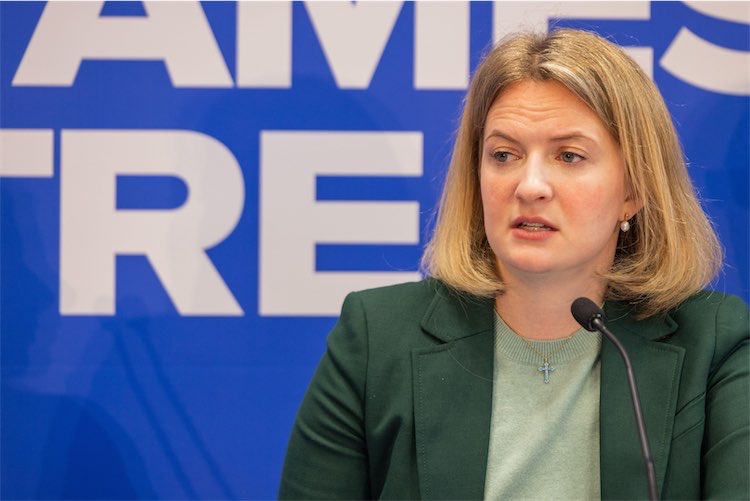 Conservative MP Katie Lam told The Sunday Times that deporting legally settled individuals would be necessary to make the UK “culturally coherent" (Alamy)
Labour MP Jonathan Brash, who is a member of the ‘Blue Labour’ group, which pushes more socially conservative positions within the party, said that in his view, immigration “always has to be the second option”.
“The actual numbers that matter are the number of people who are economically inactive who are British citizens,” he said.
“Where we want that number to be is zero. I want zero economically inactive British workers. If you can get that as close to zero as possible, then we can talk about how we feel about gaps in our labour market.
“We do need the partnership, but that starts by restricting, not opening up economic migration.”
Tom Baldwin, a former Labour adviser and biographer of Starmer, told PoliticsHome that “the argument is not fully settled” in government over whether to put more emphasis on stark moral and political differences between Labour and Reform, and that this is causing “dysfunction”.
“There are still people who want to do the insurgent thing, there are people who are against it,” he said.
“Of course, there’s a danger that you’re ceding dangerous, disruptive change to Farage – which is what a lot of Reform voters want. But there is a winning coalition [of voters] to be found in the 70 per cent of the country, ranging from One Nation Tories to Polanski fans, who are horrified by the prospect of far-right Reform.
“There is space to have a more rational conversation than the one we’ve been having.”
Baldwin said that Starmer felt he found his “authentic voice” in his conference speech in Liverpool by emphasising Labour’s dividing lines with Reform.
Starmer is guided by four distinct “wheels” of thinking, according to Baldwin: ‘Blue Labour’ concerns about the damaging impact of immigration and globalisation, the progressive argument for human rights and equality, the future-focused New Labour approach to innovation and tech, and social democratic priorities of industrial strategy, jobs in green energy, a strong welfare state and a sense of social justice.
“Those four wheels need to turn in the same direction for things to work,” Baldwin said.
“At times, only one has been spinning.”
