Jack Rankin: The Conservatives Must Bring Forward a 'Great Repeal Act'
Jack Rankin (Photography: Dinendra Haria)
7 min read
Conservative MP for Windsor Jack Rankin tells Sophie Church the Conservatives must bring forward a ‘Great Repeal Act’ to restore power to Parliament
The UK is in a constitutional crisis, according to Jack Rankin. Since Tony Blair came to power, politicians have yielded decision-making power to the judiciary. Antiquated legislation has the state in a chokehold. Bureaucracy reigns supreme.
A ‘Great Repeal Act’ would solve these issues, says the new Conservative MP for Windsor – removing all legislation causing the UK to decline.
“The thing we need to do is restore the British constitution, and that is going to be through some kind of ‘Great Repeal Act’, where we get rid of all the things I’ve just talked about: the Human Rights Act, the Equality Act and the Climate Change Act.”
Rankin says Kemi Badenoch’s policy team – comprising Neil O’Brien and Alex Burghart – “absolutely get this”, pointing to the announcement the party is expected to make at conference around withdrawing from the European Convention on Human Rights. Both Badenoch and shadow energy secretary Claire Coutinho think the Climate Change Committee has also “got to go”.
The House meets Rankin in his Richmond House office, which he shares with fellow Conservative MPs Joe Robertson and Katie Lam.
The space has an air of the sixth-form common room about it. Lam’s desk is orderly; those of Robertson and Rankin less so. The Windsor MP settles in an armchair for our interview, his stocking feet tucked underneath him.
“The changes the country needs are seismic,” he says with boyish energy, each new thought accompanied by some fidgeting. “We need to throw out the whole consensus – which has developed from, let’s say ’97 but probably before then – in the same way that Mrs Thatcher did in the ’70s. It’s not just a change of government we need. It’s a change of regime.”
Elected last year on his third attempt, 33-year-old Rankin grew up in Ashton-under-Lyne, now Angela Rayner’s patch.
His grandfathers both worked in factories and aligned themselves with the labour movement. His parents, however, grew up while Manchester was losing much of its industry and his first memories were of them going to night school on alternate evenings to secure business and accountancy qualifications. They went on to found a firm of electricians.
“It’s small fry for Windsor and Westminster,” he says. “But in terms of our family, that gave me and my brother life opportunities that my parents could never dream of.”
While not overtly political, he says his parents were viewed as “class sell-outs” for trying to improve their lot – in an area where Labour still “peddles the politics of grievance and dependency to working people, to keep them down and to keep them a client voter base”.
“All of my formative years of the Labour party in power, at no point did I see them trying to uphold people like my parents,” he explains. “I saw tax, I saw red tape, and I saw a sneering at working people as opposed to upholding them. So, I was quite politicised quite early.”
After studying maths and physics at Warwick University, Rankin went into commodities trading.
When working in mergers and acquisitions at Centrica, he remembers then energy and climate change secretary Amber Rudd changing regulations, meaning the business deal he was working on got “kiboshed at the last minute”.
“It just made me realise that we’re in the private sector trying to allocate hundreds of millions of pounds of capital – big strategic decisions – but with the stroke of a pen, the secretary of state can totally rewire the system,” he says. “It really landed with me that if you want to make substantive change in the country, the best place to do that is in the House of Commons.”
Rankin then made several forays into political life, serving as a Windsor and Maidenhead councillor for four years, then running unsuccessfully against Rayner in Ashton-under-Lyne in the 2017 general election, and in Warwick and Leamington in the election two years later.
Finally elected last year, he says Westminster is a “new world”.
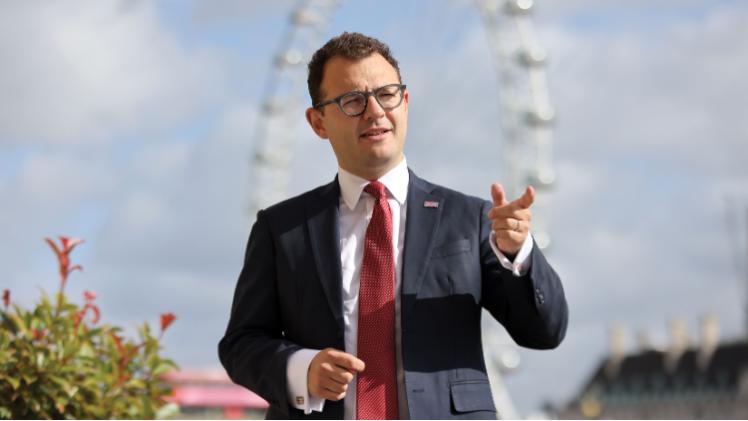 Jack Rankin (Photography: Dinendra Haria)
“I really hated the career politician path, and so I wanted to get married, have kids, buy a house and build a career, which I’ve done,” he says. “I’ve never been a special adviser or a think tanker or anyone in that kind of ecosystem.”
Though a self-professed small-c conservative, Rankin’s views could see him mistaken for a Reform UK MP. On Labour’s free school meals policy, he says it is “not the taxpayer’s responsibility to feed children”. And on illegal migration – brazenly employing the same term that saw Donald Trump labelled a racist – that “we’ve got hundreds of thousands of illegal economic migrants in this country who come from shithole countries”.
However, he baulks when asked whether he would consider defecting.
“No, no, that’s the worst possible thing,” he says. “It’s not clear to me that if you were trying to build a credible new centre-right force, that Andrea Jenkyns and Jake Berry is where you would go. That seems to me to be headline-grabbing, careerist moves on both sides of the fence.”
To take on Reform, still riding high in the polls, the party must be “authentically Conservative”, a Badenoch-coined phrase Rankin loyally repeats 14 times during our interview.
Being ‘authentically Conservative’ may represent more than mere platitudes, however. Should the UK meet a financial crisis that some regard as inevitable, the Conservatives believe communicating their economic credentials will best Reform’s offer.
“Farage is going to be on economics in the wrong place because he’s a populist, and populists cannot say to the general population, ‘we need to remove £150bn from the revenue account next year’.
“Now, is the Conservative Party in a place where it can do that quite yet? No. So we need to get ourselves into that sensible position,” he says. “It’s just about being authentically Conservative.”
Still, with the Conservatives unable to reverse their downward spiral, is he content with the leader of the opposition’s (Loto) party management?
“I’ve been frustrated by the pace,” he admits. “I’m not the only Member of Parliament to articulate that. We fed that back constructively, in my opinion. I think Loto’s team would acknowledge that now and so they’re picking the pace up.”
For months, Conservative MPs have been furious over Badenoch’s performance as leader. There is no reason to think Rankin – a backer of Robert Jenrick in the leadership election – does not share that feeling, but speaking on the record he backs the boss.
“I think our threshold to change leadership should be high,” he says. “We all need to be pulling in the same direction, and maybe things will change.”
Herein lies the problem with Westminster groupthink, Rankin says: so great are the UK’s problems, that pinning the blame on individual politicians, or even parties, is futile.
“Westminster is obsessed with who happens to be sat in what deckchair on the Titanic at any one time. Actually, we need to think about why we’re travelling across the Atlantic, not whether someone’s got a blue cap or a red cap on.”
It’s an odd – not to say dangerous – metaphor and Rankin duly heads for safer, if more partisan, ground.
“The Conservative Party needs to get itself into a situation where we can be the first page of the new consensus,” he says.
“I want to be part of a new generation of Conservatives that gets us into an authentically Conservative place which can effect regime change at British state level, to deliver the scale of change that this country desperately needs.
“If we can’t do that, Britain faces a challenge of civilisational proportions.”
