Lord Glasman: "Farage Has Got To Tone It Down – But So Does My Government"
Lord Glasman (Photography by David Sandison)
12 min read
Is a very British tech revolution on the cards? Blue Labour peer Lord Glasman talks to Sienna Rodgers about ‘big AI’ with the union jack on it, getting tough on Zelensky, and his hopes for a helpful Farage
When foreign secretary Ernest Bevin said, “We’ve got to have this thing over here, whatever it costs. We’ve got to have the bloody union jack on top of it,” he was talking about a British atomic bomb.
Today, Labour peer Maurice Glasman deliberately echoes that hero of the Labour right when he declares: “I want AI, I want big AI, and I want the union jack on it.”
For Lord Glasman, the 64-year-old academic and father of the socially conservative, economically left-wing Blue Labour movement, becoming a leader in artificial intelligence is an opportunity Britain cannot pass up – and one that must be seized by his party in the manner favoured by his faction.
His vision for AI is battling with the Blairite model, advanced by the Tony Blair Institute and Cabinet members like Peter Kyle and Liz Kendall. “They think this is all a continuation of their modernisation agenda, and it’s not. It’s a transformation of the means of production that has to be viewed in a socialist way, and a democratic way, and a Labour way, so it secures meaningful employment, stable communities and effective government,” says Glasman.
He proposes the establishment of a new, formal institution: a Royal College of Artificial Intelligence. The old Tudor approach would be applied to modern Britain, and Silicon Valley dominance would be challenged. “We want to be the centre of European AI,” he declares.
The peer presents this AI manifesto between drags on his roll-up. We had planned to conduct the interview in our office at Millbank Tower, but the chain-smoker in him objects to being indoors for so long, and the William Morris lover in him refuses on the basis of aesthetics. He describes the building, not unfairly, as an example of “contempt for beauty by the managing class”. We find a bench outside instead.
In the tradition of the arts and crafts movement, Glasman sees AI as capable of liberating the working class from mundane tasks, leading to a renewal of artisans.
“It’s not good news for the professionals – lawyers, accountants,” he acknowledges. “AI can do the basic administrative work that is 80 per cent of their workload.” But this is no bad thing for Glasman, who would like to see half of our universities closed and turned into vocational colleges.
“This is an opportunity for a much more relational society,” which will prize “the things that only human beings can do”, he says. Our shift in recent years to the “abstract” and “procedural” is a “humiliation”.
If you think sitting behind a desk answering 18 emails is dignified, you’re in the wrong space
Glasman does not worry overly about public sector workers losing their jobs to AI, even while estimating it could affect up to 60 per cent of them.
“We have to commit ourselves to the retraining of people, but not as administrators – as plumbers, as carpenters, as social workers… If you think sitting behind a desk answering 18 emails is dignified, you’re in the wrong space.”
Public sector trade unions are put on notice: if they defend “the status quo”, he warns, “they’re not going to have a constructive future”.
And yet as AI advances rapidly – leaving robotics trailing behind, for use in the domestic sphere at least – it increasingly looks like computing enjoys the creative tasks while we humans do the drudge work. AI-generated music is growing on Spotify, for example, without listeners even realising.
“This is pathetic,” Glasman decides. “Nothing robotic or AI can fix your toilet, nothing in robotics and AI can do bricklaying, nothing can do the things only human hands can do.”
Making “real music” is key. A jazz enthusiast – the Blue Labour name was partly inspired by Miles Davis’ Kind of Blue – he plays trumpet himself. He is presently pondering the idea of recording an EP called Once Upon a Time in Bilbao as a homage to Tottenham winning the Europa League.
 Lord Glasman (Photography by David Sandison)
Never one to shy away from a controversial meeting, Glasman has been talking AI with Peter Thiel, the German-American venture capitalist who co-founded data-mining giant Palantir.
They first met when Thiel gave a talk at Oxford in which Emmanuel Macron and the British empire were cast as the Antichrist, according to Glasman. “Excuse me, you had a whole revolution because we didn’t want a global system. We wouldn’t allow you to enter our parliament, you idiot,” he reports telling Thiel. Surprisingly, perhaps, the tech billionaire was happy to continue this conversation about the ethics of AI and Catholic thought, and the pair now meet when he visits London.
“He actually knows what he’s talking about and has a very strong political conception of AI, which is opposed to mine, but nonetheless, I can understand better through those conversations what it’s all about.”
Thiel has said in the past that he does not see freedom and democracy as compatible; his ally Curtis Yarvin, whom Glasman has also met with, has defended slavery, used the N-word and started a movement – Dark Enlightenment – which endorses absolute monarchism.
Many on the left would challenge Glasman as follows: while he may believe he is gleaning useful information from such characters, or even influencing them, he is in fact simply helping to normalise the far right.
“If you just want to talk to each other, go ahead,” is Glasman’s reply. It is the same attitude that led him to be invited, thanks to a connection with JD Vance, to President Donald Trump’s inauguration. He was the only UK Labour figure there.
“I was invited to the inauguration. I didn’t choose that to be the case, and I was instructed quite strongly to just go and talk to people and make some friends, which I tried to do,” he says, hinting at his long-standing relationship with No 10 chief of staff Morgan McSweeney.
“This is just a conversation I’m having about people who are genuinely knowledgeable about AI. I’m not trying to normalise them. This is progressive thought: that if you speak to someone, you’re somehow contaminated.
“The world is changing, and it’s changing really fast, and if we’re not part of that conversation, we’re going to be like every other social democrat party in Europe, except for the Scandinavians – completely out of the game.”
We’ve got to start getting tough with the Ukrainian government
Glasman’s AI plans are only the start of his Bevinite ambitions for Britain. Since the start of the Ukraine war, he has visited the country no fewer than 15 times. He sees Ukraine as a vital ally in our reindustrialisation and remilitarisation, and argues the balance of power in Europe could well shift from Paris-Berlin to London-Kyiv.
“We have to begin to really treat Ukraine not as an object of mercy and compassion but as a genuine political partner,” he urges.
On his travels, he no longer visits Ukrainian politicians but instead military and industrial people. In Kharkiv recently, he spoke to men designing drones from their basement with just a 3D printer and a bag of gunpowder. They are not just innovators – they are inventors, Glasman enthuses.
“They’ve got border drones they were telling me about. We could target every boat with a drone and say, ‘Please turn back,’” he says, advocating their use by the British to address the small boats problem. “You’re not welcome. We never invited you. Go back to France,” the drones would tell arrivals, under Glasman’s plans.
“Nobody’s in danger of being killed in France. These are not refugees. They’re just people who want to come to our country, and we don’t want them. I think we’re perfectly entitled to put the Royal Navy in the channel,” he adds.
Crucially, Glasman wants the UK’s relationship to be directly with industry rather than Volodymyr Zelensky (“an ex-comedian pretending to be a politician”) and his government. He used to be pro-Zelensky but changed his mind after talking to Ukrainians.
“Here I’m finding it more difficult to get the message across: I think there are huge aspects of corruption in the Ukrainian government – particularly the way they use anti-corruption as a means of political persecution,” he asserts. “They target previous politicians for corruption charges. Now, we’re paying for this – we’re actually bankrolling this.”
When this edition of The House lands, Glasman will be back in Ukraine once more, this time attending a trial of two people whom he believes are being “illegitimately persecuted for political reasons”.
“Ukraine is our ally, not the beneficiary of our charity. We’ve got to start getting tough with the Ukrainian government, particularly on this area of the use of the law to eliminate potential opponents. It’s very Soviet.”
Unless Britain has its own AI and military production, it will be a colony of the United States, he stresses. “And we don’t want to be. We’ve never wanted to be. Now that’s the Bevin pivot: maximum alliance and maximum autonomy.”
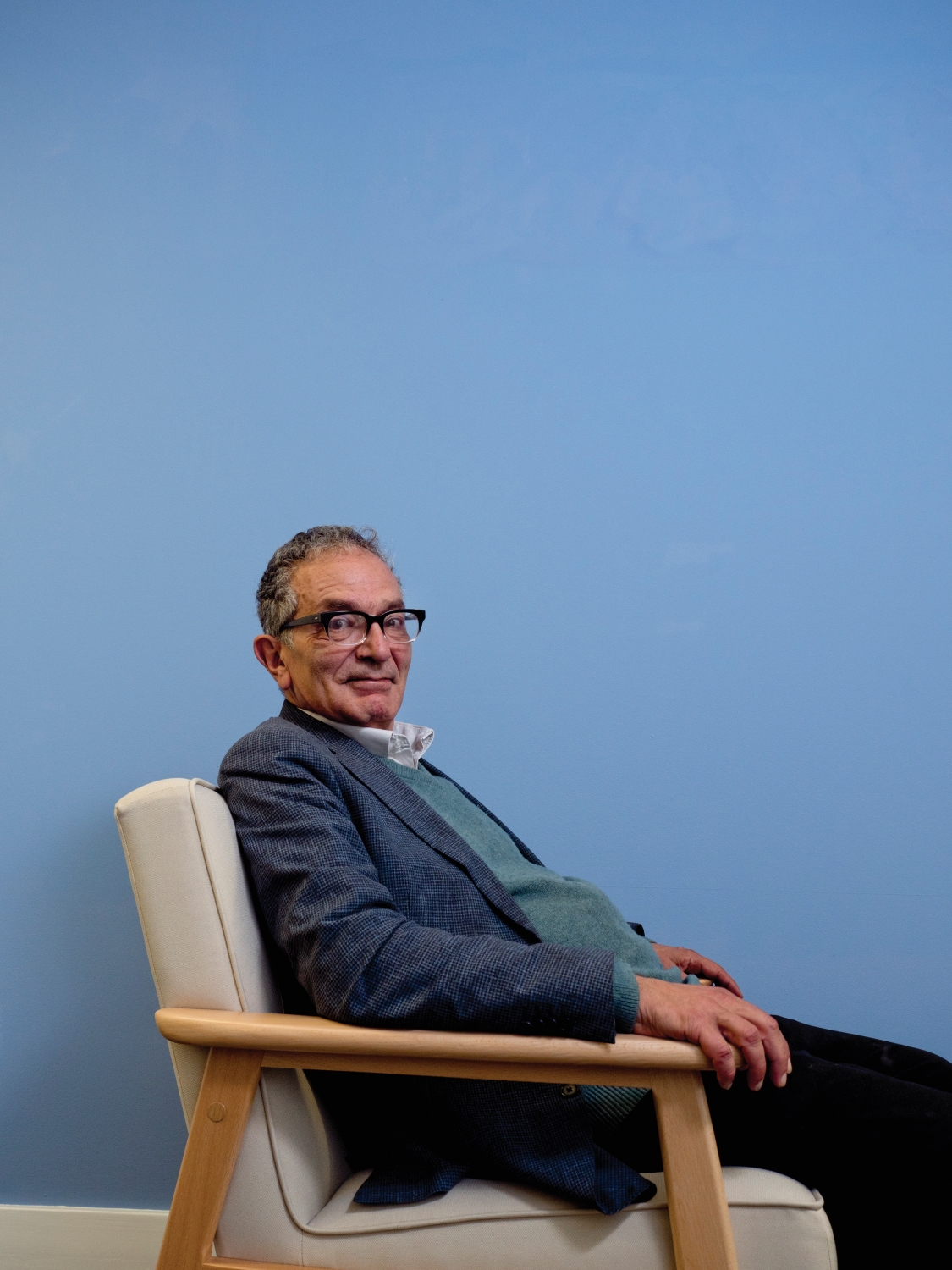 Lord Glasman (Photography by David Sandison)
Glasman was born into a Jewish family and went to Jewish schools. Although he was atheist for a time, that changed a while ago: “You might say I’m an Orthodox Jew who doesn’t keep much.” He observes Yom Kippur “religiously” and was doing so when the terrible attack in Manchester was perpetrated.
“What happened last week is that a Jew was murdered by a Muslim,” Glasman states baldly. “This has never happened in our history. This is not going backwards, this is actually going forwards. This is the potential horror of the future.”
What has gone wrong? “It’s a combination of decades of wishful thinking, misplaced thinking – ‘diversity is an unqualified good’, ‘immigration is an unqualified good’,” he replies without hesitation. He accuses progressives of a “real coldness in the heart” in how they responded to warnings that Jewish people were in physical danger.
He does not, however, go along with the idea Labour did not do enough to protect Jews, for example in allowing pro-Palestine marches to be held. “I don’t speak much about Israel. I don’t care much about Israel. I just care about my country and the people who live in it.”
Now, Glasman calls on Muslims to build trust by providing security, as the Community Security Trust charity does, for Jewish people. “I don’t want to see policemen outside synagogues. I want to see Muslims outside synagogues protecting Jews,” he says firmly.
“I think my experience and my relationship with the Muslim community is that they’re prepared to do that. We just don’t think like that – we think everything’s about the state. It’s not. It’s about how we are with each other in our communities.”
Glasman is an admirer of Shabana Mahmood, a darling of the Blue Labour crowd. “We’re blessed to have a Muslim woman as Home Secretary at this time of murder and strife who can genuinely lead and bring people with her,” he says. “Shabana is a very special person to me because she is religious; because she believes that her mission in life is to serve her country and working-class people.”
Although it is clear he would prefer her to head the party over “tragic figure” Keir Starmer, he bats away talk of leadership change: “I’ve never met a politician who talks less about who’s up, who’s down. She’s very diligent. She just does her work, and she does it meticulously.”
I’m expecting Nigel Farage to make Robert Jenrick look like a nasty, populist, empty space
Decrying the racism directed at Mahmood from some quarters, he expresses hope that Nigel Farage can help. This is partly why he was so angry when Farage’s policies were called racist by Labour last month: the Reform UK leader, he believes, is holding back the tide of a much nastier politics.
“I’ve witnessed incredible racist abuse of Shabana. I absolutely expect Nigel Farage to call that out,” he says.
“Farage has people – ugly people – to his right who are full of hate, who are racist, and they hate him. In fact, I think Nigel Farage is holding a position which we don’t see. This is what drives me nuts. We don’t see that he’s at least trying to behave in a responsible way.”
“In fact,” he adds, “I’m expecting Nigel Farage to make Robert Jenrick look like a nasty, populist, empty space.”
Glasman says he has not forgiven Jenrick for abandoning his old friend, the late Sir Roger Scruton, when he was sacked by the Tories: “I haven’t forgotten that act of abandonment.”
(Jenrick’s allies are hurt and bewildered by this claim, pointing out that he was a junior Treasury minister at the time of the sacking and that Jenrick was asked by Lady Scruton to speak at her late husband's memorial service.)
“He goes yomping around the Calais camps, and he goes around the country spouting hate,” Glasman adds of Jenrick. “The Conservatives are dead, as far as I’m concerned, and he’s certainly not their life support machine.”
When Labour conference came to a close, Farage accused Starmer’s party of putting a target on his back: his security detail had been cut, and the Labour leadership were using words like “racism” and “enemy” to describe the Reform leader and his policies.
“Yeah, and we’ve got to absolutely remedy that,” Glasman agrees. “Nigel Farage is our opponent. He is not our enemy. Our enemy are Islamists.”
His conclusion is stark: “Farage has got to tone it down, but so has my government.”
