Malcolm Offord: Scotland Can't Afford Free University For Half Of School Leavers
11 min read
Reform’s Scottish leader, Malcolm Offord, talks to Noah Vickers about his political journey, how to tackle climate change, and why his nation may have to limit free prescriptions and university places
Malcolm Offord has been having a wonderful summer. When he speaks to The House, the multi-millionaire leader of Reform UK Scotland has recently returned from Cowes Week on the Isle of Wight – where he keeps one of his six homes and where he raced one of his six boats, Braveheart.
“We did fine,” says the 62-year-old MSP for West Scotland. “We were up against a very competitive class but, that’s good, that’s what you want.”
Offord enjoyed this “tremendous occasion” – the regatta’s 200th anniversary – while Holyrood is on summer recess. Shortly after speaking to The House, he also revealed he is “raring to go” after successful surgery following a cancer diagnosis.
“I’ve got a bit of a break and obviously beautiful weather. Global warming is good for Scotland,” he cheerfully declares. The House promises to return to that claim, but first asks about his political history.
The former peer is one among several ex-Tories over the last couple of years to have jumped ship to Reform. As a minister under Boris Johnson, Liz Truss and Rishi Sunak, he served first in the Scotland Office and later as minister for exports in the Department for Business and Trade (DBT), as it then was.
Offord, who made his wealth in asset management and private equity, had also donated almost £150,000 to the Conservatives prior to being made a peer by Johnson. Was it difficult leaving a party to which he had devoted so much?
“Of course it was difficult, but I’m not a tribal Tory,” he says. “I’d donated to the party for 15 years before I was ever a member… I only joined the Conservative Party in 2020 and went into the government in 2021.”
Offord remains proud of his time in that government, the record of which has been attacked relentlessly by his new party. He insists that both his departments “did a good job”, as Alister Jack and Kemi Badenoch were “exceptional” secretaries of state.
Under Badenoch’s leadership, DBT was “probably the only department in Whitehall which tried to make a success of Brexit”, he claims. Does Offord still find her an impressive politician?
“Oh, very. I supported her as leader for the Conservative Party,” he says, adding that she and her husband Hamish are “a very strong political couple”.
While Reform leader Nigel Farage has mocked her performance as a politician, Offord praises Badenoch for sticking with her principles.
“Kemi is a visceral conservative,” he says. “If you ask her a question, Kemi will tell you what she thinks, rather than what you want to hear. That’s not the issue. The issue is that no one’s listening to the Conservative Party – nor can they or should they.”
Offord began to lose heart with the Tories after Badenoch appointed him shadow energy minister. In this role, he says he was “shocked” to discover how little parliamentary debate there had been when Theresa May’s administration passed the Climate Change Act, which legally enshrined the UK’s 2050 net-zero target – an “extraordinary act of self harm, where our energy prices are now four times more than America”.
The Scottish Conservatives, he argues, had meanwhile become a one-policy party with little to offer beyond their staunch opposition to Scottish independence.
But the MSP reveals it was East Wiltshire MP Danny Kruger, rather than Farage, who ultimately convinced him to defect in December 2025.
“He’s a philosopher, and we need philosophers in politics. He’s a deep thinker and he is a tribal Tory,” says Offord of Kruger. “The fact he felt cast adrift told me there was something wrong.”
Offord now leads a 17-strong group of Reform MSPs, tied with Labour as the joint-largest opposition to John Swinney’s minority SNP government.
It was an impressive performance in May’s election, but nonetheless followed the trend of Farage’s political outfits – be they Ukip, the Brexit Party or Reform – doing noticeably less well in Scotland than in England or Wales. Does Reform have more work to do in showing Scottish voters it is not just a party of middle and deprived England?
“For sure. That’s absolutely my challenge. I take that head on,” he says. “Over the next five years, I have to demonstrate Reform Scotland has its own voice.”
The Scottish party, he stresses, has “autonomy over our devolved matters” and will take policy decisions on the basis of whether they benefit Scotland specifically.
“We’ve got ourselves in a mess over the last 25 years with so much liberalism, so much progressivism, that we’ve lost our way as a country,” he says of Scotland and the UK more widely.
Yet there are some progressive policies in Scotland about which Reform’s Holyrood manifesto had little to say. One of them is university tuition fees.
Scottish students continue to enjoy free university courses north of the border, subsidised by Holyrood to the tune of roughly £900m per year, while English students take on loans. Would a Scottish Reform government maintain that unequal status quo?
Offord suggests there are advantages to England’s model, as there is more incentive on students to think carefully about whether their course will help them get a well-paid career.
The MSP, who studied law at Edinburgh, says “a lot” of Scottish students nowadays are completing “meaningless degrees” rather than vocational or technical qualifications that would be a better use of their time.
“The difference between England and Scotland is that, in England, it’s the marketplace that is now making this decision for young people, who are now saying, ‘This is not worth the money’.”
In 2024/25, about 42 per cent of Scottish school leavers went on to university, while 26 per cent went into further education and 22 per cent straight into employment.
Offord stresses that his “instinct” is to “hold on to as much free education as possible” in Scotland, but says Holyrood should narrow the number of free university places it funds.
“We can afford maybe to pay for 20 per cent of kids to go to university – maybe – but not 50 per cent. Maybe that’s the way to do it. Maybe we should be saying to people, ‘You should be going to [vocational] colleges and getting better jobs at the end of it’.”
Prescription charges, abolished in Scotland since 2011, are another point of difference with England on which Reform’s manifesto was silent.
Offord faced questions during his Holyrood campaign, however, over a 2025 Centre for Policy Studies report he edited and co-authored, which called for a “dialogue” with the Scottish public “about the acceptability of user charges for some [healthcare] services up to an annual ceiling, as in Sweden and Germany, and the removal of free prescriptions for certain categories of medication, e.g. over-the-counter pain relief medicines, given the increasing annual cost associated with prescriptions for these medications”.
“It’s our job to reinvigorate Scots… They’re scunnered and fed up”
Asked whether he is still calling for that dialogue, the MSP points out that in England 89 per cent of prescriptions are dispensed free of charge to exempted groups like the elderly.
Regarding Scotland’s policy, he says: “Those who need them most will always be looked after, but perhaps [for] those who don’t need free prescriptions [we] might need to look again, I don’t know.
“To me, it’s something we should talk about with the medical profession, as a complete review of our health system.”
The House soon returns to net-zero, where Offord has been on something of a journey.
“Some say that the UK has a limited role to play in climate change as we account for only one per cent of world emissions,” he said in his 2022 maiden speech to the House of Lords.
“Yet COP 26 proves that our leadership still counts, because we can demonstrate that it is possible simultaneously to grow our economy while cutting our emissions.”
Offord, who in that same speech praised Scotland for combatting the “climate emergency”, now rails against the “madness” and “sheer disaster” of net-zero policies.
But with wildfires destroying homes and record temperatures causing almost 3,000 excess deaths across the UK in May and June, is there not an imperative to work with our international allies to significantly cut carbon emissions, even if – as Offord acknowledged – we make little difference individually?
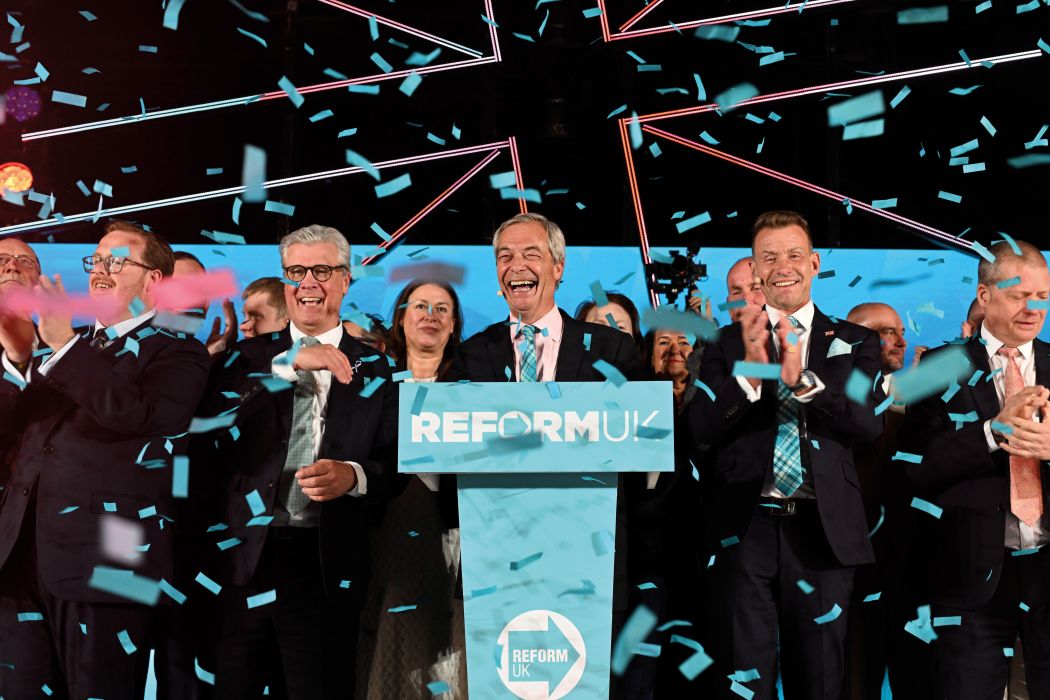 Malcolm Offord with Nigel Farage in April 2026 (PA Images/Alamy)
“We’ve got to stop seeing this as a conflict between net-zero and/or oil and gas. I think we just have to grow up a little bit on this conversation,” he replies, arguing that a more “pragmatic” approach is needed to stop Britain “impoverishing” itself with high energy costs while importing most of its gas from elsewhere.
“Why on earth would we import from Norway, when we can create our own?” he asks. “By creating our own, we can create our own domestic gas supply, get our prices right down, and that can actually give us the cheaper energy to make renewables merchant viable.
“The whole of Scotland is covered in turbines – not a single blade is made in Scotland. We can’t manufacture anything, because our energy’s so expensive. These things are interconnected…
“Gas is our transition fuel – let’s be sensible about that – and then we can create a much more environmentally-friendly energy system.”
As UK energy prices are dictated by international markets, experts agree that further drilling in the North Sea would have a negligible impact on that price. Research from the University of Oxford earlier this year showed that if all the UK’s remaining North Sea resources were maximally exploited and the government used the extra tax revenues solely to lower bills, households would save somewhere between £16 and £82 a year.
As to whether there is a climate “emergency”, Offord says: “We need to stop using that word. It’s not an emergency. The planet heats up and cools down, many times and many cycles.
“We do have warming. I’ve been to the Arctic, I’ve seen the ice-flows melting – I’ve seen that with my own eyes. I’m not a climate change denier, but I’m pragmatic about how we deal with it.”
Offord speaks to The House soon after Farage’s victory against Count Binface in Clacton. He confesses to not visiting Essex during the five-week campaign – part of which was occupied by Cowes Week – but says Farage’s “outstanding” result “proved his point that he’s got a true mandate in Clacton”.
Beyond confirming the Reform leader’s popularity with his own constituents, did the by-election prove anything new? The result has no bearing on the investigation being conducted by the parliamentary standards commissioner, Daniel Greenberg, into whether Farage should have declared his £5m donation from crypto billionaire Christopher Harborne.
“That investigation – you have to ask yourself how objective that is,” replies Offord. “And is it politically motivated or not?”
Where is Offord’s evidence that Greenberg is in any way politically motivated?
“It’s the committee members around it. I believe the committee members on that are from other parties, aren’t they?”
Yet Greenberg will be the person writing the memorandum on which the standards committee would deliberate – if he does conclude that Farage has breached the code of conduct and that the breach was serious enough to merit referral to them.
“Yeah, yeah, so again, the question is whether he will be influenced or not – I don’t know. I assume, we hope, we expect, all these people to be independent, don’t we? So we expect an independent result.
“I’ve not been privy to the conversations, but obviously he [Farage] felt that he wasn’t getting a fair hearing. He may or may not be right or wrong, but that’s what he felt.”
Offord, and Reform, still have a long road ahead of them. How confident is he that by 2031 he will be first minister of Scotland, serving alongside prime minister Farage?
“I’m only in it to win it. There’s no point without being committed to winning and I believe we’ve got a roadmap through the council elections [in 2027], then Westminster and then Holyrood. There is a roadmap for us. There is a strong amount of apathy amongst people, especially in Scotland, and it’s our job to reinvigorate Scots who have traditionally always been politically motivated. They’re scunnered and fed up. It’s our job to motivate them and put something in front of them which will appeal to them.”
