The Mick Whelan Interview: Strikes, Starmer And "The Lunatic In The White House"
Outgoing Aslef general secretary and Tulo chair Mick Whelan (Credit: Andrew Wiard, Report Digital)
11 min read
Mick Whelan, outgoing general secretary of Aslef and chair of Labour Unions, talks to Sienna Rodgers about the state of the Labour Party, its future leadership and being ‘terrified’ of retirement
Over an authentic Italian lunch in Farringdon, near Aslef offices, Mick Whelan tells a table of colleagues and hand-picked journalists that – counter-intuitively – he finds it “terrifying” his members are in the top five per cent of UK earners.
“My people earn more than doctors. I’m not going to say my people should earn less – but I do believe that doctors should earn more,” explains the head of the train drivers’ union, speaking amid a battle over pay between government and the British Medical Association.
“It is this acceptance that work shouldn’t pay,” he fumes. “You’re accepting that the state has got to subsidise poor employers or people who can’t get a decent level of housing. If you accept that, we’ll be trapped where we are now forever.”
As the Labour government refuses to up its pay offer to resident doctors, and generally tightens belts after an initial generosity to public sector workers, where does that leave party-affiliated left-wing unions like Aslef?
Labour MPs mutter that it might only take a dire set of local election results next May, or a badly miscalculated Budget in November, to trigger a leadership crisis. The question of who could come next looms large. As chair of Tulo, the Trade Union and Labour Party Liaison Organisation which brings together all 11 Labour-affiliated unions, Whelan is well-placed to know their mood on such matters.
Angela Rayner – who rose through the ranks of Unison to reach Parliament – had been tipped for the very top job, despite her insistence she did not want it. Then a scandal over stamp duty forced her from office, prompting a reshuffle and deputy leadership election. In the battle to replace her, Aslef is backing former Commons leader Lucy Powell over No 10’s preference of Bridget Phillipson.
“It’s a shame she’s gone,” Whelan says of Rayner. And while he emphasises that there is currently no vacancy in the Labour leadership, he does indulge in a little speculation. He is not impressed by one widely discussed option, Wes Streeting: “If it was Wes, would it be more of the same?” For left-wing unions, the Health Secretary’s stock is low. “That’s probably not someone I would support,” Whelan makes clear.
What of Andy Burnham? “Andy is an old friend. But Andy isn’t an MP and Andy hasn’t been touting for business yet,” replies Whelan. Describing him as “one of the best Labour mayors we’ve ever seen”, he adds: “If at some point in the future Andy would like to come forward and have a conversation, I’m sure we’d like to talk to him. But he hasn’t.”
If it was Wes, would it be more of the same?
While Whelan has clear political differences with Keir Starmer, and says of the Lord Mandelson sacking that it was “a car crash waiting to happen and he should never have been appointed”, he is also happy to offer credit to the government where it is due.
“The external pressures from the lunatic in the White House and elsewhere possibly haven’t helped. I can say that crassly – other people don’t get the opportunity,” he says. “I disagree with pandering to Trump on the trade deal, but the trade deal we’ve done, at least, is better than the deal the EU have done.”
While the Aslef boss is friends with Jeremy Corbyn – “and always will be”, he points out – no approach has been made about the union joining the new political party temporarily called Your Party, and Whelan is firmly committed to Labour. He can see upsides in terms of dragging Labour leftwards, though.
“I don’t think it hurts either politics or the movement to have that voice. I do look at how most parties have drifted to the right, as the world has driven to the right over the last 15 or 20 years. What was considered left-wing 20 years ago is now considered ultra left-wing. It could bring the centre ground to a more level place,” he remarks, in comments made before the new outfit blew up publicly with a spectacular row between Corbyn and Zarah Sultana.
Aslef helped create the Labour Party back in 1900 and Whelan has repeatedly made a strong case to the union’s annual conference that it should stay affiliated. “I believe that it’s the best game in town for working people,” he says of Labour.
In Whelan’s office, The House spots badges displayed around us. “I’ve got one of the best badge collections in the world,” he says proudly, explaining that badges are important in this industry – they are awarded to drivers after five, 10, 15, etc consecutive years of membership.
More unexpectedly, in the corner sits a framed pair of tight-looking swimming briefs. They were given to him by comrades from the Australian Rail, Tram and Bus Union during Aslef’s latest conference; the gift provoked much laughter among delegates in the hall and shouts of: “Put on the budgie smugglers, Mick!”
Memorabilia from Whelan’s 14 years as general secretary of Aslef are all the more meaningful to him now that his tenure is coming to an end. He is 65, and the union has a policy of officials respecting the retirement age just as drivers do. After a contest, he will make way early next year for a successor. Assistant general secretary (AGS) Simon Weller is the anticipated frontrunner.
When Whelan took charge, the union had just undergone a tumultuous period – “we nearly collapsed” – and been brought back from the brink by his predecessor. The new boss made it his mission to drag Aslef from the periphery of the labour movement to its centre; 14 years later, he is Tulo chair and a member of Labour’s ruling executive committee, while his AGS is on the Trades Union Congress general council.
“For a little trade union of 22,000 people, to have two people in those positions, I think shows how hard we worked,” he says. “There’s no point in being a powerful industrial trade union if no one knows who you are. During that period of time, all we heard was: ‘Bob Crow says this, Bob Crow says that’, ‘Mark Serwotka says this’. ‘Who’s Aslef?’ I think over that first 10 years, very successfully, we changed that.”
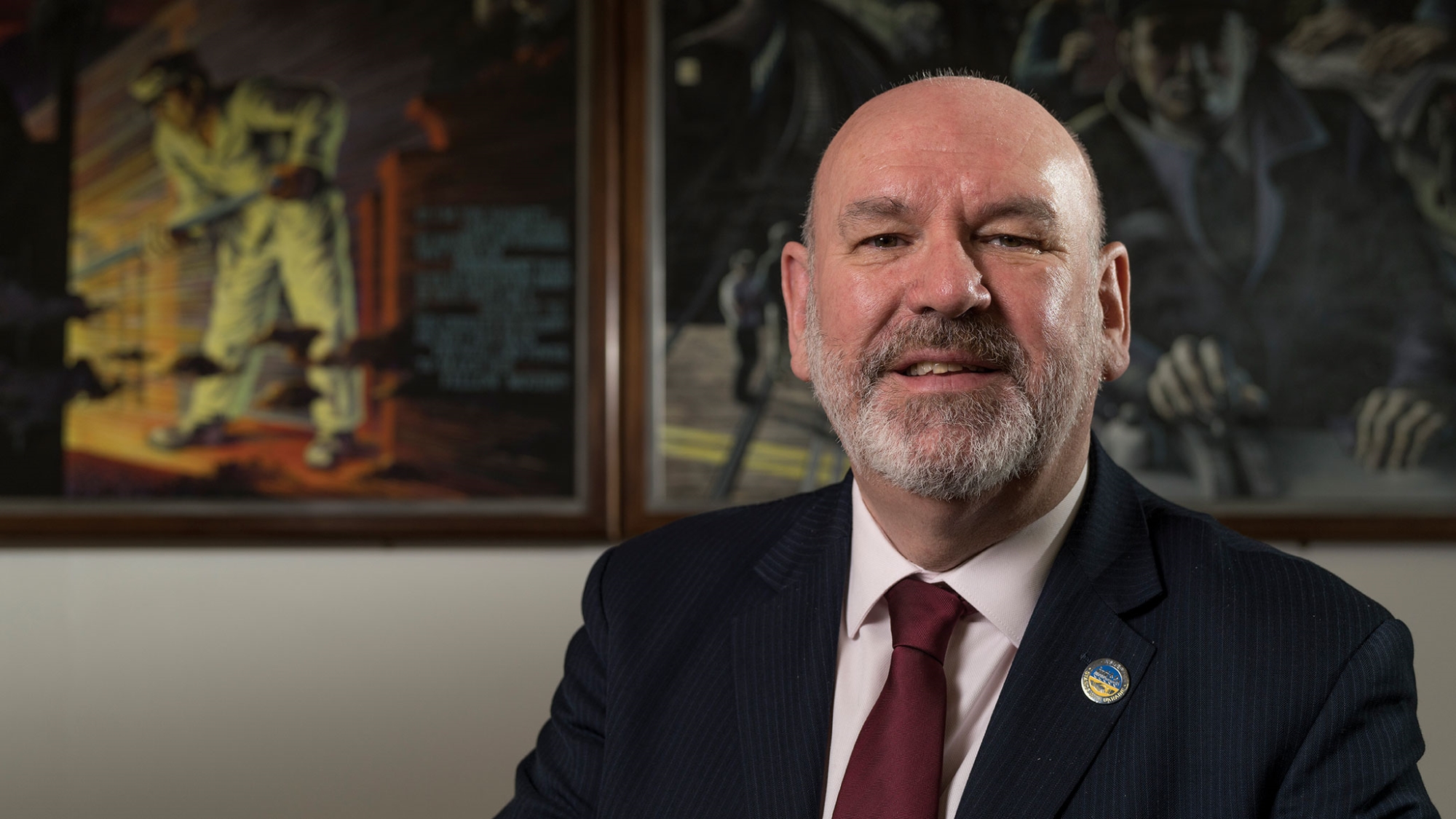 Mick Whelan (Credit: Andrew Wiard, Report Digital)
The son of Irish immigrants, Whelan fell into a career on the railways by accident in 1984, when he turned up for a job interview in accounts, but the posts had been filled. He became a guard and saw how Margaret Thatcher did not want the railway unions to strike at the same time as the miners.
“When the railway union said: ‘We’re not moving coal’ – and I was part of that because I joined in anything back then – nothing happened to us. We weren’t penalised, we weren’t sent home, we weren’t suspended. That taught me an awful lot about the power of solidarity.”
At 23, he was too old to be a driver; the career path back then started at 16, giving young men an apprenticeship as ‘secondman’ (assistant driver) before they ‘passed out’ at 21. The workforce now looks very different: the average driver age is 48 and rising; new entrants are 34 on average. In a bid to attract a younger cohort, Labour has given him a win on the campaign to lower the age threshold from 20 to 18.
Whelan says the industry prefers to employ former military or prison service personnel, particularly with families, on the basis it might give unions less influence. They fail to realise, he argues, that, if anything, those accustomed to relying on others for their safety are “more attuned to trade unionism”. Aslef has 90 per cent membership density.
Although ‘male and pale’ himself, he has consistently focused on increasing diversity. “I remember when I started, at Stonebridge Park, there was a drivers’ cabin, predominantly white, and there was a guards’ cabin, predominantly Black. These people worked together, day in, day out – and back then, everybody worked seven days a week, 28 days on the trot. There was no hidden or compulsory 13th or 14th day off. It was a different culture.”
He has even advertised in women’s magazine Cosmopolitan and Black newspaper The Voice. The job has changed and now suits women better, he points out: “When I grew up in the railway, it was heavy lifting. You might have to lift a coupling iron and couple the train. These days, it’s all step on, step off.”
The fact is, 60 per cent of people fail the aptitude test. Not everybody can be a train driver
Despite those efforts, Whelan concedes: “We’re white, male and stale.” Why is that? “I’ve wandered around this industry for the last 40 years, seeing the same people on the barriers, the booking offices and the platforms that I’ve always seen. I can’t believe that they don’t have the aptitude to be a train driver.
“It’s a lack of encouraging people to come through. We know how HR works: if you want 20 train drivers, you don’t want 20 guards becoming trained drivers, because then they’ve got to replace 20 guards as well.”
He does emphasise that being a train driver is far from easy, however.
“I’ve lived with four or five years of politics of envy about train drivers, particularly after Covid and the national dispute. But the fact is, 60 per cent of people fail the aptitude test. Not everybody can be a train driver. It’s a certain skillset, mindset, medical fitness and competency.
“I love seeing ‘you don’t have to steer them’. If you can drive something 1,000 tons, 75 miles an hour or above, to stop at a place you can’t see at two o’clock in the morning, in the dark and the rain... It’s not like driving a car or a bus – it’s not like doing anything else.”
Although to many he will be remembered for the longest period of sustained strike action in the union’s history, starting in 2022 and lasting more than two years, Whelan says he is proud as general secretary of “the fact we don’t go on strike very often”.
“Talk to any member of the public, they believe we’re out on strike all the time. Before the national strike post-Covid, look at the number of days Aslef went on strike for the previous 12 years – probably fewer than any other sector. We like to negotiate,” he asserts.
Turning to the future of the railways, Whelan says he is not worried about the impact of artificial intelligence: “The biggest problem for the railways won’t be in my grade.” In fact, it is only better technology that can help change Britain’s status as having the most congested railway in the world, he says. With our Victorian viaducts and tunnels, we cannot replicate the capacity solutions of the French, who have double-decker commuter trains.
And how confident is he that nationalisation will work better than the current system?
“I can’t think it’ll work worse!” he replies. “I’ve got no rose-tinted glasses about British Railways. I started on British Railways, and people worked 28 days on the trot without a break because they were so poorly paid.
“If privatisation did one thing, due to the poor way it was handled and brought in, it created a dearth of skillsets and gave an opportunity for people to be paid the rates of pay that they deserve and didn’t get before. But I look at the money that went into privatisation: if you invest the same money into a vertically integrated railway system, we would’ve got more bang for our buck, and we’d have a better railway.”
In many ways, this is the perfect time for him to go: Great British Railways will come into existence in the next couple of years, and a new chapter will begin, with Aslef negotiating on collective bargaining, representative structures and more.
What advice would he give to his successor? “Take your time. If you don’t know, don’t answer.” He warns: “Not everybody tells you the truth. Someone will ring you up and tell you the most sorry story in the world. Your natural instinct is to protect the victim and do whatever. And on some occasions, they turn out not to be accurate. I’ll battle for anybody, anywhere, if the cause is right. If you lie to me, you lose my sympathy and my everything.”
So, is he looking forward to retirement? “Oh, I’m terrified,” Whelan replies with characteristic candour. Asked what he will do with his time, he offers up weakly: “Sleep?” Even before his current role, he was a resource officer; particularly when privatisation happened, he was never at home, he says. “I’ll spend time with family. Trouble is, they’ve got families of their own. So, yeah. We’ll see.”
Reflecting on the position of general secretary, he adds poignantly: “It’s not a job, it’s not a role, it’s just something you live. And it won’t be there any more.”
