MPs Are Racing To Tackle AI Deepfakes Ahead Of The Next Elections
Deepfake technology has become more sophisticated and accessible in 2025 (Alamy)
11 min read
With voters heading to the polls in May for elections in England, Scotland and Wales, a cross-party group of MPs is organising to tackle the threat of deepfake artificial intelligence (AI) content to British democracy.
None of this is true: The UK will have a 32-hour working week from the start of 2026. UK residents leaving the country more than three times a year will be flagged for additional income and tax checks. The government must be notified about cash withdrawals over a certain amount.
However, all of this has been presented as fact in AI-generated deepfake videos circulating on social media over recent months, often using manipulated footage of senior politicians, including Prime Minister Keir Starmer.
Research by non-profit group Reset Tech, seen by The Guardian, found that more than 150 YouTube channels were created in the last year to promote anti-Labour narratives, alongside outright fake and inflammatory accusations about Starmer and other politicians. Those channels have amassed 5.3m subscribers, produced over 56,000 videos, and generated almost 1.2bn views in 2025 alone.
There was widespread concern that deepfakes would play a decisive role in spreading misinformation ahead of the 2024 general election. However, after the election, Research Associate at The Alan Turing Institute Sam Stockwell said that there was no evidence AI impacted the result. Still, researchers remained “concerned about the persistent erosion of confidence in what is real and what is fake across our online spaces”.
With the May 2026 elections looming, experts and politicians have told PoliticsHome the risk landscape has changed. The threat comes not from a single viral deepfake, but from an industrial-scale flood of synthetic content that makes it harder for voters to distinguish fact from fiction.
New AI image tools like Google’s Veo 3 are making AI deepfakes more realistic than ever before, and MPs, campaigners and regulators are increasingly worried that the sheer volume, sophistication and coordination of AI-generated political misinformation now facing voters represents a growing threat to democratic trust.
PoliticsHome understands that a cross-party group of parliamentarians is already organising to push for legislative action in the government’s anticipated Elections Bill, arguing that existing laws are ill-equipped to deal with the rapid spread of AI-generated deepfakes and political misinformation online.
MPs have no protection over deepfakes being created of them
While campaigners are hoping to see the bill introduced in the first few months of 2026, allowing changes to be made ahead of the May elections, the government has not yet committed to a timeline. PoliticsHome understands that around six cross-party MPs – including former Conservative AI minister George Freeman and Labour MP Emily Darlington – alongside a small number of peers, are involved in early discussions to add amendments to the bill.
The Speaker of the House of Commons, Sir Lindsay Hoyle, has also taken a close personal interest in the issue, following findings from the Speaker’s Conference report on threats to MPs’ safety in October, which highlighted the role online abuse and false information can play in undermining democratic participation.
Darlington, Labour MP for Milton Keynes Central and a member of the Science, Innovation and Technology Select Committee, told PoliticsHome that existing frameworks leave politicians dangerously exposed.
“At the moment, MPs have no protection over deepfakes being created of them,” she said.
“We're in this weird grey area where the Electoral Commission doesn't really have a remit online, and the Online Safety Act doesn't cover elections. So Ofcom hasn't prioritised it because it's working on the priorities that have been set out in legislation.”
That regulatory gap has become increasingly apparent as MPs have been reporting encounters with deepfakes of themselves, only to be surprised to discover that current laws do not clearly classify such material as an offence, particularly when material falls short of explicit threats or fraud.
Conservative MP Freeman experienced that reality firsthand when a deepfake video circulated online falsely claiming he was defecting to Reform UK in October.
“I'm pretty shocked that Meta doesn’t view the use of AI deepfake material for deliberate political misrepresentation as a problem and not a breach of their protocols,” Freeman said.
“In which case, I think we need to make sure that it is.”
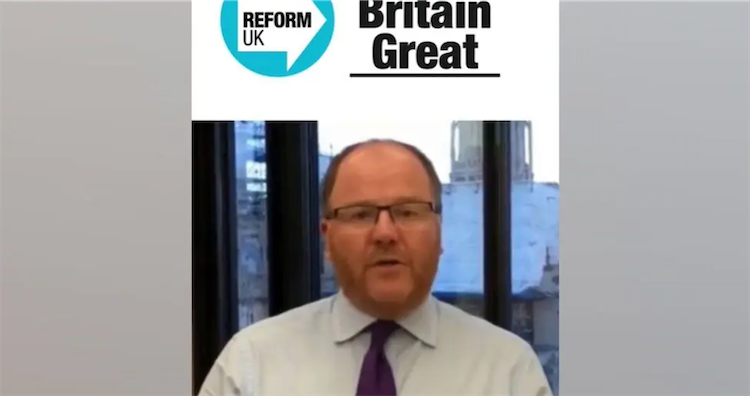 Screenshot of a AI deepfake video falsely showing Conservative MP George Freeman defecting to Reform UK (Facebook)
Thomas Barton, executive director and founder of the Council for Countering Online Disinformation, said MPs are “waking up to the scale of the problem” as they realise they themselves are vulnerable.
PoliticsHome spoke to several MPs who plan to be more vocal on deepfakes in the new year, in an effort to raise political pressure. While it is very unlikely that the Elections Bill would become law before May, this set of local elections could indicate how serious the problem has become. If the Labour campaign comes up against a tide of false information, this could provide more political incentive for the government to introduce tighter regulations.
Darlington believes momentum is building. “There's certainly support from across the House,” she said. “I've had conversations with MPs from various political parties, and given that we're on the front line of this fight, we're seeing that we're at a moment where we need to protect our democracy.”
However, many MPs are keen not to frame the issue purely in terms of personal risk. Amendments to the Elections Bill are likely to focus narrowly on impersonation of candidates, while other legislation – such as the Cyber Security and Resilience Bill currently going through Parliament – could address deepfakes in areas like fraud or the impersonation of business leaders.
Politicians are also concerned about the impact on national security. Mark Frankel, head of public affairs at Full Fact, warned that there has been an “explosion” of synthetic content online, which has increasingly involved political misinformation coming from international sources.
“We're seeing, for example, lots of video content being created by people who are not necessarily based in the UK,” Frankel explained.
“It's very difficult for us to determine exactly the provenance of these accounts, but there does seem to be a trend in just trying to generate en masse quite a lot of manipulated video content. There does seem to be some level of coordination to them, because there are similar messages that are cropping up on these accounts.
“These are troubling because they all contribute to a level of distrust in the political system, and we already know that the people's willingness to trust politicians and the democratic process is at an all-time low.”
MPs are waking up to the scale of the problem
Labour MP and former international development minister Anneliese Dodds told PoliticsHome that she fears the volume of AI deepfakes will contribute even further to the “harassment” of politicians, to the extent of “preventing people from being able to participate in politics”.
She recalled seeing the destructive impact of deepfakes on a foreign trip while in opposition.
“The first time I saw a sexually explicit deepfake was in Montenegro a few years ago,” she said. “It was of a civil society anti-corruption activist, whose appearance had been manipulated, and it was a really horrific instance of misrepresentation, which some politicians then seized upon to discredit her.
“That was a number of years ago, but I am concerned that we could see similar developments in the UK, absolutely. I find it interesting that in countries like Moldova, in the Western Balkans, this [deepfakes] is described as hybrid warfare.”
Freeman added that he believes the proliferation of deepfake AI content on social media could severely impact turnout in elections, which is already at the lowest levels in more than a century.
“Public trust in our democracy is fragile and falling,” he said.
“If the public can’t tell which MP or councillor posts are fake and which are real, they'll just switch off, and turnout will collapse. The danger is that people just lose all trust and switch off and conclude that all political material is spin, lies, and misrepresentation."
In the new year, Freeman plans to examine how other countries are tackling the problem and look for lessons the UK could adopt. In the meantime, he believes a combination of legislative and non-legislative measures is needed.
“Legislation is important, but too often in Parliament we pass laws which aren’t enforceable, and sit on the statute book, and big tech can ignore them,” he said, in part referring to the Online Safety Act, which has seen delays in its implementation and enforcement by Ofcom.
“I'm wondering if there isn't a better way and a quicker way to deal with it by using AI to identify AI deepfake material automatically.”
The Electoral Commission itself is already doing preparatory work ahead of the May local elections. MPs from multiple parties told PoliticsHome they would also like to see greater AI media literacy programmes for children, though few believe education alone can solve the problem.
MPs who want to protect democratic integrity from AI deepfakes can’t also use it for political misrepresentation of our opponents
The question, however, will be how to incentivise the large technology platforms to make these changes. For many MPs and for Full Fact, legislation is essential.
Full Fact is calling for a suite of measures to be included in the Elections Bill. These include stronger rules on political deepfakes, updates to the offence of making false statements about candidates, and requirements for campaigners to clearly label AI-generated political content.
The charity also wants a comprehensive public library of political advertisements to increase transparency and accountability.
“Preserving that historical record of facts is really important,” Frankel said. “Particularly in an internet age where so much has become synthetic and distorted.”
Other proposals include a regulatory framework to prevent misinformation in political advertising, overseen by an independent and adequately resourced body, and enhanced powers for the Electoral Commission to compel action from social media companies.
There is concern about a lack of clarity over which department will take the lead on the Elections Bill, with the Ministry for Housing, Communities, and Local Government, the Cabinet Office, the Department for Science, Innovation and Technology, the Home Office, and the Ministry of Defence all responsible for areas relating to elections, misinformation and AI. Some believe that the responsibility for legislating AI deepfakes is already drifting away from DSIT and increasingly towards the Home Office.
“Coordination [across departments] is going to be absolutely critical,” Dodds said. “I have raised this in Parliament and said that the government really needs to have a joined-up approach on this.”
As ministers and MPs debate how to regulate this growing threat, some have themselves been turning to AI to generate images of opponents. In November, Shadow Justice Secretary Robert Jenrick shared an AI-generated video of Justice Secretary David Lammy wearing a clown costume in the House of Commons.
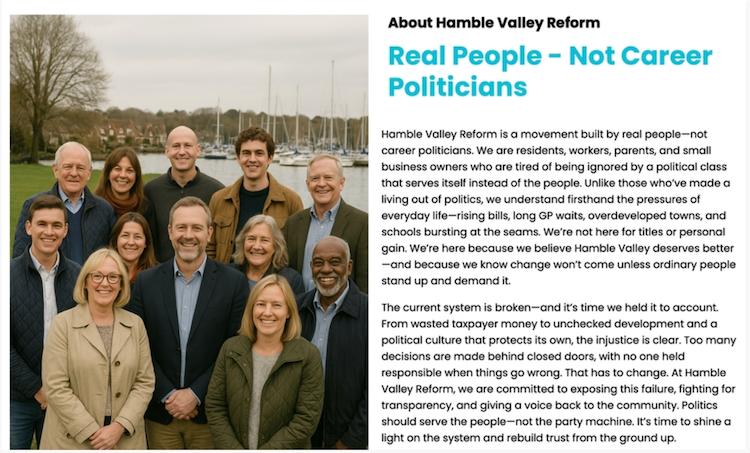 The Reform UK Hamble Valley website was taken down after it was accused of using AI-generated people to show supporters (Reform UK Hamble Valley)
While the video was clearly AI, Labour MPs accused Jenrick of breaking Westminster rules on the use and modification of Parliament TV footage for satire.
Asked whether he approved of his colleagues using AI to generate images of opponents, Tory MP Freeman said he would “never dream” of doing it himself.
“Of course, MPs who want to legislate to protect democratic integrity from AI deepfakes can’t also use it for political misrepresentation of our opponents," he said.
Freeman hopes that the volume of AI-generated online content might eventually trigger a pushback from the public, who, he said, are starting to value authenticity even more as a result.
“Maybe then MPs could spend less time on social media videos and more time out on the ground or in the chamber,” he said.
“It was interesting that when I got out on the high streets of my constituency to be seen and reassure people I wasn’t defecting to Reform after the deepfake attack, it was encouraging how many people said that even if they didn’t vote for me, the deepfake attack had made them value having an approachable MP they could talk to.
“It was noticeable how many people said ‘Look, Mr Freeman, I don't vote for you necessarily, and I don't even agree with you quite often, but I do like the fact that you're not a deepfake’.”
In an age of synthetic politics, it speaks volumes that one of the most reassuring things an MP can now offer voters is proof that they are, in fact, real.
