Nick Thomas-Symonds: “The Prime Minister Makes His Own Decisions, Always”
Nick Thomas-Symonds (Photography: Darren Britton/WNS)
9 min read
EU minister Nick Thomas-Symonds shows Sophie Church how close the UK is to a youth mobility scheme, and how far the Prime Minister is from danger. Photography by Darren Britton/WNS
Nick Thomas-Symonds, along with Attorney General Richard Hermer, is the closest thing to a personal friend that Keir Starmer has in the Cabinet.
Speaking to The House in his family home outside Cardiff, the minister responsible for the Brexit reset offers a staunch defence after a torrid month.
“The Prime Minister is one of the most resilient people I think I’ve ever met, and I’ve known him a long time,” he says.
Elected in 2015, Thomas-Symonds has long counted Starmer as a friend. It’s a bond even supporting different football teams – the Welshman Liverpool and Starmer Arsenal – can’t break, he says with a laugh.
This is not the moment to fragment European defence industrial capacity. I’ve taken that message to the EU
“He is someone who is deeply motivated by public service, and the Prime Minister doesn’t lose his focus. But I’m not going to pretend the last two weeks haven’t been turbulent, because of course they have.”
The appointment of Lord Mandelson as US ambassador called the PM’s judgement into question. While Starmer may be resilient, does he need to better consider the advice he is given?
“The Prime Minister is very much his own person,” he insists. “The Prime Minister makes his own decisions, always.”
Starmer has been the only Labour leader to run a public service before office, the minister adds; and so knows how to “get the plumbing of the state to work”.
Critics say the PM may know how to tinker and fix, but lacks the necessary political nous.
“That criticism is not acknowledging at all his political achievement,” he replies. “I don’t agree with that. If you look at the Prime Minister’s achievements, he took over a party in April 2020 that had won 203 seats, its worst result since 1935, then in the space of four years delivered the party to government with over 400 seats.”
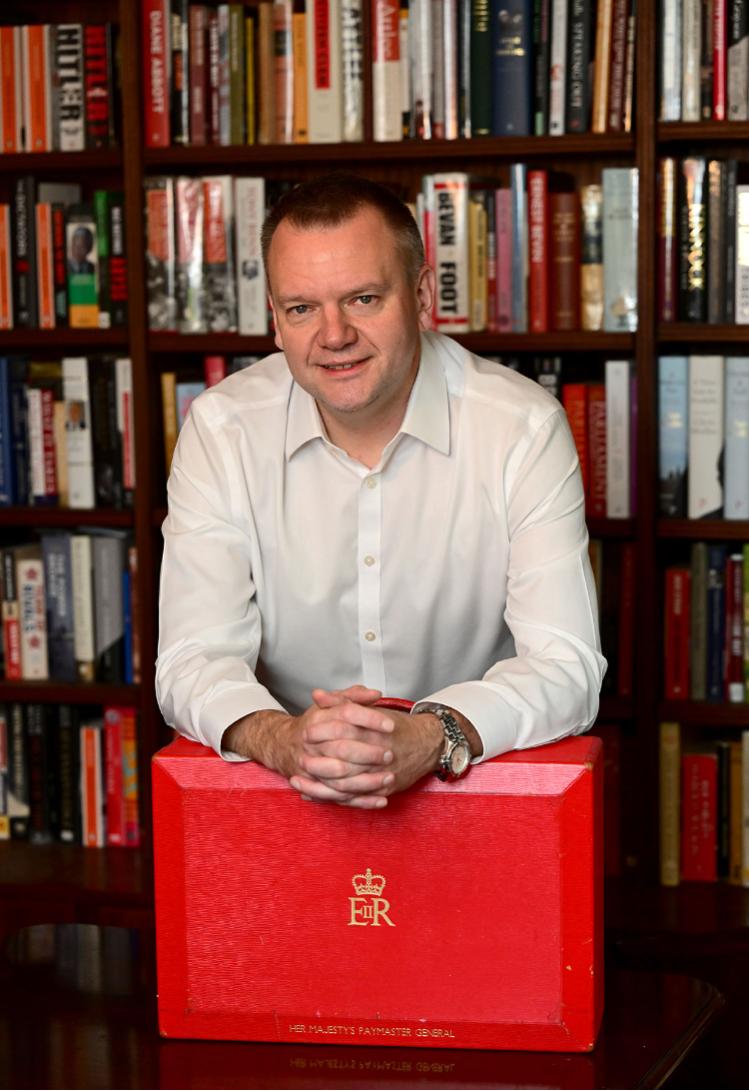 Nick Thomas Symonds (Photography: Darren Britton/WNS)
Repairing relations with the EU was a major part of Labour’s offer at the last election, but so far rhetoric is running ahead of reality, as familiar problems like freedom of movement continue to hamper efforts at closer ties.
There are signs that one sticking point – a youth mobility scheme – may be closer to agreement than many realise. Thomas-Symonds reveals he is now in weekly talks with the Home Office about nailing down its logistics.
“The conversations logistically coming forwards I co-ordinate from central government, and they’re ongoing every week,” he says. “It’ll be obviously in making sure that for young Europeans who come here that we know who they are – all the work you expect the Home Office to be doing.”
He adds: “To achieve my ambition of having people from all different backgrounds be able to access it, I’m going to be asking, ‘Well, what are we doing? What is the comms strategy we’re using? How are we actually doing that? How are we getting that up and running?’”
The House has joined Thomas-Symonds at his family home in Wales, in a small village near Cardiff. The house sits on a hill, overlooking a viaduct where the minister goes for early morning runs.
We head inside to the minister’s library, a room he dreamed of owning while growing up. Thomas-Symonds is a meticulous book collector: entire works of Martin Amis, Philip Larkin and JRR Tolkien are stacked on one side of the room; with world history in one corner, and Conservative and Labour Party history in the other.
But as Cabinet Office minister and paymaster general, Thomas-Symonds now has little time to read. His is an unglamorous life, he says, consisting of “Eurostar, car, meeting, meeting, meeting, meeting, meeting, bed, back up, meeting, meeting, meeting, Eurostar”.
He has just returned from a breakfast in Brussels with Maroš Šefčovič, the EU’s trade commissioner, when we speak.
“I started the work when I was shadowing this role in the summer of 2023, which seems a long time ago now, and it enabled me to build the relationships that I needed to build,” he says. “It’s one of the things that’s been a real success story for the government, actually.”
But even so, negotiations have not been smooth sailing. On returning from Brussels, reports suggested the EU had demanded the UK accept its requirements on a youth mobility scheme before signing a deal on food safety.
Thomas-Symonds strenuously denies this deal to ease export checks on food – a Sanitary and Phytosanitary (SPS) scheme – is conditional on Brussels’ demands for youth mobility.
“Just to be absolutely clear, there is no direct link between those two things in the negotiation. There should be no doubt about that,” he says. “This is a balanced package across a number of areas, and I don’t see or recognise that particular framing about this at all.”
So, these reports were incorrect?
“What I was talking about was the fact that, in terms of delivery, we will want to deliver the whole package,” he replies. “I’ve been very ambitious in terms of delivery on the SPS agreement to 2027, and the point I was actually making was that I would expect to see a similar level of ambition in delivering all the rest of the package as well.”
Though immigration has become Labour’s political albatross, Thomas-Symonds insists the British public is broadly supportive of the youth mobility scheme. Still, he won’t be drawn on where the government would cap numbers.
“The British public recognise very well that a controlled, smart youth experience scheme is very, very different to the very serious issues – I’m sure we’ll come on to – that we are facing on illegal migration. These are completely, completely different things.”
It is noticeable, however, that the minister is redubbing the youth ‘mobility’ scheme, as it’s always been known, as the youth ‘experience’ scheme. Is this a conscious decision to break association with people moving to the UK?
“I think it just reflects the reality of what it is,” he insists. “It reflects the reality of it being an opportunity to go overseas and... to actually experience different cultures, to actually experience working in a different country. But I’m not afraid of using these different terms – far from it.”
Like others in government, Thomas-Symonds vigorously defends his party’s measures to stop the boats. But at the time of speaking, the first asylum seekers selected to be deported on its ‘one in, one out’ scheme had just successfully argued to remain in the UK. The flights eventually left for Paris with none aboard.
 Nick Thomas Symonds (Photography: Darren Britton/WNS)
“It is a pilot, so we will want to –” he begins to say, as if about to acknowledge faults in the scheme, before reverting to: “I’m very confident it’s going to produce a deterrent and scale it up.”
As a barrister for 11 years – the bookshelves behind him are a relic from his old office – Thomas-Symonds bristles at the thought of leaving the European Convention on Human Rights (ECHR) altogether.
“The idea that leaving the ECHR and joining Russia and Belarus as the only two other European countries that are not signatories will somehow help us secure the international co-operation we need – that is, in my view, completely misguided.”
So he’s with the Attorney General – another with a claim to personal friendship with the Prime Minister – on this? “I’m 100 per cent aligned with the Attorney General, who by the way I’ve known for many, many years and is doing an excellent job.”
As the continent ramps up its defence production, British manufacturers stand to benefit from access to the EU’s €150bn defence fund. However, France has just proposed a 50 per cent ceiling on the value of components British firms can supply. Thomas-Symonds must now negotiate the amount the UK must pay to simply access the scheme in the first place.
With costly obstacles complicating matters, Thomas-Symonds says he has warned the EU against pushing the UK away in negotiations.
“This is not the moment to fragment European defence. This is not the moment to fragment European defence industrial capacity,” he says. “I’ve taken that message to the EU. I think it is very well understood.
The Prime Minister makes his own decisions, always
“I’m not offering a counsel of perfection. I’m sure there are many things that I could improve upon,” he says, then adds: “I’m sure I always struggle, frankly, with the number of hours in a day. That’s just the nature of the role that I have in the Cabinet Office at the very centre of the government. It’s a unique role in having its domestic and foreign policy elements.”
In South Wales, rooted in the Labour tradition of Aneurin Bevan and Roy Jenkins, the public are increasingly turning towards Nigel Farage’s brand of populism.
A few miles west of where we are sitting, Reform and Plaid Cymru are battling it out to win the Caerphilly by-election. Labour hardly features. Looking further ahead, the Senedd elections in May 2026 are predicted to be disastrous for the governing party.
Voters must remember that it was Labour who gave an extra £600m to the NHS in Wales in the Budget, says Thomas-Symonds, when considering who to support.
“The case I and Welsh Labour will be making over the next eight, nine months is, if you value it, you’re going to have to go out and vote for it, because Reform are a threat to the National Health Service,” he says. “Believe me, the campaigning energy in Welsh Labour to do this is as strong as anything.”
With Labour facing an uphill battle to fend off Farage, Starmer’s man in Europe insists it is in the doing – in the negotiations and deals abroad, but also in the investment at home – that his party will triumph.
“Look at Harold Wilson in the 1960s and the great social changes, or Tony Blair in 1997 with things like the national minimum wage and devolution and reform of the state. Each Labour government has risen to these moments,” he says. “That’s exactly what I see at this point: a moment of change.”
