Rebecca Smith: Conservatives Must Be "Careful" In Aligning Party With Christianity
Rebecca Smith (Photography: Dinendra Haria)
8 min read
South West Devon MP Rebecca Smith tells Sophie Church the Conservatives must be wary of describing British values as Christian, why the party needs to ‘hold its nerve’ and her love of Formula 1.
In the days before Parliament broke for summer recess, Danny Kruger stood in a near-empty Commons Chamber advocating for a revival of Christianity in the UK.
“To repudiate Christianity is not only to sever ourselves from our past, but it is to cut off the source of all the things that we value now and that we need in the future: freedom, tolerance, individual dignity and human rights,” the then-Conservative MP for East Wiltshire said, before defecting to Reform UK last month.
A few weeks later, Conservative leader Kemi Badenoch pitched in. “The world that we have in the UK is very much built on many Christian values,” she said in a BBC interview, describing herself as a “cultural Christian”.
Amid claims of a revival of engagement with Christianity among some groups, senior Conservatives are increasingly speaking about the connections between Christian faith, conservativism and Britishness.
Rebecca Smith, the Conservative MP for South West Devon, identifies danger for the Tories in this messaging.
“I think that narrative could be open to misuse potentially, and it could be used as an excuse for something, or it could legitimise something, and actually it doesn’t represent everybody, or it just represents some,” she tells The House.
“I’ve got friends of other faiths who would have similar values. We just have to be really careful and make sure that we’re being really clear on what we mean, and perhaps actually name the values that we’re talking about, rather than call them Christian values.”
Smith, a Christian herself, says she has not had the chance to speak with Kruger or Badenoch about their interventions but is “really happy” to continue these conversations when Parliament resumes.
Softly spoken and considered in her answers, Smith is one of the new Conservative MPs shaping the future of the party.
Plymouth born and bred, Smith is evangelical about her hometown: excitedly describing its geography – the sea to the south, Dartmoor to the north and the rivers and valleys in between – and its history – the defeat of the Spanish Armada, the Mayflower which set off from Plymouth, and the small friaries still standing from the civil war.
“A lot of it is built out of granite, because of our proximity to Dartmoor,” she says. “So when it’s grey, it’s pretty grey – you have grey sky, grey sea and grey buildings – but when it’s blue sky, oh my gosh. I genuinely don’t think there’s anywhere else like it.”
Her father trained as an architect, then started his own kitchen building business – which he eventually sold to Smith’s brother. Her mother came to Plymouth to study medical physics, then became a school governor.
Family friends with the former holder of her seat Gary Streeter, Smith, now 44, was exposed to politics from a young age. Though the family never had much money – she self-funded her first trip abroad at the age of 19 – Smith was raised with Conservative principles.
“I think my parents’ small business background – working hard, assuming that they had to make stuff work for themselves – all of that is basically why I am Conservative,” she says. “We never had very much money… they went out to work and we made sacrifices.”
Though “not a massively confident teenager”, she decided at the age of 18 that she’d like to work in Parliament. Having gained a history and politics degree from the University of Southampton, she did some work experience for Streeter in Westminster, then worked at the European parliament in Brussels.
On returning to London, she took a job at the Conservative Christian Fellowship, which trains Christians to be elected representatives. She then worked for an MP for five years before the Coalition government came in.
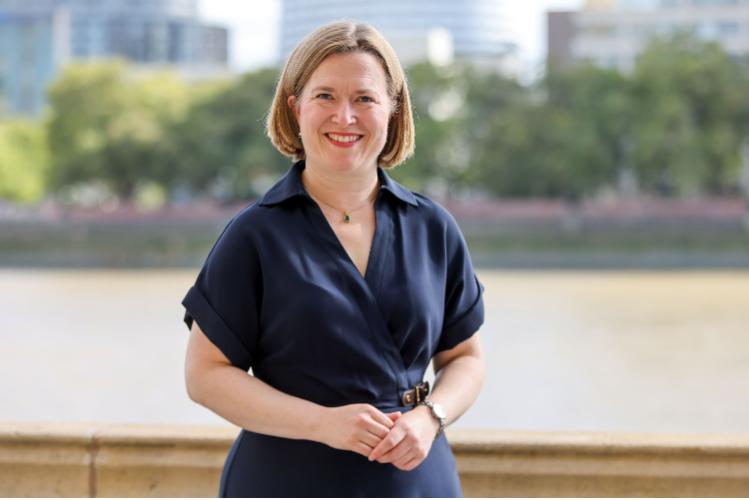 Rebecca Smith (Photography: Dinendra Haria)
Smith then stepped back from politics, working as an operations and volunteer manager for a church, then in roles at a tech startup and the Bar Standards Board. After being “treated quite badly” in one workplace, and her self-confidence dashed, she went for counselling.
“This is probably way too honest to stick in an article, but [the counsellor] actually said to me – this was in 2014 – ‘your capacity is greater than your vision for your life’.
“He basically encouraged me to dream big. He was like, ‘what do you actually want to do?’ I was about 32 and I was like, ‘I actually do think I want to be an MP.’ He caught me at just the right time, because you just think, ‘gosh, if you haven’t said that to me, where would I be?’”
It was like “a switch flicked”, she says. On a trip to America in 2014, she pulled out a notebook and wrote a 10-year plan of how she would become a Member of Parliament: “Try and become a councillor, do an unwinnable general election, then give it 10 years and become an MP,” she says. “I did it in nine-and-a-bit years.
“I actually went back to America on holiday last year after recess, and I was in the same place 10 years later after I’d made it, to the day. That felt pretty cool.”
Smith is still a councillor on Plymouth city council, and ends her term in May 2026. After losing Plymouth Sutton and Devonport to armed forces minister Luke Pollard in the 2019 general election, Smith was elected to South West Devon last year. She is now an assistant whip and sits on the transport and ecclesiastical committees.
With the Conservatives struggling to make impact, does the party need to reinvent itself as she perhaps did?
“I’m not a big believer in changing to fit the current scenario,” she says. “I’m in a weird constituency where I basically have two or three different opponents; I’m not just facing one or the other.
“Therefore, being Conservatives is going to be really important, because if we try being somebody else, it gets really complicated, it gets messy, and the electorate aren’t going to know who we are. So I’m much more: hold our nerve. Stay true to who we are – from those basic levels of what is conservatism.”
That “doesn’t feel like a million miles away” from what the party is currently doing, she adds.
With values in place, the party must hone its comms efforts, Smith says. “Being that community champion as well as a legislator, that’s how you can show leadership. Giving people a reason to get up in the morning, saying, ‘this is great. Look at this exciting thing that’s happening’.
“So much of politics can be: ‘oh my gosh, everything’s terrible’, whereas I think it is our job to flag-wave for our community.”
However, the Liberal Democrats – bent on wiping out the Conservatives at the next election – are employing the same strategy. Ed Davey’s party is also aligning itself with Christianity: albeit by modelling Lib Dems as community champions who fix local church roofs, rather than ambassadors for the faith.
In fighting for a similar political space in a similar fashion, are the Lib Dems more of a threat than Reform and Labour?
“I think they are as equal a threat, and I think we ignore them our peril,” she says. But in a similar show of disdain for the Lib Dems as has been displayed by Badenoch, Smith adds: “They’ve still got to deal with the fact that not everybody likes the Lib Dems.”
With some saying the Conservative Party could be obsolete come the next election, Smith is sanguine.
“I’m an optimist,” she says. “I want to see us hang together as much as we can, and stay together. I think there’s strength in that, and it’s a real opportunity for those of us who are there to shape what that looks like.”
Asked whether she would like a position in Badenoch’s shadow cabinet, she says she “hasn’t come into Parliament with an end goal” but will hopefully “get noticed for doing a good job”.
“I’ve experienced being a councillor. I’ve done cabinet and I’ve had leadership roles in council. So who knows in the future?” she says, with quiet confidence. “I’m basically just here to do whatever I can to help the Conservative cause in Westminster.”
For today, though, Smith has one job: sticking up a limited edition poster in her Plymouth constituency office of Lewis Hamilton winning last year’s British Grand Prix.
While she won’t accept being an “avid” F1 fan, she recalls driving to Silverstone and back in a day to watch Hamilton win the Sunday after gaining her seat, before catching the 6.55am train to Parliament on the Monday morning.
“The poster says: ‘every dream needs a team’ which is really cheesy,” she says, laughing.
“But I love the team aspect. I feel, in a way, politics is a bit like F1: you’ve got your driver; you’ve got your candidate, but none of it happens without the team behind them.”
