Reform UK Divided Over How To Tackle Challenge Of Increasingly Split Right-Wing Vote
Reform's Matthew Goodwin in January 2024 (Alamy)
6 min read
As Reform UK prepares for the next general election, the right-wing vote is splitting – and the party is divided over how to deal with the challenge.
When members and senior party figures gathered for Reform conference in Birmingham last year, the party was high in the polls and still riding the wave of council election victories in May.
But as new Prime Minister Andy Burnham enjoys a bounce in the polls, Reform's 2026 gathering takes place during an apparent dip in its popularity, as well as amid allegations that it broke political donation rules.
Another electoral challenge has also been discussed at Reform's conference: the problem of the right-wing vote becoming increasingly fragmented.
Research from More in Common has revealed that while Reform's grip on right-wing voters had been far stronger than Labour’s grip on the left-wing vote in the year to March 2026, that picture has flipped in recent months.
Labour has been re-uniting the left – a trend that has only become more apparent since Burnham took over from Keir Starmer – at a time when Reform’s ability to bring the right together has declined. Reform's share of the combined right vote was 63 per cent in September 2025, but it has now dropped to 50 per cent.
Reform’s struggle with a fractured right-wing bloc is playing out at the ballot box. In Dover last Thursday, a council by-election delivered a shock win for Green candidate Ingrid Dodd after the right-wing vote split three ways between Reform, Restore Britain and the Conservatives.
With the combined right-wing vote receiving a larger share than than the Green and Labour vote, Dover is a result that party figures – including commentator Matthew Goodwin, who was Reform's unsuccessful Gorton and Denton candidate – have highlighted.
Speaking at a More in Common panel even at Reform conference on Friday, Goodwin warned that the council by-election showed “exactly what is going to happen at the next general election if people on the right don’t wake up”.
“Everybody on the right of politics, everybody who would describe themselves as being anti-establishment, has to understand what is happening today. The left have an inbuilt advantage going into the next general election because the left are much more willing than people on the right to vote tactically,” Goodwin said.
On the same panel, Luke Tryl, the executive director of More in Common, said: “One of the things for Reform to think about is that they will face tactical voting on the left.” He advised that voters are “becoming increasingly savvy about finding the best alternative to the party they want to stop Reform”.
In an interview with PoliticsHome on the eve of conference, senior Reform figure and leader of Kent county council Linden Kemkaran said some voters have "taken their eye off the ball" in being "enticed" by Restore Britain.
“Tactical voting today is helping the left, and it is hurting the right,” Goodwin told the Reform fringe event. He urged voters on the right to “forget about the individual leaders”, adding: “If the ordinary voters in this country don't start to vote tactically, we will lose the next general election.”
While both Reform and the Conservatives have publicly rejected the idea of an electoral pact, Goodwin appeared to back the idea of informal alliances at a local level ahead of a general election.
“What I'm saying is, we are going to have to, ahead of the next general election, find some way of building an accommodation, an alliance of sorts among voters at the constituency level,” he said.
“Conservative-Reform voters finding unity locally is going to be absolutely critical to determining whether or not we actually win that next general election.”
Goodwin dismissed the long-term impact of Restore Britain, however, arguing that its vote would eventually be “squeezed”.
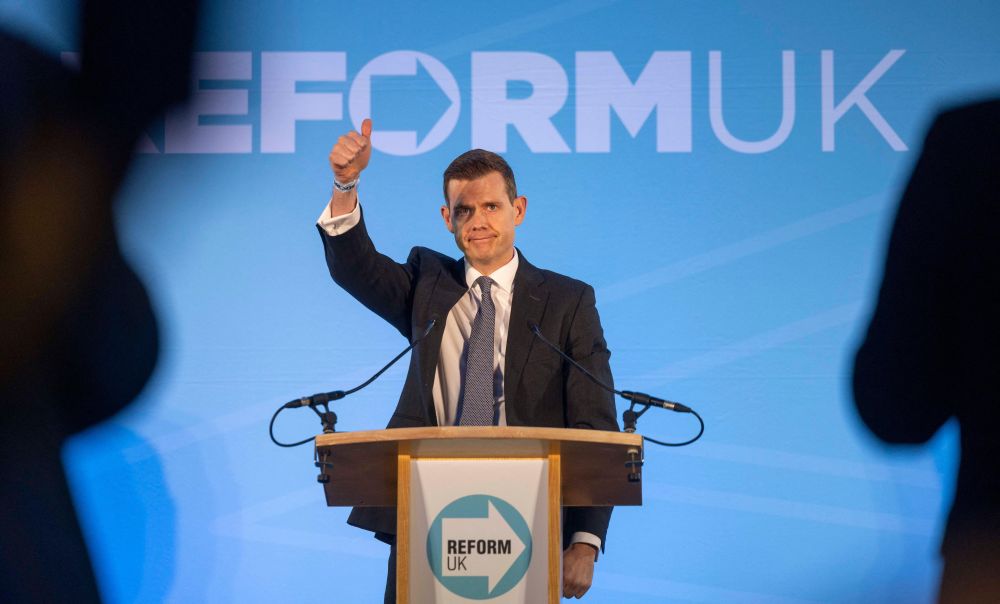 Matthew Goodwin (Alamy)
There is evidence to suggest that an explicit pact between Reform and either Restore Britain or the Conservatives could hurt the former's electoral chances. Tryl said that in both cases “a pact would actually lower Reform’s likely voter pool”, as a pact with Restore would deter Conservative 2024 voters, while a pact with the Tories would deter 2024 Reform voters.
Like Goodwin, one senior party figure told PoliticsHome that they were convinced that Restore Britain “won’t be a question that needs answering”, predicting that Rupert Lowe’s party would soon collapse.
But the same source did not agree with Goodwin's argument that Reform should build “an alliance of sorts” among voters at a local level ahead of the general election.
While they acknowledged that a hung Parliament may necessitate the need for conversations with other parties on the right, they dismissed the idea of a pre-election alliance. If they told their local branch that the party was doing a local deal with the Tories ahead of an election, they said, “half of them would walk out”.
Speaking to PoliticsHome on the condition of anonymity, a Reform councillor from the South East admitted that “on a local level, unofficially, pacts would have to be made”. They said it would be “very tough, because we don’t want to lose the idea of us being different”.
They also acknowledged the differences between the left and right bloc on this issue, pointing to Green-voting friends who would be willing to vote tactically for the Liberal Democrats. But referring to Reform voters, the councillor observed: “We are a lot more stubborn and won’t change [our] vote.”
A Reform member attending the conference voiced support for Restore Britain while speaking to PoliticsHome and said they would be open to a deal with the party. They said they would not be open to such an alliance with the Tories, however, as they had “stabbed Boris Johnson in the back”.
In a More in Common focus group recently, one voter voiced concern that Farage's party had let in Tory defectors: "I'm not so sure that he now stands for what his party originally stood for... Rupert Lowe's party that he's bringing in is actually what Reform were when they first started.”
Speaking to PoliticsHome at an event on Friday, pollster John Curtice predicted that Reform would be engaged in an “existential fight until spring 2028”, but at that point the party would “have to work out where they are at, and whether or not they need to do a deal, and whether or not they can”.
Noting the difficulties around agreeing where the parties would stand down, Curtice warned: “The route to hell is paved with electoral pacts.”
