Plaid Cymru Leader Rhun ap Iorwerth: “In New York, it’s Mamdani. In Wales, it’s Plaid”
Plaid Cymru leader Rhun ap Iorwerth (Photography by Darren Britton/WNS)
7 min read
Plaid Cymru leader Rhun ap Iorwerth is turning Keir Starmer’s Reform strategy on its head by telling Welsh voters only he can stop Nigel Farage. He talks to Tom Scotson about his plans for government and why he’s like Zohran Mamdani. Photography by Darren Britton/WNS
It’s a name Westminster is going to have to learn: Rhun ap Iorwerth now looks odds-on to be the next first minister of Wales.
The 53-year-old former journalist has emerged as favourite for the role after Plaid Cymru, the party he leads, won the by-election for the Senedd seat of Caerphilly.
The result confirmed Labour’s struggles but also suggested that Reform may not be set for the sweeping gains that had been predicted. Reform pledged to throw everything at the campaign but its candidate Llŷr Powell came second, more than 3,000 votes behind Plaid.
Nigel Farage’s party had been widely expected to win the by-election, with the Reform leader visiting the constituency twice in the run up to the vote.
In New York, it’s Mamdani. In Wales, it’s Plaid
In an interview in Cardiff, ap Iorwerth tells The House that voters were turned off by the fact that it was funded by a “well-funded billionaire” machine. “And actually, that’s turned them more towards a grassroots party in Plaid Cymru.”
Both Plaid and Reform dwarf Labour and the Tories in the polls, on 14 per cent and 11 per cent respectively. “If the polls are anything to go by, Plaid Cymru could be in a position to form a minority government,” he claims.
In fact, a coalition with Labour and the Greens is far more likely. His message to voters is clear: to move the Welsh population towards independence and stop a Reform government.
“I’ve made it abundantly clear that there won’t be formal deals with the parties of the right,” he says, referring to Reform – a party to which his views are “diametrically opposed” – and the Conservatives, who face an “existential” wipeout.
Plaid will be doing its utmost to persuade people that it represents positive change, “especially in contrast with the divisiveness that would inevitably follow the prospect of a Reform government”, he says. “Labour will have to recognise that surely that is a better option for Wales than the Reform option.”
In effect, ap Iorwerth is pursuing the same strategy in Wales as Keir Starmer wants to deploy across the whole of the UK: telling voters appalled by the idea of a Farage prime minister that a vote for them is the best way to stop Reform winning the keys to No 10.
Inside his Senedd office, bunting of the Welsh standard hangs from the ceiling. He distances himself from those who tied English flags to lampposts over the summer to express their patriotism.
“I am massively proud of our flag,” he says, but adds: “I don’t feel the need to scream it from the rooftops in order to persuade people that I will do whatever it takes to build my nation and give it a better future.”
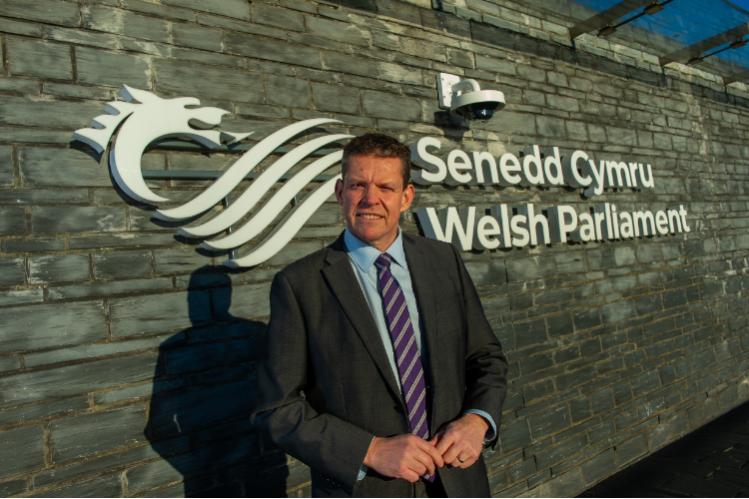 Rhun ap Iorwerth (Photography by Darren Britton/WNS)
At the upcoming May election, the Senedd’s current 40 constituencies and five regions will be replaced by 16 larger constituencies. The newly established seats will elect six Members of the Senedd (MSs), raising the number of MSs from 60 to 96.
Ap Iorwerth talks about the need for a progressive alliance before May’s elections to prevent Reform from forming a government. The agreement resembles the so-called ‘firewall’ pact in Germany, where centrist and left parties work to keep the far right out of government.
“We have a stark choice facing Wales next year,” he says. “Polls now, for over a year, have pointed to there being two parties quite a bit out in front: Plaid Cymru have been topping the polls; Reform also on a significant proportion of the vote.
“As we’ve seen in Caerphilly, but as we hear and see in the political discourse in Wales in general, people are looking for a way of showing that they want to reject that divisive political right. And that’s got to be Plaid.”
The Plaid Cymru leader is keen to burnish his progressive credentials. He sees himself as a progressive alternative to mainstream parties – as the Greens do in England and the socialist firebrand Zohran Mamdani does in New York – and claims Labour has been “rapidly shedding the label of progressive politics”.
“In New York, it’s Mamdani. In Wales, it’s Plaid,” he adds, enthusiastically bumping his fist on the table.
Ap Iorwerth believes a trans woman is a woman; raises the alarm over Labour’s right-ward shift on immigration; and is a republican. Does he believe, then, that the Prince of Wales should be Welsh?
“As a republican I don’t believe in kings and princes, but I’ve also made it clear that’s not a political priority for me,” he replies, before adding: “While I appreciate and respect that the monarchy remains important to many across Wales, I think there is a clear argument to be made that the Prince of Wales title should be consigned to the history books.”
I want to see a redesign, essentially, of the relationship between the countries of these islands
Ap Iorwerth is also a former political journalist who worked at the BBC for 20 years. A recently leaked memo concluded that there is institutional bias within the organisation.
Asked whether he noticed a left-wing bias within the Beeb, he says: “I’ve heard accusations of there being a deep, deep right-wing bias in the BBC, as well as a left-wing bias in the BBC. Well, it can’t be both, is my experience.
“Are mistakes made in the BBC? Absolutely, you know – absolutely. It’s a massive organisation and they’ll get things wrong, but you can’t be biased in every way.”
Before he left broadcasting in 2013, ap Iorwerth – who uses music to unwind – bought himself a baby grand piano. Also a guitarist, he writes songs for his singer daughter’s folk-pop band, Tant. “They play stuff I wrote years and years ago,” he says, adding that he is now “far too old and ugly” to be fronting it.
So, how committed is he to Welsh independence? Plaid is wedded to it but ap Iorwerth tells The House he will not seek to use a victory as a mandate for a referendum on the union during its first term.
“I’ve been clear throughout my life that Wales is held back by virtue of not being in that position that normal countries face, which is to be independent. That’s the normal state of affairs, and I still believe that.
“Now I want to bring the people of Wales with us on that journey. And absolutely, I think it is what we should aim for nationally.”
He adds: “I don’t look at that from an isolationist position. I want to see a redesign, essentially, of the relationship between the countries of these islands.”
If Plaid wins the next election, it will have to immediately work with a Labour government in Westminster. Ap Iorwerth tells The House he has never met Starmer, before adding that he has received more interest after winning in Caerphilly.
“I did ask for a meeting when he was elected [as prime minister]. I thought it was important for us as an opposition party in Wales to be able to lay out our thoughts on how our relationship could work as they were coming into government,” he says.
“This is the new politics in Wales, and there’s no ducking that. What we have now is a situation where Labour and all other parties have to take seriously the potential that Plaid Cymru will be leading government in Wales next year.”
