Shadow Culture Secretary Rebecca Paul: Government Must Stop Funding "Divisive" Arts Projects
Photography by Louise Haywood-Schiefer
11 min read
Rebecca Paul was pleasantly surprised by her promotion to shadow culture secretary in Kemi Badenoch’s reshuffle. She tells Noah Vickers about her own relationship with culture and the Conservative plan to cut £1bn from the DCMS budget.
It’s Friday 13 November and staff in Rebecca Paul’s Westminster and constituency offices are not having the best of mornings. Microsoft’s systems have been paralysed by a global outage, grinding Outlook email and other IT facilities to a standstill.
But Paul, the recently appointed shadow culture secretary and MP for Reigate, has taken it all in her stride.
“I was saying to the teams, go and have a leisurely coffee. It’s rare you get the chance to do that,” she says, settling down for her interview with a coffee of her own and a chocolate digestive biscuit.
The 47-year-old acknowledges, though, that the outage has provided yet another illustration of the need for more resilience planning in Britain.
“I think it is worrying and just shows the importance, doesn’t it, of thinking about what you do when the thing you depend on stops working. That’s when, for my office, having a landline becomes important, so those emergencies can still get through…
“This is going to cost the country, and across the world it’s going to cost a huge amount, but it might actually be a bit of a wake-up call to say ‘OK, these things could happen, what are we going to do to make sure that we can all stay connected and that we can still function as we should?’”
Internet connectivity is one among several areas covered by Paul’s new Digital, Culture, Media and Sport (DCMS) portfolio. Having become an MP only two years ago, she has enjoyed a swift rise to reach the shadow cabinet, but admits her promotion in September came out of the blue.
“It was the first reshuffle that I was actually enjoying,” she recalls. “This is the first reshuffle where, two years in, I know everyone, I know the characters. You know sort of what people were wanting to do, what they don’t want to do.
“So I was just on my phone, watching avidly because it was the bank holiday, sitting in the garden as stuff got leaked, really enjoying the news come through. I didn’t for a second think that I would get a call, and Kemi came up on my phone.
“I’m a backbench MP, right? It’s not that often Kemi’s going to be phoning me. My husband saw me getting flustered and going, ‘Oh my goodness, Kemi’s phoning!’ So it was a massive surprise and the role itself was a massive surprise, but I’m delighted. It’s such a privilege to do it and it’s a great role.”
Paul’s pre-political career was as a chartered accountant and tax adviser, and since entering Parliament, she has served as an opposition assistant whip on the business and trade brief, while maintaining a strong policy interest in women and equalities. DCMS, in short, was not an obvious choice for her – but one she was pleased to accept.
“It’s a really important portfolio,” she says. “I don’t think people quite realise how important it is and it contributes massively to the British economy – so if we get it right, it can really boost growth and then it brings everyone together as well.”
The House asks about Paul’s own relationship with culture. Is she someone who has always enjoyed the arts?
“I wouldn’t say I’m a particularly cultured person,” she replies. “I would say I’m a very ordinary person, ordinary background. I’m state-educated and as soon as I left school, left university, I needed to earn money in order to get on the housing ladder and have a family, all those things that many of us aspire to do.”
At school, Paul was a long-distance runner and played several musical instruments, though she admits to having had “no particular musical talent”. In her art lessons, it also became clear she had “absolutely no artistic ability at all”.
But this was all for the good, the shadow culture secretary argues: “I think it’s really important when you’re young that you try lots of different things, because you don’t know what you’re good at, so you’ve got to try them to find out.”
Today, Paul is a pop music fan, particularly fond of Dua Lipa and 1980s hits.
“Whenever I’m in the car – a lot of my colleagues, they’re always listening to podcasts or serious stuff, or the news – I quite often have Heart or Capital on…
“I even like a lot of the K-pop stuff that my kids are really into. It is quite exciting I think, the whole K-pop thing,” she says, noting how South Korea has capitalised on the success of its music industry to build a wider global brand for itself.
But ultimately, life as an MP has left Paul little time to enjoy many cultural pursuits.
“I don’t get to go very often – hopefully I will get to go more in this role, which is quite nice – but I love the theatre, I love a musical,” the MP says, two of her favourites being Wicked and The Phantom of the Opera.
What about TV?
“I love telly, I get no time to watch it anymore. I used to watch a lot of it and now it tends to be, you get home late at night from Parliament and you might watch something on Netflix just to wind down before bed.”
She was “obsessed” with the most recent series of Celebrity Traitors and is currently watching Younger, a US comedy-drama about a “40-something woman who couldn’t get a job, so she pretends she’s 26”.
And reading?
“No,” she sighs. “Again, I don’t get enough time. I tend to read when I go on holiday and then I blitz it, so I’ll have a few books on the go.
“I like a proper book – I like the smell of a book, the feel of a book. My husband has an e-reader. I like an actual book that smells of ink and paper. I wish I had more time to read.”
Her news diet, meanwhile, is mostly drawn from the platform formerly known as Twitter.
“I’m on X quite a lot and I actually find it’s quite a good way to get a feel for what the national conversation is. It’s not indicative, obviously, of the broader population, but it gives me an idea of what journalists and politicians are talking about on that day,” she explains.
“I’m sure it’s probably terrible for me though, just looking at X the whole time.”
Paul’s opposite number – Lisa Nandy – has been accused of not showing enough commitment to her job, as critics claim she is uninterested in the brief. But Paul shies away from endorsing such complaints, saying she hasn’t been shadowing her long enough to know whether they’re fair.
“It’s difficult for me to give a view on that. I’ve had a couple of conversations with her since coming into the role. She has been very nice to work with. She’s very constructive. If I ask her a question, she gives me an answer. She gives me information in advance.
“So in terms of an opposite number to work with, she’s been very professional, very easy to get on with. I like her a lot. But, obviously, I have a job to do.”
Indeed, if her party wins the next election, Paul is preparing herself for some difficult choices. DCMS has one of the smallest budgets of any department – projected to be around £2.8bn by 2028/29 – but the Conservatives plan to cut it by £1bn annually to help fund 50,000 new prison places.
The pledge has sparked concern from groups like the Campaign for the Arts, who say the reduction “could only be made by cutting deep into the institutions the public use in their millions, and the local organisations in every constituency that depend on public funding”.
Paul says £700m of the £1bn could be found by bringing DCMS’ budget back to the level it was at it in 2023/24. She also points out that most of Britain’s arts and sporting industry is made up of businesses which don’t receive subsidy, and that the cut should be viewed in the context of other Conservative policy proposals which will boost the sector.
“I wouldn’t say I’m a particularly cultured person”
These include the reintroduction of tax-free shopping for non-EU tourists, halving employer national insurance for young people, abolishing business rates for high street shops, and the repeal of the Employment Rights Act.
The cuts would start, she adds, by identifying waste within DCMS itself, before looking at external spending. Paul has started researching which arts and sporting organisations across the country currently receive public funds – and what they’re doing with the money.
“Obviously there’s lots of government funding that goes to very worthwhile things which are brilliant and bring people together and are absolutely the kind of stuff that we would continue,” she says. “But there are also lots of divisive, quite politically charged projects that money is going to and that’s a problem. That isn’t something I would want to see.
“We’ve got sports money going to sports organisations that allow males to play in women’s sport. That’s unacceptable. There are various arts projects we’ve seen where again, [they are] very divisive, political…
“If you’re spending government money, it needs to be bringing people together. It needs to have value. It can’t be about keeping lobby groups happy. It needs to be about the country, what’s good for the country – and my goodness we need it, because right now people are really polarised.”
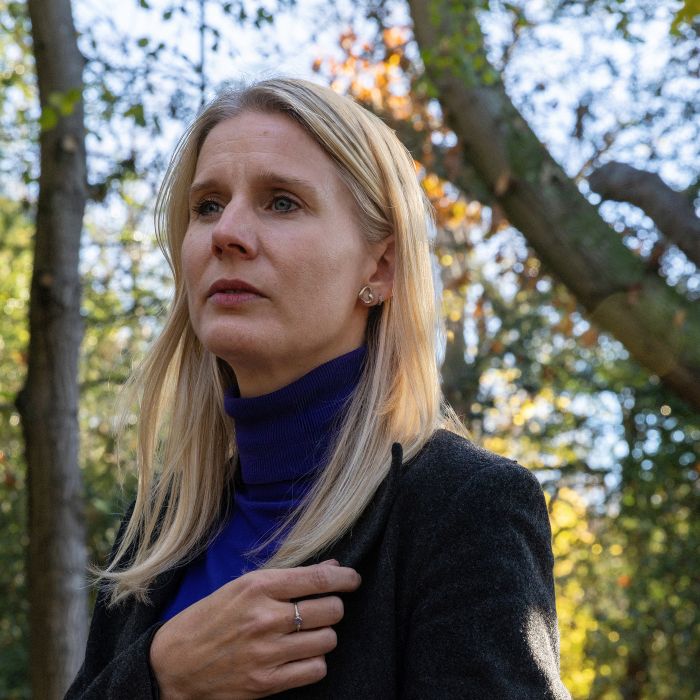 Rebecca Paul. Photography by Louise Haywood-Schiefer
Isn’t art inherently political though? Should artists really be worrying about whether their work is sufficiently unifying?
“I completely agree, but when it’s government-funded, that’s when it shouldn’t be overtly political,” says Paul. “I’m all for the freedoms, if someone wants to spend money on art that makes a political point that they’re really passionate about… absolutely go for it.
“But I think different rules apply when you are taking taxpayer money. There are people in this country that are struggling… We have to look them in the eye and be able to say we spent that money well.”
Asked whether any arts organisation currently in receipt of taxpayer grants – like the Royal Shakespeare Company, National Theatre or National Gallery – would be protected from the £1bn cut, Paul declines to rule any out.
“Until we know what the budget is and know how it’s allocated, it’s really difficult for us to do that. But what I can say is that where spend is delivering value – social value and other value – we’re obviously going to be looking to continue that where we can.”
She is similarly open-minded when asked about the future of the BBC and whether the licence fee has had its day, though she doesn’t express a preference for any particular alternative at this stage.
“The BBC is a big question. Clearly with the decline in the number of people buying the licence, the financial situation is difficult and we do need to look at the changes that need to be made to put it on a [path to] stronger financial sustainability.”
The last Conservative government spent millions developing plans to privatise Channel 4, before abandoning the idea in 2023 – but Paul refuses to rule out making a fresh bid to sell off the broadcaster.
“I’m going to have a look at Channel 4, get into the detail, take exactly the same approach that I’m going to take with the BBC and think it all through properly,” the MP says.
While she supports the government’s plan to ban social media for under-16s, Paul is also concerned about the ban’s scope being too broad. Reports recently suggested that platforms like YouTube Kids, Lego Play, eBay and Spotify could come under the ban unless they make changes to their functionality.
“One of the difficulties the government has – and I feel for them on this – is that in order to do the ban, to come up with it, you have to define what social media is…
“They need to not make the mistake of trying to get it perfect. Progress is better than nothing. Something that’s narrower, that deals with a chunk of the risk even if there are still other risks out there, might be the best way to go.”
For now, Paul is enjoying some smaller wins. On the floor of the Commons, she recently persuaded Nandy to organise celebrations next year marking 1,100 years since England’s founding by King Æthelstan.
“It was actually a really nice moment in Parliament, because originally, obviously, the government had said they had no plans [to celebrate it], and you literally saw them in that moment reconsider and actually were being quite enthusiastic about marking it and having a celebration,” she says.
“Tom Holland’s been pushing for this. For me, probably, my highlight of the year was Tom Holland tweeting that I’m his favourite MP. Yeah, I was delighted with that.”
