From Sandhurst To Parliament: Meet New Veterans Minister Louise Sandher-Jones
Louise Sandher-Jones (Photography: Dinendra Haria)
8 min read
Louise Sandher-Jones never pictured herself as an MP yet is now a minister just a year after her election. What is her secret? asks Sophie Church. Photography by Dinendra Haria
Louise Sandher-Jones never expected to be an MP. But in little over a year, the 35-year-old veteran’s life has changed such that not only is she sitting in the Commons but she has also quickly risen to the rank of minister.
“I don’t think she was expecting to be promoted quite as quickly as she was,” says Alex Ballinger, the Labour MP for Halesowen, who is also a military veteran. “She always had ambitions to end up there. But no MP expects to be there after just over a year.”
It was a speech during the election campaign that brought Sandher-Jones to the attention of No 10. Polling day was round the corner, and then opposition leader Keir Starmer was at the Fusilier’s Museum in Bury meeting some of the military veterans running to be his MPs.
Of the 10 veterans attending, Sandher-Jones was chosen to speak. Taking to the stage, she confidently set out the military’s woman problem. She would make it her goal to root out misogyny in the forces if she were elected.
“I was really impressed,” says Al Carns, now armed forces minister. “She was super capable.”
“That’s when she got noticed,” says Ballinger. “She did a really good speech in front of lots of media, right next to the Prime Minister. That obviously puts you on the radar.”
I don’t think she was expecting to be promoted quite as quickly as she was
She had a “good relationship” with then home secretary Yvette Cooper, he adds. “That obviously helps as well – having someone who’s quite close to the centre respecting you.”
Sandher-Jones, now MP for North East Derbyshire, grew up in Leicestershire. Her father, a technology industry analyst, was often away with work. Her mother worked on the desk in a bank before going to university, where she trained to be a primary school teacher.
Wanting to do something a little different, Sandher-Jones went to the University of Edinburgh to study Chinese. “It was a toss-up between Chinese, Russian or Japanese,” she tells The House. She went on to study at the Ocean University of China in Qingdao for her year abroad.
After leaving university, somebody “put it into [her] head” to join the army. She started on the civil service graduate scheme while waiting for her application for the army to be approved.
Sandher-Jones finally got the call to Sandhurst for her training in 2012.
An academic at heart, she was challenged by the physical demands of the academy. “I found certain things like getting all the drill for marching right, or taking the rifle apart in the right way – to learn all that kind of stuff was really terrible, certainly at the beginning.”
But this training culture of “breaking you down and building you up” ultimately taught her she could “achieve anything”.
This is a trait Ballinger recognises in Sandher-Jones today. “The forces are still a bit sexist as an organisation,” he says. “You have to be really resilient and robust in that circumstance – especially if you’re going on operations. Undoubtedly, she’s picked up a lot of resilience through her role there.”
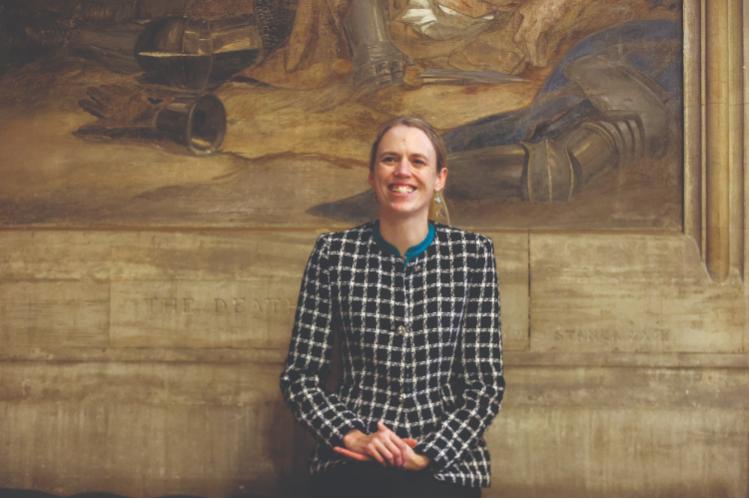 Louise Sandher-Jones (Photography: Dinendra Haria)
With just over a year of general officer training from Sandhurst, Sandher-Jones spent a couple of years in Germany with a military unit. She was then sent on tour to Afghanistan. Sandher-Jones arrived in the country in 2017, after Operation Herrick – in which British and Nato forces sought to better secure and help reconstruct the region – had finished.
“You could see that the Taliban had not necessarily got momentum, but that there had been a bit of a change in how darker red the map was getting coloured,” she recalls in an interview with The House.
“You felt like it was a bit of a forgotten conflict, because at that time the counter Isis mission was probably at its height as well, so that was a real focus. Obviously, ISIS was a huge threat to here as well – to the UK homeland.”
Asked how she found her time in Afghanistan, Sandher-Jones says it was “really hard work”. Pushed for more detail on her day-to-day operations, she is opaque: “My role was definitely in support and liaison, so I would have a lot of meetings,” she says. “I’d be travelling around the city, producing reports, things like that. Not very warry by the sounds of it.”
Sandher-Jones grappled with fatigue and burnout on her return from Afghanistan and took a trip to Hawaii in her time off. She later wondered whether staying in the military was for her.
“You question what you want to do with your life: do you want to stay with the military lifestyle, or do you want to try and have a different future, one that’s maybe a bit easier?”
And so, feeling disappointed by the UK’s direction of travel through the Brexit years, she settled on the “easier” path: becoming an MP.
Running for Labour may not have been an obvious choice, with her mother’s side of the family Conservative-supporting farmers, and her father’s Labour-supporting miners and teachers.
“I grew up reading the Guardian at Nanny and Grandpa’s and reading the Daily Mail at Grandma and Grandpa’s,” she says. “They wouldn’t let the other paper into the house.”
Both conservative and left-leaning influences are evident in Sandher-Jones’ politics today.
“I feel really strongly that you make of your life what you can. It depends on your hard work and the choices that you make, but we all do so supported by public services that educate you, look after your health, give you the transport to get around and help you access these opportunities,” she says. “For me, public services are the bedrock of everything that we have in this country.”
It was while campaigning that Sandher-Jones, as she was then known, met her fellow Labour candidate and husband-to-be Jeevun Sandher.
I grew up reading the Guardian at Nanny and Grandpa’s and the Daily Mail at Grandma and Grandpa’s
Sandher was running in nearby Loughborough and was the first to text Sandher-Jones. With their friendship developing into something more, the pair married in August. They now live together in Westminster during the week, and travel to their separate constituencies for the weekends.
The Loughborough MP has enjoyed watching “everyone else catch up” to his wife’s abilities. “She’s brilliant, that’s what I would say. People wouldn’t see the side of her that I see, that I think is even more impressive, but she’s absolutely brilliant.”
While many MPs turn to Strangers’ to wind down in Westminster, Sandher-Jones is no hedonist. Her parliamentary team have never been on a night out with their MP. She doesn’t really drink, smoke, or even eat chocolate.
This focus has made an impression on her parliamentary colleagues. “She’s pretty hard-working, that’s probably her overwhelming quality: hard-working and sensible,” says Ballinger. “She’s extremely straightforward, says exactly what she thinks – very professional.”
Sandher-Jones approaches her role with the confidence typical of a veteran: problems in her constituency are missions to solve; helping her unit achieve its aims in government is an overriding personal ambition. She answers questions economically and directly, never revealing more than absolutely necessary.
Is Sandher-Jones always this private? “I don’t think she’s a closed book at all. I think her book is the agenda of this government, and so she is absolutely focused on that,” insists Alex Baker, Labour MP for Aldershot and Farnborough.
“She’s probably done some pretty tough gigs while she was serving, as much as she has in the Home Office in here. She’s not somebody, I would say, who boasts about what she’s done.”
Though ex-forces herself, when asked by The House before she became a minister whether she recognised the plight of veterans struggling to access social housing and healthcare, Sandher-Jones’ response was surprisingly matter-of-fact.
“The veterans charity sector can be quite busy and disorganised sometimes,” she replied, adding: “I would say veterans aren’t immune from all the issues that everybody else is facing.
A lot of people, particularly younger generations, are really struggling with housing, cost of living, getting settled and adapting to life after the military. All of these issues veterans are definitely facing.”
“We’ve got VALOUR to make sure that we’re supporting veterans properly with access to housing and things like that,” she continued, referencing the project Labour brought in in May to provide veterans with more support.
But veterans continue to report systemic problems with accessing services. The House revealed earlier this year, for example, that councils – including Labour-run ones – are failing to implement the government’s policy to help house all UK armed forces veterans, .
“Sometimes it’s – with the best will in the world – the right system, [but] somebody is not interacting with it, and that hasn’t helped them,” Sandher-Jones said. “The vast, vast majority of people who leave the military don’t have any problem with transitioning. They go on to have really successful lives.”
Now veterans minister, Sandher-Jones is keen to learn as much as possible, says Carns. “When we did the handover, usually these things are a bit high five, low five, as you walk past each other,” says the now armed forces minister. “But actually, she’s really engaged in learning and understanding.”
However confident of her skills, he did offer Sandher-Jones some words of advice: “My overarching point was, whilst you’ve got to sit back a little bit listen and understand and set really demanding timelines, when you find very capable individuals in the system, delegate, delegate and delegate until you’re a little bit nervous, and then delegate a bit more.”
