Nick Gibb: The Tories Are Too Focused On Culture Wars
The former schools minister believes parties are no longer focusing on “the real lives of people and their challenges” (Alamy)
5 min read
Former schools minister Sir Nick Gibb has accused the Conservatives of focusing too much on culture wars and not enough on “the real lives of people and their challenges”.
Gibb, who served as schools minister for a total of 10 years during recent Tory administrations, and was a Conservative MP for nearly three decades, said his party has not reflected on what it got wrong in power following its heavy general election defeat last year.
Gibb spoke to PoliticsHome while Conservative Party conference was underway in Manchester, where leader Kemi Badenoch is under pressure to prove to MPs and members that they can recover from their devastating defeat in July 2024.
To kick off the event, Badenoch confirmed that if elected prime minister, she would withdraw the UK from the European Convention on Human Rights as part of her policy for tackling illegal migration, a decision she described as having not been taken lightly.
According to Gibb, however, the UK should be leading efforts to reform certain conventions of the ECHR, not “tacking to the right” and picking the “most immediate superficial solution” of leaving it altogether.
He bemoaned what he believes is a Tory strategy too focused on culture wars and insufficiently interested in the everyday lives of voters. He told PoliticsHome that his party must “get back to first principles” and ask itself, “what does the Conservative Party actually stand for?”
“There is still too much focus on culture wars in the narrative, and we are too responsive to what the newspapers are talking about,” Gibb said, adding that while it may stir up emotion, “it's not going to relate to economic growth or helping young people get on the housing ladder”.
“What the Conservative Party should be doing is analysing what went right and what went wrong in the previous government. They have not done that," he added.
Gibb, who stepped down as an MP at the last election, was keen to stress that he feels there is a lot that “went right” during 14 years of Conservative rule, citing his own wheelhouse, education, as well as the economic approach taken following the banking crash of 2008.
But he warned his party that it cannot expect voters to be "cheerleaders for free markets" in a time of such "unfairness", and urged the current generation of Tory MPs to be "far more radical" when it comes to fixing the problems facing the public.
Despondent about the state of British politics, it is a criticism that he extends to all parties.
"The stuff of politics is solving the country's problems, developing policies to tackle those problems, and I don't sense in the mainstream parties in this country that that is where the focus is, it's on these other peripheral things," the former Tory MP said.
“[Mainstream parties] have become too cynical, too obsessed with themselves, too obsessed with the media, and they’ve stopped doing the fundamental thinking about our country and the problems that real people face every day."
This, he said, is why politics in the UK is moving "to the extremes”.
Writing in The House last week, political scientist Rob Ford said the threat facing the two main parties — the Conservatives and Labour — is the greatest it's ever been. "A majority of those with a preference are now telling the pollsters they will back someone other than Labour or Tory. That’s never happened before," he wrote.
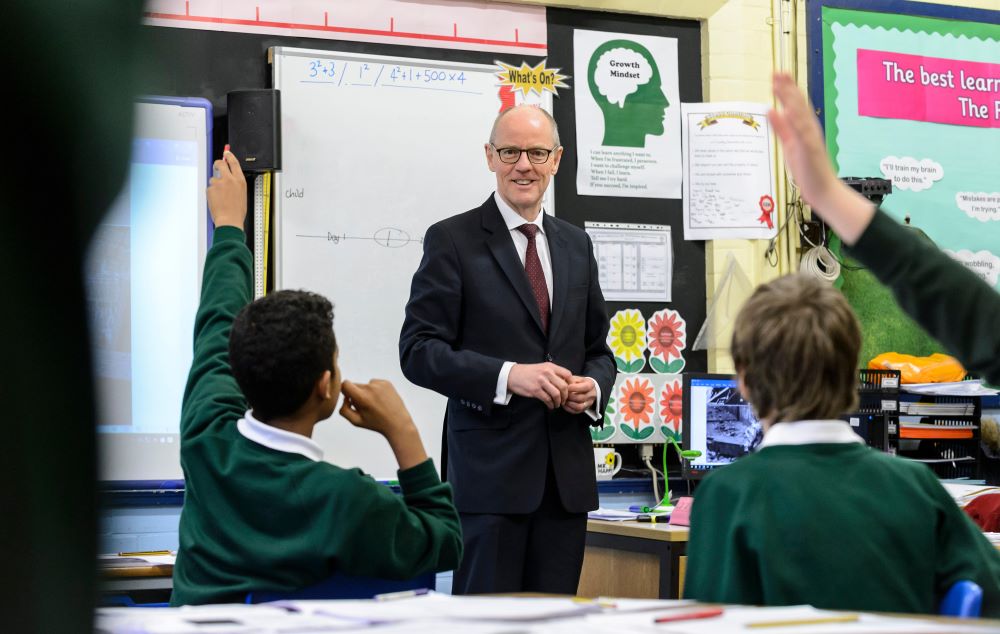 Gibb says students need to be warned against using AI to complete homework (Alamy)
Gibb, regarded as a quietly influential force within recent Tory governments, shaped much of what is taught in schools today and is praised for his passion for the education system, even by some critics. He has just published a book, Reforming Lessons, on his many years as schools minister.
He is particularly worried about the use of artificial intelligence in classrooms and the impact it could have on the long-term development of children. He disagrees with advice issued by exams regulator Ofqual about how students should use AI in coursework, and wants young people to be warned against using the technology in homework.
Gibb is also critical of the direction of travel under the Labour-run Department for Education, claiming that both the curriculum and assessment review and the Children's Wellbeing and Schools Bill risk “chipping away” at his reforms, which were all about embedding a “knowledge-rich curriculum”.
He also doesn't support lowering the voting age to 16.
PoliticsHome reported in February that most teachers believe the curriculum currently fails to provide young people with sufficient political education to participate in elections.
Recent reports suggest the curriculum and assessment review will seek to address this issue. But Gibb said that such an addition shows why the policy was a mistake in the first place. “If you're saying [votes at] 16, but we don't think they're ready, so we need to adapt schools to make sure they are ready, it just makes the point for you.”
He argued that once you go lower than 18, the cut-off is arbitrary: “I see no difference in arguments between 14 and 16.”
He added: “The danger of teaching politics [in schools] is that it can be biased, depending on who the teacher is, and with the best will in the world, it is difficult not to be biased.”
Reform UK chairman Zia Yusuf told PoliticsHome at the party’s annual conference in September that he believes schools and universities in the UK are “indoctrination camps”.
What does Gibb think will happen if Nigel Farage does become prime minister?
“He won’t be able to deliver [on] the promises, and you add to the disillusionment that got him there.”
