Wes Streeting: EU's Made In Europe Rules Could Threaten Nato's Security
Photography by Tom Pilston
11 min read
Defence Secretary Wes Streeting talks to Noah Vickers about his abandoned Labour leadership bid, the future of European security, and the strength that comes with being openly LGBT.
Before our eyes, Wes Streeting has undergone something of a metamorphosis.
As Sir Keir Starmer’s health secretary, he was known as the straight-talking media performer who regularly took to the TV studios to knock back the pay demands of striking doctors and who always seemed to have a well-rehearsed joke up his sleeve.
In his new role as Andy Burnham’s Defence Secretary, the public has seen a little less of the 43-year-old MP for Ilford North, dealing as he now is with classified information and tasked with keeping the country safe from the gravest of threats.
But Streeting, who strides into the grand surroundings of Westminster’s Horse Guards building for his interview with The House, does not seem to have found the job-switch too disorientating. He argues, in fact, that there is a common thread linking his past and current cabinet roles.
“I feel very privileged to have had the honour and responsibility of leading two of the greatest institutions that Labour governments have ever built, which is the National Health Service and the Nato alliance – both of which have the same collectivist principles at their heart: an injury to one is an injury to all.
“We pool risk and share responsibility. We take care of each other. That’s true of the health service and it’s true of Nato allies.”
Streeting says he has felt “vindicated” every day since the events which led to his new job: his resignation from Starmer’s government and decision to throw his weight behind Burnham, rather than pursue his own Labour leadership bid.
“There was definitely more than a small feeling of liberation in that moment of deciding to back Andy,” he says.
“To be honest, I knew that when I resigned from Keir’s government – at the time that I did, in the way that I did – I kind of had a sense then that that was the end of my leadership ambitions.”
The end of those ambitions forever?
“Yeah,” he replies, “and I did it because it was the right thing to do. I do not regret it for a second. There has not been a single moment where I’ve regretted the decision to resign or the decision to back Andy…
“He was unquestionably the best candidate and I think he has shown on every single one of those hundred days that we have been in office under his leadership why he is the right person to lead our country. He has undoubtedly given Labour a second hearing with the public.”
The Prime Minister, Streeting adds, is willing to “run towards difficult issues that others would either try and avoid or kind of tiptoe around” – including on Britain’s relationship with Europe.
But while Burnham has promised to adhere to Starmer’s 2024 manifesto on EU relations, it remains unclear what the PM would do in the event of securing a second term for Labour. Opinions among his MPs, needless to say, are varied.
Foreign Affairs Select Committee chair Emily Thornberry, for example, has said the government could simply re-apply for EU membership if it wins the next election on a manifesto promising to do so, rather than having to “bother” with a fresh referendum on the issue. Does Streeting agree?
“I think we’re some way from that,” he says. “One of my reflections, having been in Parliament for 11 years and for all of the post-referendum aftermath, is that Brexit isn’t an on and off switch. You can’t turn the EU membership off and then just switch it back on again.
“The EU has changed a lot in the last decade and it’s not clear what the terms of re-entry would be either.”
Indeed, the bloc has taken an increasingly protectionist turn as it pursues a ‘Made in Europe’ industrial policy designed to boost its own manufacturers. Burnham has said he will make the case for Britain to become a “trusted partner” under that framework, though any agreement will inevitably depend on what conditions EU member states try to attach to it. On this, Streeting issues a stark warning.
“I see Made in Europe as both an opportunity, but if got wrong, it could actually be a threat to our collective security across Nato,” he tells The House.
“What I see and what I’m part of leading in Nato is greater co-operation when it comes to our military readiness. Our defence industrial base and our economic co-operation is absolutely integral to that, and so I’ve warned our allies that whether it’s America First or Made in Europe, we mustn’t allow healthy competition and an understandable focus on building our domestic industrial capacity to become self-defeating protectionism – that’s the risk.
“The Prime Minister’s drive to look at what we can do to build a stronger partnership with the EU, and to deal with the shortcomings of the Brexit deal that the Tories botched, is all about understanding both the opportunity of Made in Europe, if it applies to Britain – a European country – but also the threat to British industry if it doesn’t.”
In addition, Streeting confirms that while the government remains interested in joining the EU’s Security Action for Europe defence fund, it will not do so at any price. Talks collapsed last year after France pushed the EU Commission to demand more than €6bn in entry fees from the UK, even though the price tag was later reportedly slashed to €2bn.
The Defence Secretary says of any new negotiation: “If it’s a good deal for Britain, we’ll be willing to sign up and if it’s not a good deal for Britain, we won’t.”
He welcomes, nonetheless, the EU’s increased focus on defence issues, arguing that Europe cannot simply wait out Donald Trump’s presidency in the hope of the next US administration taking on more of the continent’s security burden.
“There’s always been a danger that as President Trump has been challenging European countries to spend more on defence, that people think ‘Well, we’ll just wait for President Trump to leave the Oval Office and then things can go back to normal’. I think that’s wrong on two counts,” he says.
“Firstly, President Trump is not the first US president to express frustration with European over-reliance on the US and those frustrations haven’t been confined to Republican presidents, so the idea that the next president will be relaxed about European over-dependence I think is for the birds.
“But secondly, and even more importantly, European countries stepping up and taking greater responsibility for our own continent is the right thing to do, especially with the threat environment we face. We don’t always see eye to eye with President Trump, but I think in the fullness of time, history will thank him for challenging Europe to the extent that he has.”
“There has not been a single moment where I’ve regretted the decision to resign”
The House turns to the recent controversy over Ukraine’s access to the Starlink satellite network, after its owner Elon Musk admitted imposing speed restrictions which disrupted Kyiv’s military operations.
As a backbencher positioning himself for Labour’s leadership, Streeting was unafraid of taking Musk to task, having accused him of “meddling” in British democracy and saying he should “bugger off”.
But asked how it can be acceptable for a tech billionaire’s whims to hold such sway over Ukraine’s ability to defend itself, he takes care to avoid any personal rebuke, saying: “I have often railed against monopolies, and one of the challenges I think we have is a lack of competition between key capabilities and platforms.”
Britain and its EU allies should be asking how they can develop alternatives to systems like Starlink, by backing home-grown innovation and getting behind “the Elon Musks of the future who are Brits”, he suggests.
“The question is: why haven’t we got a British version? Or where’s the European version? Making sure that you don’t concentrate too much power in too few hands is one of the central questions of this remarkable technological revolution we’re all living through.”
He adds, however, that the episode has served to further underline how “the intelligence support that the US provides for Ukraine has been life-saving and game-changing”.
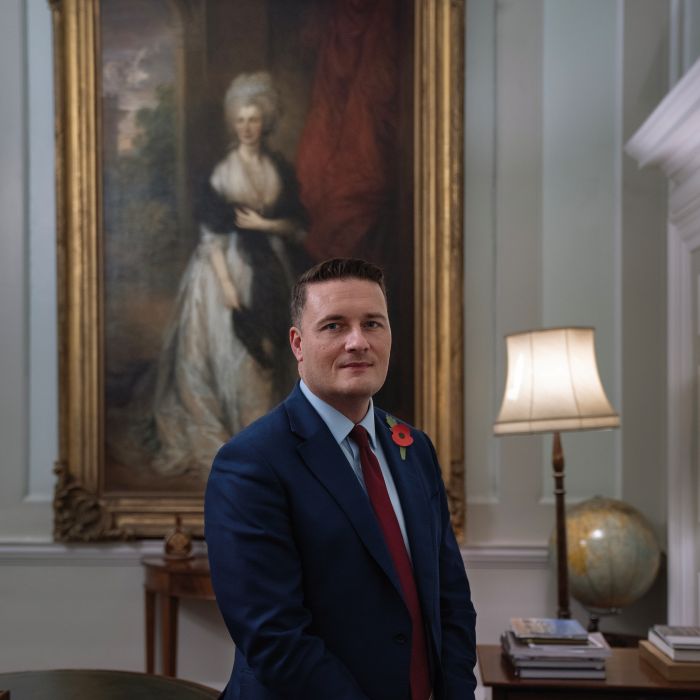 Photography by Tom Pilston
At a meeting last month in Washington with his US counterpart, Pete Hegseth, Streeting says he reiterated that the UK will “back Ukraine to the hilt”.
Like Streeting, Hegseth is a practising Christian and The House asks whether that proved helpful in striking up a positive relationship with him. Did the subject of faith come up at all?
“No, we haven’t spoken directly about our faith. We come from different political traditions and different Christian traditions,” he says with a smile.
But of Hegseth – who in his book American Crusade called for “a 360-degree holy war for the righteous cause of human freedom” – Streeting adds he finds the US defense secretary “a straight shooter”.
“I know with Pete Hegseth who I’m dealing with, what he thinks. We can be quite open with each other. We have a very candid relationship, which is really important.”
More generally, the MP acknowledges that his faith has helped shape his own worldview as a politician.
“One’s faith is inseparable from how you view the world,” he says. “It’s not that I’m making decisions and then applying a Christian lens across. It’s more that there are a whole set of ethical and philosophical values that I hold that are undoubtedly informed by my upbringing, by political influences and by my Christianity.”
He regrets that people who aren’t religious often view politicians of faith with suspicion, for fear that they may legislate against others’ rights or hold prejudiced views.
“For me, Christianity is about love, acceptance, inclusion, the importance of valuing every human being, to take care of one another. I would definitely describe my kind of politics as drawn from both Labour’s revisionist tradition, but also the Christian socialist tradition of the left.”
Ministry of Defence staff are said by Streeting to have told him how proud they are that Britain now has its first gay Defence Secretary, though his new job has also come with a torrent of homophobic abuse online.
“Why is it that I have had a daily deluge of online homophobia since my appointment?” he asks. “It is because for those people who are prejudiced against LGBT people, there’s a perception that to be gay is to be weak, or to be trans is to be weak.”
For Streeting, this couldn’t be further from the truth. He takes, for example, LGBT members of the armed forces, including those who served when it was illegal to do so.
“Despite the prejudices of the state at the time, and the prejudice written into the law of the land, there were still LGBT people who were willing to put on a uniform and make the ultimate commitment to their country… I think that was an extraordinary act of courage and bravery,” he says.
“Those kids who grew up in school being themselves and facing down bullies? Those are strong people.
“Those who walk the streets being openly themselves, whether that’s holding hands with someone of the same sex, or matching your appearance to your gender identity, knowing the risks of physical harm that trans people face – those are courageous acts and courageous people.
“I feel inspired by LGBT people who serve in our armed forces and I think they are the embodiment and epitome of the notion that to be authentically yourself – and to be LGBT and out and proud – is also to be strong.”
Streeting may be less visible than he was in Starmer’s government, but if he was disappointed by his new job, he is hiding it well. He also appears convinced that with Burnham at the helm, the tide is turning for his party – something he may take an especially personal interest in given his majority of 528 votes in Ilford North.
“I am finding, more and more, there are people out there in the country who have quietly and cautiously – considering everything that’s happened in recent years – begun to believe again,” he says, slowly and reverently. “Believe in Labour and believe in Britain, and that is a credit to Andy’s leadership.”
