Hope In Westminster: The Frontline Of The Homelessness Crisis
Westminster has the highest levels of rough sleeping in the capital (Alamy)
11 min read
Nowhere exposes Britain’s homelessness crisis more clearly than Westminster – the home of British politics, but also the area with the worst rates of rough sleeping in the UK. There is cautious optimism, however, that it can be solved.
In the days before Christmas, with Westminster filled with tourists, festive lights and last-minute shoppers, two murals appeared on the streets of central London, believed to be the work of Banksy. Painted quietly overnight, they both depicted two children lying on the ground, gazing upwards to the sky.
Some passers-by interpreted them as stargazing children, perhaps searching for the North Star in a nod to Christmas mythology. Others saw something darker: children sleeping rough, forced to look up because there is nowhere else to go.
The identical artworks sit in, or on the edge of, the City of Westminster, the borough with the highest levels of rough sleeping in London and England. One of the murals sits underneath the Centre Point tower, which was built in the 1960s and stood empty for years while homelessness rose across London. 50 years ago, activists occupied the building in protest, and the youth homelessness charity Centrepoint was later named after it. Today, the tower houses multi-million-pound luxury flats, and art commentators have suggested that Banksy is highlighting how little has changed in the availability of affordable housing since it was built.
A few days before the artworks appeared, PoliticsHome accompanied Rachel Blake, the Labour MP for Cities of London and Westminster, to St Martin-in-the-Fields church on Trafalgar Square to speak with the homelessness charities based there.
Tourists milled around taking photos, while office workers in suits headed home for the evening. Right outside the church entrance, around 10 tents were scattered along the edge of the building, with some of their inhabitants standing nearby and voices heard from inside the tents.
Before PoliticsHome started recording, Blake and the charity workers in the church reflected on what they described as one of London’s greatest and most tragic ironies: that the home of the UK government and Parliament, with majestic buildings and millions of visitors each year, has the highest rates of rough sleeping in the country.
Between July and September 2025, 1,053 people were recorded as sleeping rough in Westminster alone, an increase of 174 from the previous quarter. Across Greater London, 4,711 people were seen sleeping rough over the same period, a 9 per cent rise from the previous quarter, and the latest CHAIN quarterly report for Greater London suggests the number of people living on the streets long-term in London is rising.
Earlier in December, the government launched its new homelessness strategy in an attempt to address the problem. The plan set out how departments will work together with mayors and councils across England to reduce homelessness, introducing new duties for local collaboration. The strategy pledged to halve long-term rough sleeping by 2029, end people becoming homeless after leaving public institutions, and reduce the number of families living in temporary accommodation. It also committed to ending the unlawful use of bed and breakfasts as accommodation for families. All of this, the strategy states, will be achieved within this parliament, with the backing of £3.5bn in funding over three years.
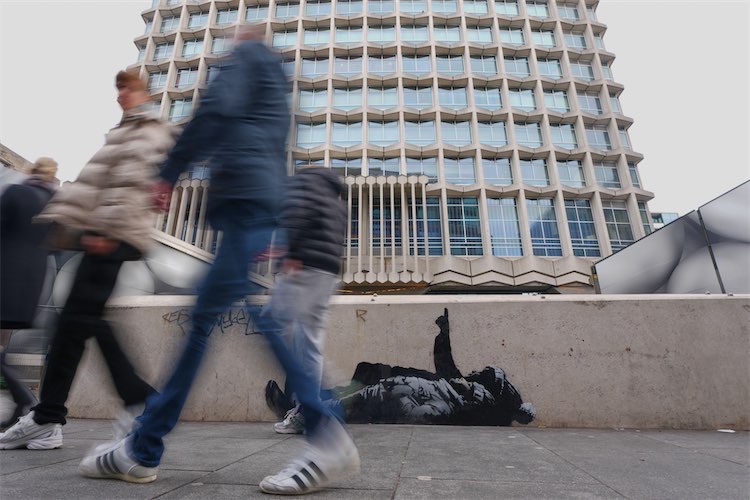 People walk past artwork beneath Centre Point tower, believed to be by Banksy (Alamy)
London mayor Sadiq Khan has announced a £1m fund to deliver new Floating Hubs in homelessness hotspot areas across the capital, and pledged to end rough sleeping in London by 2030.
Government ministers also point to a £39bn investment in social and affordable housing as part of a commitment to build 1.5m homes across the country.
But is the strategy enough to solve the scale of the challenge? More than 200,000 Londoners will be homeless and living in temporary accommodation on Christmas Day, including over 100,000 children.
Rough sleeping is the visible side of homelessness that you can see on the streets of Westminster. But for those working on the frontline, it is important to highlight the link between temporary accommodation and long-term homelessness and rough sleeping.
Referring to the people living in tents outside the church, Duncan Shrubsole, chief executive of St Martin-in-the-Fields Charity, which helps people out of homelessness across the UK, told PoliticsHome that many of these individuals are likely to have grown up in temporary accommodation or in low-quality, insecure housing.
“There’s a large correlation between people who were homeless in temporary accommodation growing up and people who end up homeless,” he said.
“All that instability, lack of space, moving around schools, sometimes terrible quality [of housing], violence around the house, all of that breeds instability later in life.”
Pamela Orchard, CEO of Connection, a charity which provides services for people sleeping rough in Westminster, was blunt about the root cause.
“We just haven't been investing in affordable social housing for decades and decades, and we're paying the price for it now,” she said.
“If we can unlock planning and get more decent housing built that's affordable, that is clearly going to have a really positive impact across the whole housing system. It's going to take quite a long time to make that happen.”
Shrubsole added that councils are becoming “so desperate” that they are buying back social homes that were previously sold off. A Telegraph investigation has found that councils have spent more than £900m buying back Right to Buy homes to plug social housing shortfalls, sometimes paying 88 times more than the properties were originally sold for.
Local MP Blake, who previously worked in affordable housing and as a councillor in Tower Hamlets, told PoliticsHome there is a particularly acute problem in London with local authorities having to compete to acquire flats for people to live in temporary accommodation.
“That makes it obviously more expensive, because the private landlords can ask for pretty much whatever they like, because local authorities are so desperate for the properties,” she said.
She believes reform is essential, and is “confident” that there will be a “big focus” going forwards on forcing local authorities to share information, and end the need to compete for space.
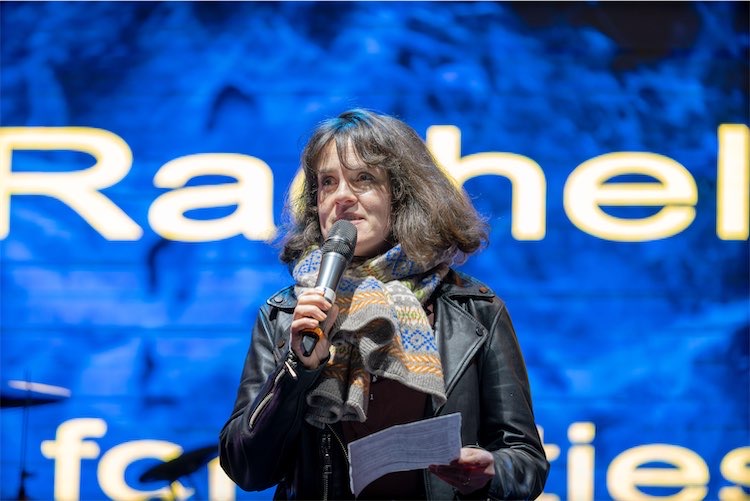 Rachel Blake was elected as Labour MP for Cities of London and Westminster in 2024 (Alamy)
“There is a much greater recognition than there ever has been about the problem of temporary accommodation,” she said.
“But there's much more work to do at a granular level with local authorities.”
But she stresses that relationships matter as much as structures. “Local partnerships and relationships. There's nothing that central government can do to make people have each other's phone numbers and have confidence that they're going to be decent people to their clients.”
An important part of the government strategy for frontline workers is the commitment to a joined-up approach across Whitehall departments and councils.
"The big problem that local authorities have is that some of them are literally cutting their budget for preventative services in order to pay for temporary accommodation,” Shrubsole said.
“They all know that can't carry on. Lots of strategies talk about cross-government, but in this sector, it really matters, because people end up sleeping rough or homeless because of the failings of everything else.
“When everything else fails, you end up in one of two places, either homeless or at the food bank or sometimes both.”
Blake agreed, describing housing supply and mental health services as major “underlying problems” behind the homelessness crisis.
“We can't really solve the problem entirely until we've really tackled mental health and supply of genuinely affordable homes,” she said.
“Rough sleeping is everybody's challenge to solve. And that's connected to hospital discharge, prison discharge, all sorts of different care services.”
Orchard described low trust in institutions, as well as poor health and addiction, as being a huge factor in why people live on the streets.
“There is this perception that you sort out rough sleeping by giving people sausages and a shower and helping them write a CV, and then they'll go and get a job,” she said.
“But actually, people who are coming in here are profoundly unwell. It's going to take ages to sort that out.
“People will either massively romanticise rough sleepers or persecute rough sleepers for being evil, terrible people. The reality is that there are hardly any rough sleepers who are war veterans, and actually, the truth lies in the middle.”
Even measuring the scale of the problem is complex. Women have been traditionally underrepresented in rough sleeping statistics, as many hide out of sight due to feeling vulnerable on the streets. But Orchard pointed to progress in understanding women’s homelessness, through joint work by councils and charities to carry out a women’s census.
Other groups remain hard to monitor. “Lots of people who sleep rough are anti-vax conspiracy theory people who get really, really uncomfortable about what data is being held about them,” Orchard said. “So it's very difficult to then track who's where.”
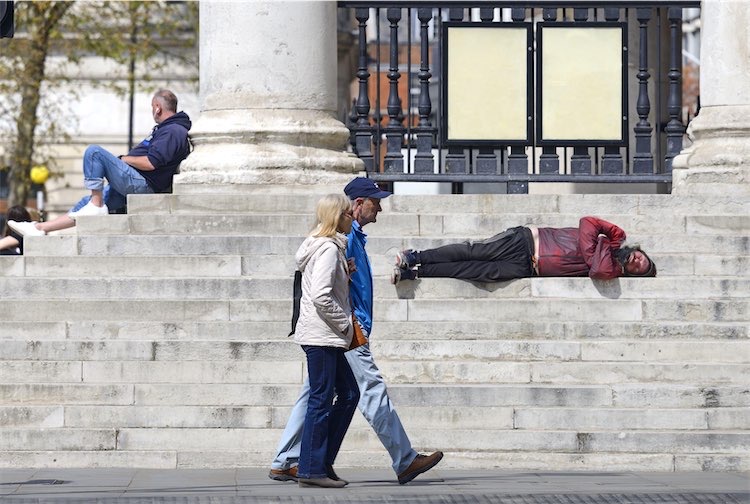 A man sleeping on the steps of St Martin-in-the-Fields church on Trafalgar Square (Alamy)
Both Orchard and Shrubsole welcomed the government’s new strategy, but said the key to its success will be whether the issue is consistently prioritised in the long term and is given adequate resources. Having worked on the frontline of homelessness for many years, both pointed to successes under the New Labour government as an example of how to tackle the problem.
In the early 2000s, rough sleeping fell dramatically across the UK after it was made a political priority, backed by sustained funding and clear targets. In 1999, the Rough Sleepers’ Unit replaced earlier initiatives, and a goal was set to reduce rough sleeping by two-thirds by 2002. Central to this was the appointment of Louise Casey to lead the unit. Now Baroness Casey, she recently led the independent review of culture and standards in the Metropolitan Police in London following the murder of Sarah Everard.
“It isn't a surprise that rough sleeping and homelessness went down every year because the investment was made in the services,” Orchard said, lamenting the fact that many of these services were then slashed through austerity measures in the 2010s.
Shrubsole said that it has all “been done before”: “Where there's a will and sustained resource and commitment… you can make a difference.”
He praised Housing Secretary Steve Reed and homelessness minister Alison McGovern and described the strategy as “a good start to actually show that the government cares about this”.
But he cautioned: “The key question is, is there that sustained will and focus to drive it through… and not do some stuff that undercuts it.”
While the majority of people experiencing homelessness are UK nationals, Shrubsole believes that recent Home Office measures could increase the number of asylum-seekers facing destitution and homelessness – putting further pressure on the temporary accommodation and social housing system.
For example, a pilot scheme which extended the period successful asylum seekers had to leave Home Office accommodation from 28 days to 56 days had been due to run until the end of 2025. In late August, the government reversed this policy and stated that all new single asylum seekers would have only 28 days to leave asylum accommodation after a successful application. According to Shrubsole, this could force more people onto the streets and reverse some of the impact of the government's measures to reduce homelessness.
Orchard said that the rising number of homeless people in London can make the problem feel “overwhelming”.
“But it's actually 0.05 per cent of London's population,” she said. “It's a much more manageable problem if we have the will and the impetus to do something about it.
“I don't think the numbers are going to go down particularly significantly over the next year… But in the first year, we might see a stabilisation or a slowing down of the rise in rough sleeping. If some of the supported accommodation that's promised in the strategy can get released quickly, that could make quite a big difference reasonably quickly.”
Shrubsole provides a note of optimism, telling PoliticsHome: “There is energy in all parts of the system: not just central government, but the mayor and councils, and we've got local elections next year. There's some real energy, and the voluntary sector’s always got energy.
“Any project like Connection or the other ones that we support will tell you that people in the hardest circumstances, with the right help, can turn their lives around. So you've got to believe it's possible.”
