The challenges of editing The House during the Brexit fallout years
4 min read
Lord Brady was editor of The House during a particularly vexed period in British political history. He recalls the challenges of trying to run an impartial magazine as Parliament remained in uproar
My time as editor (and then chairman of the editorial board) of The House, 2017 to 2024, coincided with the most tumultuous period in British politics imaginable. A year on from the EU referendum, Theresa May had called an election to secure the majority that she would need to deliver the Brexit for which the British people had voted. Launching a big new policy on paying for social care without having rolled the pitch meant that Theresa’s election had the opposite effect. Returning to Westminster among the rubble, it was obvious to everyone that a difficult task had just been made even harder.
The House magazine is rarely about ‘hard’ news – the joy of looking back at those editions nine years on is that we captured the main players setting out their own hopes and plans.
Interviewing the newly appointed first secretary of state, Damian Green, we posed the question, “Can he save her premiership?” For all his loyalty and determination to see the party pulling together, it wasn’t long before the answer became clear.
Our feature on working with the DUP, necessary to keep the show on the road, also presaged the increasing salience that would attach to the Irish border.
Events were moving rapidly and our last issue before the summer recess carried a Commons diary from Nadine Dorries:
I head to Westminster trying to keep up with developments. No 10 announces Boris has resigned as well [as David Davis]. I attend the ERG meeting that evening. I make the point to my fellow Brexiteers that references to the ‘common rule book’ are a misleading euphemism. It’s the EU’s rule book, rules we have to follow with no say in making. Despite excitable media reports to the contrary, the mood is tense but focused. The Chequers agreement must be dumped – we discuss how best to achieve that.
Looking back at all of this brings a welter of memories and emotions
By October, the all-important EU Withdrawal Agreement was facing a gathering storm, but the pages of The House are an important reminder that whatever is the ‘big story’ of the day, parliamentarians will continue to champion a plethora of causes close to their hearts or those of their constituents. Autism and learning difficulties, abortion law, bullying and harassment in Parliament and the future of fixed-odds betting machines all featured in that issue.
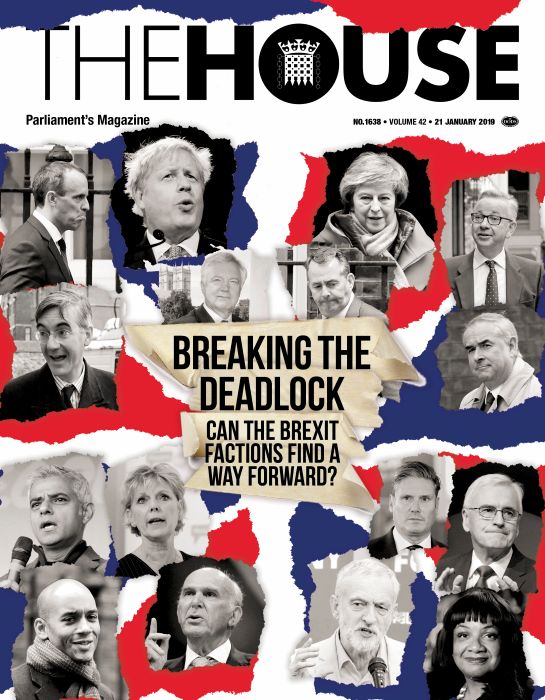
By January 2019, we reported on the biggest Commons defeat for a British government in history as the ‘EU Withdrawal Agreement’ finally hit the fan and the Commons rejected it by a majority of 230. Modesty prevents me from dwelling on my own amendment seeking to approve the agreement but with “alternative arrangements for the Irish border”, which went on to secure a majority of 16 a week or so later!
Looking back at all of this brings a welter of memories and emotions. Certainly it was a period that appears to have marked the shift to a more volatile, febrile politics. Four prime ministers were to fall in the next five years – only one at the hands of the electorate. It was a period parodied by the Labour Party as years of ‘Tory chaos’ – at least until they discovered a taste of their own for regicide.
I took the editor’s chair at The House when it had just turned 40 and stood down as board chairman in 2024 to move to quieter pastures on the red benches. Now, as The House celebrates its half-century, it still seems to me a unique window on the world of Parliament – a world that few understand until they have lived it. I wish my successors well as the magazine continues to offer that insight over the next 50 years.
Lord Brady is a Conservative peer
