Left-wing and moderate voters are Burnham's winning coalition
4 min read
Uniting the progressive bloc is key to the prime minister-in-waiting's electoral prospects.
Unsurprisingly, people who describe themselves as left-wing are key to Andy Burnham's support.
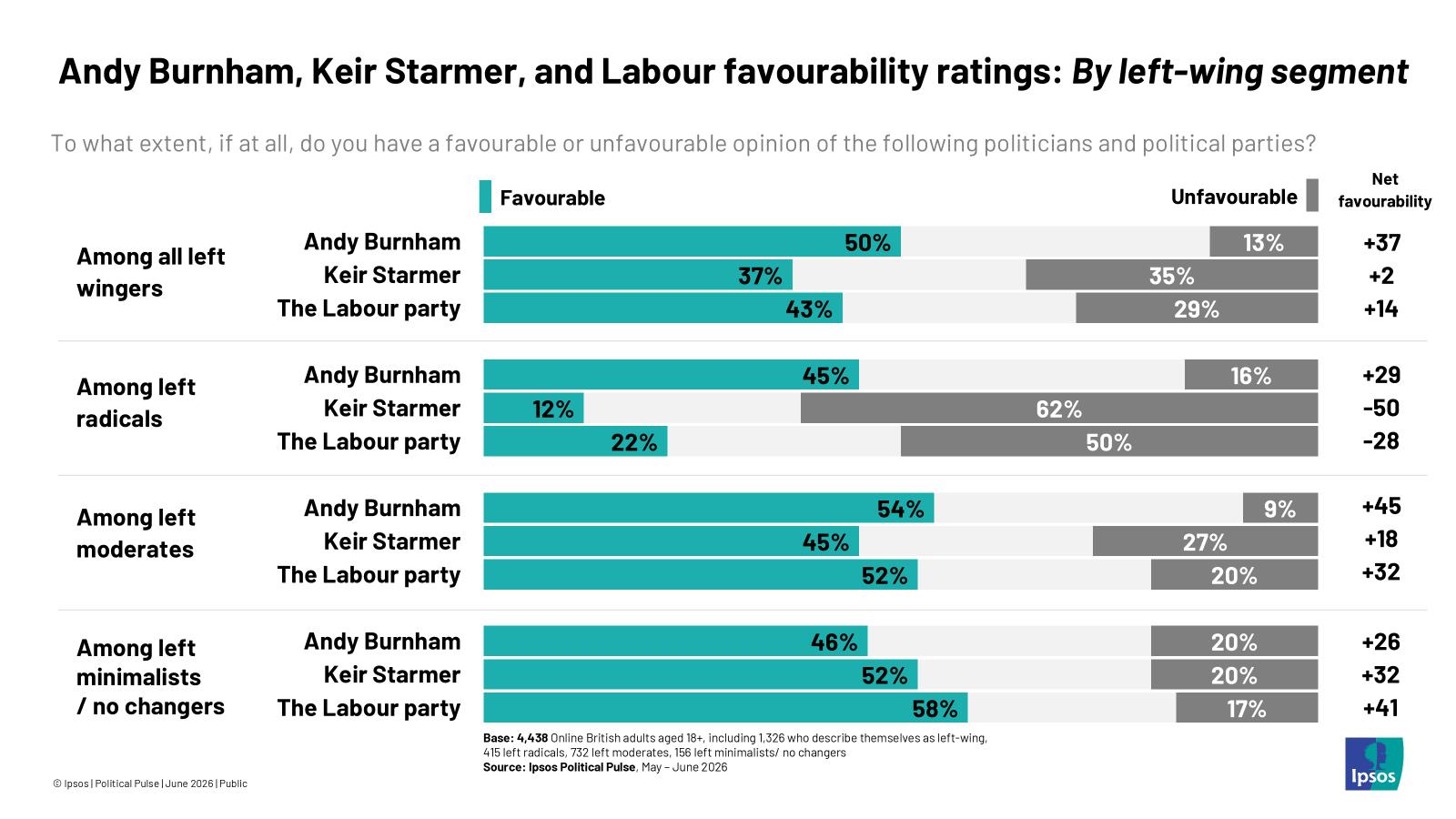
Between May and June, half of Britons (50 per cent) who said they were left-wing said they had a favourable opinion of him, while 13 per cent were unfavourable. This gives him a net rating of +37 among left-wingers.
Burnham’s strongest support comes from left-wingers who want moderate change, with a net rating of +45. Burnham is also well supported among left-wingers who want radical change (net +29) and the small group of left minimalists (net +26).
Comparing Burnham's ratings among the left with those for the Labour Party and Keir Starmer, several patterns emerge:
 Ipsos aggregate analysis of Political Pulse data: May – June 2026
First, Burnham’s absolute favourability is highest among left moderates, suggesting this group could form a reliable core for a Burnham-led Labour. But second, Burnham outperforms Starmer and the Labour Party most dramatically with left radicals. Together, these groups represent the foundation of a potential Burnham coalition.
However, as Starmer’s contrasting favourability ratings among left radicals and left moderates demonstrate, satisfying both groups will not be easy.
Convincing left radicals to back Labour will be challenging given the prominence of the Greens among this segment. Nearly two-thirds (63 per cent) of left radicals are favourable towards the Greens, and 55 per cent are favourable towards leader Zack Polanski.
This means Burnham is much closer to Polanski’s favourability ratings than Starmer was among left radicals, and convincing these voters to back Labour will be crucial for the party's electoral fortunes – especially in metropolitan areas.
But, on the other hand, the Greens will be hoping to capitalise upon any left radicals who feel let down by Labour and Burnham, if the change they want is not enacted.
The Greens are also just as popular as Labour among left-wingers hoping for moderate change, followed by the Liberal Democrats, which means Burnham cannot take his relative popularity anywhere among the left for granted.
Beyond the left
Burnham’s current performance among centrists is solid, if not spectacular.
The key distinction is between the moderate and more radical centre, although Burnham consistently outperforms both Labour and Starmer among both groups, largely because he is far less disliked.
Centre moderates are a key part of Burnham’s support coalition. Among centre moderates, 34 per cent are favourable towards Burnham, with 21 per cent unfavourable, giving him a net rating of +13. Although Burnham only has a slight lead over Starmer and the Labour Party on the percentage saying they have a favourable opinion, centre moderates are less likely to feel outright negatively towards him. The Lib Dems and Ed Davey are the key competitors who match Burnham’s popularity with this group.
Burnham will be hoping to improve his negative favourability rating among centrists wanting radical change, especially if he needs to convince centrist voters to back Labour at the next general election. With this group, he is currently net -11 (23 per cent favourable, 34 per cent unfavourable). Whilst Burnham’s rating among them is stronger than Starmer and Labour’s, this is a hotly contested group with Kemi Badenoch, the Conservatives, Nigel Farage and Reform UK, all performing well.
Can Burnham succeed where Starmer failed?
If Burnham becomes the next prime minister, his current ratings among the left and moderate centrist Britons give him a good foundation to first stabilise and then look to improve on Labour’s current poll ratings – if he can deliver what feels like significant change.
However, the test for Burnham will be pursuing a policy agenda that both satisfies the hopes of those wanting radical change on the left, whilst at the same time consolidating support from centrist and left-wing moderates. And Burnham must do this while facing different competitors looking to feed off Labour’s current unpopularity with each group.
As Starmer has found, finding an approach that both delivers noticeable change and is palatable to people across the political spectrum is a hard challenge – and one that could define Burnham’s legacy.
Ben Roff is a senior research executive at Ipsos focused on UK politics
Ipsos aggregate analysis of Political Pulse data: May – June 2026.
Ipsos interviewed a representative sample of 4,438 adults aged 18+ across Great Britain. Polling was conducted online between May and June 2026.
Data are weighted to match the profile of the population. All polls are subject to a wide range of potential sources of error.
