There are signs of young people returning to Labour
4 min read
The 18-34 age group looks ready to give Labour another chance.
Young adults have powered Labour’s electoral coalition for much of the past decade.
In 2024, 45 per cent of 18-34s voted Labour, but by the first half of 2026, the party’s support among young adults had fallen to 21 per cent. The Green Party overtook Labour, while Zack Polanski became the age cohort’s most popular political leader.
For Labour, this was more than a temporary problem. It raised questions about the future of an electoral coalition built partly on younger voters.
It is an issue we will explore further on Monday at our flagship Labour conference panel event in Liverpool: How can Labour win back Gen Z?
Our data shows signs that Burnham may quietly be starting to win back young people.
Many young adults turned away from Labour because they believed the government was failing on the issues that mattered to them. In June, 72 per cent of 18-34-year-olds said Labour had done a bad job reducing the cost of living, while 65 per cent said it had managed the economy badly.
Ipsos' Economic Optimism tracker presents a similarly bleak picture. Economic sentiment among 18-34s in 2026 is as negative as at any point in recent decades, including during the 2008 financial crisis, the austerity years, and the post-pandemic cost-of-living squeeze.
Keir Starmer was also deeply unpopular. Between January and May 2026, his average net satisfaction rating among 18-34s stood at -51, placing him alongside Nigel Farage and Kemi Badenoch as one of the age group's lowest-rated major political leaders.
The Green Party seized on this opportunity. Between January and May, the party averaged 33 per cent support among 18-34s, 18 points above its 2024 election result. Polanski also recorded a net satisfaction rating of +1, far ahead of the other major party leaders among young adults.
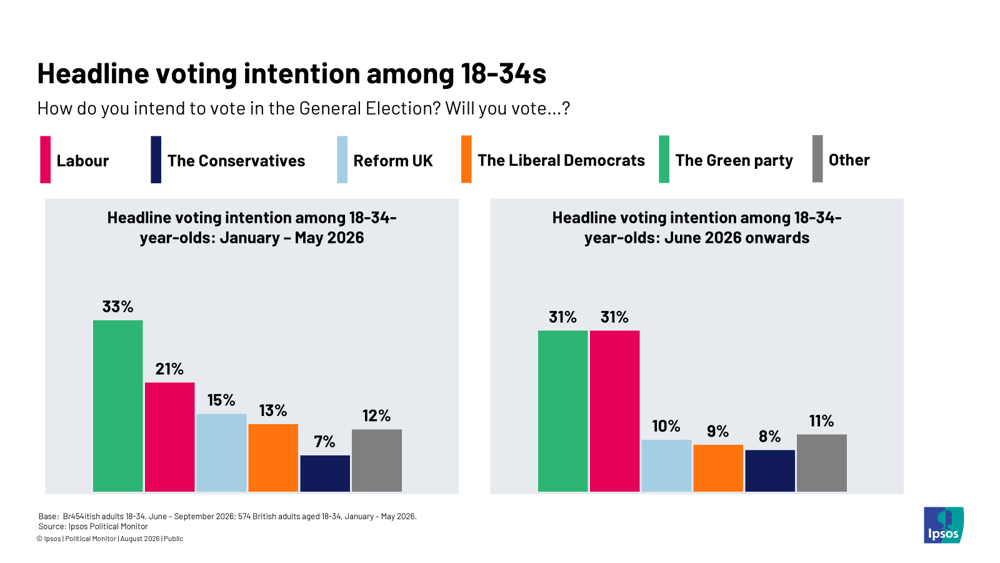
Labour's position has improved since Starmer resigned. Across three subsequent Ipsos voting intention polls, the party has averaged 31 per cent support among 18-34s, ten points above its January-to-May average and level with the Green Party.
At the same time, Green support has barely moved. The aggregate figures suggest Labour’s recovery among younger voters may come partly from those who had considered Reform UK or the Liberal Democrats, rather than from voters returning directly from the Green Party, as well as those who had drifted away from Labour since 2024 but not found a new home.
Burnham also leads the other major party figures on personal ratings. Across Ipsos polling from July to September, he recorded an average net satisfaction rating of +7 among 18-34s, compared with -6 for Polanski. In August, half of young adults said they liked Burnham (25 per cent disliked him). By comparison, 38 per cent liked Polanski, and 37 per cent disliked him.
Part of Burnham's appeal may simply be that he is not Starmer. But presentation definitely matters too.
Direct-to-camera videos, online trends, and influencer collaborations make his social-media output feel native to TikTok and Instagram rather than adapted from television or print. Savvy young Labour TikTokers have amplified that approach through fan edits and other promotional content.
The electoral effect is difficult to measure. But the strategy distinguishes Burnham from the Starmer government and allows Labour to enter younger voters' feeds in a less formal political voice.
The Burnham government is barely two months old, and political honeymoons rarely last. Young adults will ultimately judge Burnham by what he delivers, not what appears in their feeds.
Expectations are high: 49 per cent of 18-34s expect a Burnham-led Labour government to look after young people's interests. Housing, employment and student finance will provide lasting tests. Labour must also rebuild its youth vote without weakening the broader electoral coalition it needs to govern.
Labour has recovered ground, but 31 per cent would still match its weakest election performance among young adults since 2010. Ipsos' How Britain Voted data, stretching back to October 1974, shows Labour recording a similarly low share at only two elections: 1983 and 2010.
Burnham has regained young voters' attention. Now he must give them a reason to stay, beyond the reels.
Ben Roff is Senior Research Executive at Ipsos
