A reckoning has begun for the gambling sector, and the country will thank Andy Burnham for it
AI generated image.
Andy Burnham has announced he will end the “aim to permit” rule in the Gambling Act 2005
Will Prochaska, Director
| Coalition to End Gambling Ads
The new Prime Minister’s clampdown on Britain's gambling companies will save lives, breathe life back into high streets, and deliver economic growth
It was 2007, the year the iPhone came out, that Britain's gambling nightmare took hold. A new Gambling Act came into force, ending centuries of accepted wisdom that gambling was to be permitted but not promoted. It reframed gambling as a mainstream leisure activity, enabling liberalised advertising, licensing and product innovation that have been linked to heightened harm.
Under the Act, the Gambling Commission has given out licences liberally, creating a market that has over 2,000 licensed gambling operators. Whilst it’s widely accepted that social media and smartphones can be addictive, what’s less understood is that the gambling sector pioneered some of the worst addictive digital features, and online slot and casino games still far surpass the addictive potential of other digital products.
The physical land-based versions of these slot games, machines in bookmakers and slot venues across the country, essentially deliver the same highly addictive content.
The result has been millions of people harmed, communities held back, high streets blighted, and losses to the national economy.
When the Starmer administration repeatedly called for the growth of the gambling sector as well as the reduction of harm, the gaslighting seemed to have reached its zenith. Fortunately, Andy Burnham has enough empathy, political nous, and understanding of public opinion to realise something had to be done, and he has acted quickly.
Within days of becoming Prime Minister, Burnham announced that a major principle that made the Gambling Act so harmful – that councils shall “aim to permit” gambling venues, even if they and their residents don’t want them – is to be scrapped.
This isn’t just the deletion of a couple of clauses, “aim to permit” underpins the legislative ambition to grow the gambling sector. Removing it signals a fundamental change to the government’s stance. It acknowledges that the policy of the past 20 years has failed, and a new approach is needed.
Both sides of this debate will be watching closely to see what Burnham does next. As Mayor of Greater Manchester, he also joined calls for a prohibition on gambling advertising, something which has long been advocated for by public health leaders.
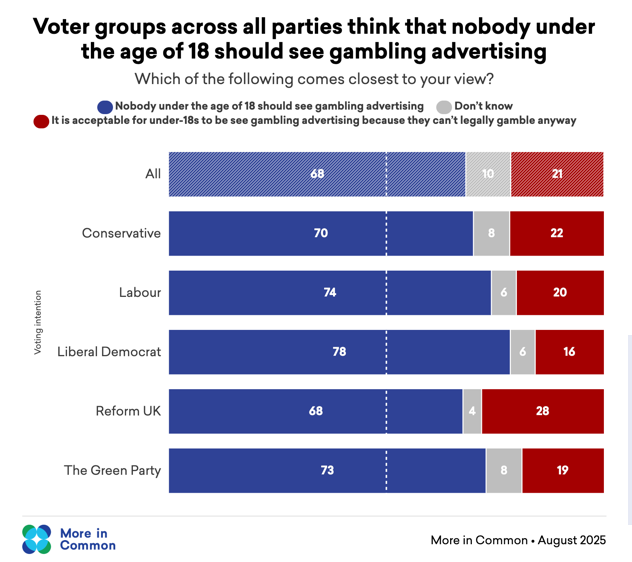 More in Common: Polls show Britons are overwhelmingly in favour of gambling advertising reform (click to enlarge)
Burnham’s new gambling minister, Vicky Foxcroft MP, could support such a policy. In the past Foxcroft has called gambling addiction a “public health emergency", urging greater reforms including a ban on gambling advertising in live sport. Lewisham Council, which covers her constituency, has joined the Coalition to End Gambling Ads, alongside 60 other organisations, including 20 other councils – so she would have a lot of support. Polls (Survation; MiC) have shown the public are fed up with seeing so many gambling ads so any action would also be a vote winner.
As if the opportunity to introduce policies that are popular, cost little to implement, and deliver public health gains weren’t enough, the beauty of restricting gambling advertising is that it will deliver economic growth by restricting the gambling sector.
According to the University of Sheffield this year, a 10 per cent reduction in gambling spend could lead to a £1.25bn uplift to the economy and more than 22,000 new jobs. Combined with multiple other studies with findings that gambling spend is bad for the economy (SMF; NERA) this should be enough to get the buy-in of the Treasury.
Under Burnham, the gambling sector’s permission to profit from the country’s population and finances could be coming to an end. A sector that’s had its way for far too long may be about to experience the overriding feeling of 99 per cent of its customers – what it’s like to lose.
